
Top 5 3D Printing Innovations: Reshaping Industries and Daily Life with Additive Manufacturing
Welcome to our weekly roundup of the most groundbreaking developments in the world of additive manufacturing! Each week, we scour the latest news, research, and industry applications to bring you the most captivating videos showcasing how 3D printing is not just a technology, but a transformative force. From medical marvels to industrial efficiencies and educational breakthroughs, these innovations are rapidly shaping our society and pushing the boundaries of what’s possible. This curated selection of the Top 5 videos encapsulates the dynamic evolution of 3D printing, offering a glimpse into the future of manufacturing, design, and even human health. We believe these highlights will not only inform but also inspire, demonstrating the immense potential of this rapidly advancing field. For even more insightful content and cutting-edge discoveries, be sure to explore our dedicated YouTube channel, where a wealth of 3D printing videos awaits. Get ready to dive into the future – we hope you enjoy this week’s selection and have a fantastic day!
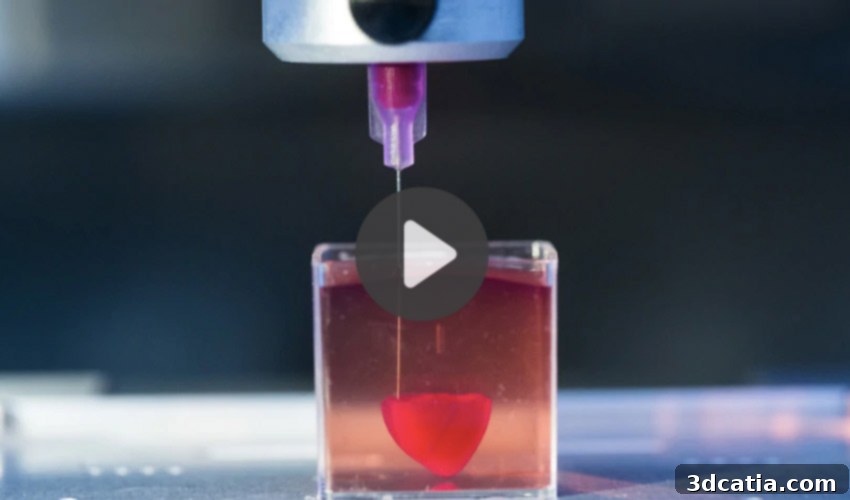
Top 1: Bioprinting Breakthrough – A Tiny, Functional Human Heart
The Dawn of Organ 3D Printing in Medicine
In a monumental leap forward for medical science and 3D printing technology, a visionary team of scientists from Tel Aviv University has unveiled an extraordinary achievement: the successful 3D printing of a heart. This isn’t just any replica; it’s a cherry-sized, functional organ composed entirely of human tissues and blood vessels, capable of contracting. This groundbreaking research represents a significant stride in the realm of bioprinting and regenerative medicine, promising to revolutionize organ transplantation and disease modeling in the near future. While the printed heart can contract, the ability to pump blood effectively remains a complex challenge for researchers. Nevertheless, the team’s optimism is palpable, with an ambitious projection that within the next decade, hospitals could be equipped with advanced bioprinters to create patient-specific organs on demand. Imagine a future where the critical shortage of donor organs is mitigated by personalized, bioprinted alternatives, significantly improving patient outcomes and quality of life. This achievement not only highlights the incredible precision and versatility of 3D printing but also underscores its profound potential to directly impact human health on an unprecedented scale, paving the way for intricate tissue engineering and complex organ fabrication. The implications for drug development, disease research, and surgical training are also vast, as these bio-printed structures offer realistic models for study.
Top 2: Revolutionizing Manufacturing – Additive Manufacturing for Tooling
Polaris Drives Efficiency with 3D Printed Tools and Prototypes
The manufacturing landscape is continually being reshaped by additive manufacturing, and leading companies like Polaris are at the forefront of this transformation. Polaris, a renowned American manufacturer specializing in snowmobiles, motorcycles, and rugged off-road vehicles, has strategically integrated 3D printing, particularly Stratasys’ advanced solutions, into its tooling and prototyping processes. This adoption marks a significant shift from conventional manufacturing methods, offering unparalleled advantages in design complexity, iteration speed, and overall production efficiency. By leveraging industrial 3D printers, Polaris can now design and produce more intricate and optimized tools that would be prohibitively expensive or impossible to create with traditional techniques. The ability to rapidly design, test, and refine tools allows for faster product development cycles and significantly reduced lead times. This agility not only enhances their internal operational flexibility but also enables them to respond to dynamic market demands and customer specifications with greater precision and speed. The benefits extend beyond mere prototyping; 3D printed jigs, fixtures, and end-of-arm tooling are lighter, ergonomically superior, and often more cost-effective, directly impacting assembly line productivity and worker comfort. Polaris’s experience exemplifies how additive manufacturing is not just a niche technology but a core component of modern, competitive manufacturing strategies, driving innovation and delivering tangible improvements across the entire product lifecycle.
Top 3: Innovative Education – 3D Printing and Mathematics
Making Abstract Concepts Tangible for Students
The intersection of technology and education continually opens new avenues for learning, and at the Rochester Institute of Technology, 3D printing is transforming how students engage with mathematics. Nate Barlow, an innovative educator, has pioneered a project where students utilize 3D printed parts to grasp complex mathematical concepts. Barlow explains a fundamental truth about learning: many students connect more effectively with abstract ideas when they can interact with them physically. The tactile experience of touching and manipulating a physical model derived from a mathematical equation can profoundly deepen understanding and enhance memory retention, making abstract principles far more accessible and intuitive. This hands-on approach moves beyond traditional textbook diagrams and two-dimensional representations, allowing students to explore three-dimensional geometry, calculus functions, and other intricate mathematical structures in a tangible way. Using an FDM (Fused Deposition Modeling) 3D printer, Nate Barlow translates various mathematical equations into physical models, enabling students to literally hold and rotate parabolas, understand spatial relationships in calculus, or visualize complex topological forms. This method not only makes learning more engaging but also caters to diverse learning styles, fostering a more profound and lasting comprehension of mathematical principles. It’s a powerful demonstration of how 3D printing can bridge the gap between theoretical knowledge and practical application, empowering the next generation of mathematicians and scientists.
Top 4: Material Science Innovation – A New Lightweight 3D Printing Filament from colorFabb
Introducing LW-PLA: The Future of Lightweight 3D Prints
Material science is a cornerstone of additive manufacturing, and innovations in filament development are continuously expanding the capabilities of 3D printing. The Dutch manufacturer colorFabb, a leader in high-quality 3D printing materials, has introduced a groundbreaking new filament named LW-PLA, or Light Weight PLA. This revolutionary material is engineered to address the growing demand for lightweight, low-density parts, particularly in applications where weight is a critical factor, such as aerospace, drone technology, and remote-controlled models. What sets LW-PLA apart is its active foaming technology. When heated to approximately 230°C during the printing process, the material undergoes a controlled expansion, increasing its volume by nearly three times. This unique characteristic allows users to achieve significantly lighter prints. By strategically reducing the material flow by up to 65%, engineers and hobbyists can produce parts that are astonishingly lightweight without compromising structural integrity. Furthermore, the expansion properties of LW-PLA offer an innovative way to reduce printing time; users can utilize larger layer heights or very thick perimeters without adding excessive weight, effectively speeding up the production process for specific geometries. This innovation from colorFabb not only pushes the boundaries of PLA-based printing but also opens up a new realm of possibilities for designers and engineers looking to optimize their creations for minimal mass and maximum performance, proving that the evolution of 3D printing is as much about the materials as it is about the machines.
Top 5: Precision Manufacturing – TRUMPF 3D Laser Cutting System
Enhancing Rapid Prototyping and Small-Series Production
In the high-stakes world of precision manufacturing and rapid prototyping, efficiency and accuracy are paramount. The German high-tech company TRUMPF has once again demonstrated its prowess with the introduction of the TruLaser Cell 5030, a state-of-the-art 3D laser cutting system that is redefining prototype production and small-series manufacturing. For rapid prototyping service providers like 3-Dimensional Services, based in Detroit, this machine has proven to be nothing short of a “dream machine.” The TruLaser Cell 5030 offers unparalleled speed, precision, and versatility in cutting complex three-dimensional components, a significant upgrade from conventional cutting methods. The true strength of this system lies in its ability to process intricate geometries with incredible accuracy, making it ideal for industries requiring high-tolerance parts and rapid iteration cycles. What makes this story even more compelling is the collaborative development process. 3-Dimensional Services acted as a key test customer, actively involved from the very inception of the project. Over a two-year development period, their invaluable feedback and real-world application insights led to the “overturning of many machine requirements” that were subsequently implemented, resulting in a system perfectly tuned to meet the rigorous demands of modern manufacturing. This partnership exemplifies how close collaboration between technology developers and end-users can yield truly revolutionary industrial solutions, streamlining production, reducing costs, and enabling the creation of previously unachievable component designs for a wide array of applications.
What are your thoughts on this week’s incredible TOP 5 3D printing videos? Each one highlights a unique facet of how additive manufacturing is pushing boundaries, from medical breakthroughs to educational innovation and industrial efficiency. We’d love to hear your insights, predictions, or even your favorite application of 3D printing. Feel free to drop a comment below or join the conversation on our vibrant community pages on Facebook and Twitter! Stay ahead of the curve and ensure you never miss out on the latest advancements and breaking news in the dynamic 3D industry by signing up for our free weekly Newsletter. Delivered straight to your inbox, it’s your essential guide to everything additive manufacturing. Thank you for joining us on this journey through innovation!