
RAPID + TCT 2022: Unveiling the Future of Additive Manufacturing and Key 3D Printing Trends
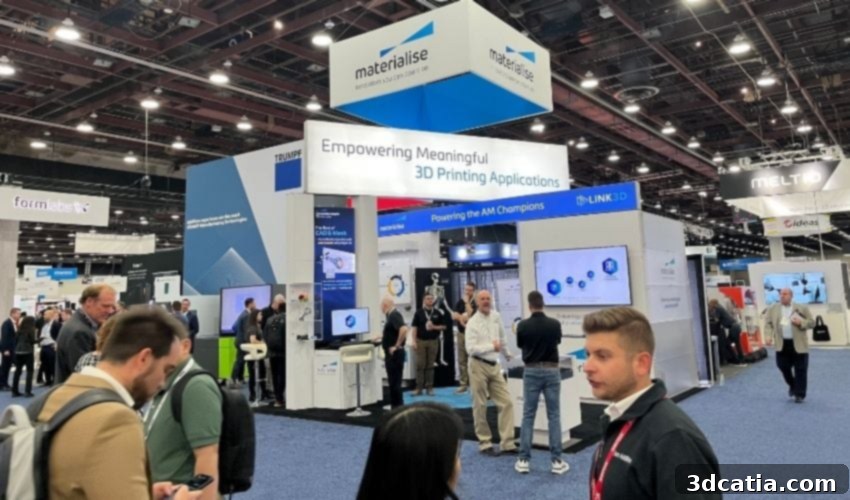
Last Thursday marked the conclusion of RAPID + TCT 2022, a three-day powerhouse event that brought together the global additive manufacturing community. The convention center buzzed with activity, hosting insightful conferences, extensive networking opportunities, significant industry announcements, and showcasing groundbreaking innovations. Celebrating its 30th anniversary, SME reported an impressive turnout, with over 400 exhibitors, more than 150 leading experts, and over 25 keynote and panel presentations. What truly sets RAPID apart is its enduring legacy and its strong foundation in advanced manufacturing, consistently drawing in major original equipment manufacturers (OEMs) and influential figures from across the industry. This year, attendees had the unique chance to connect with representatives from iconic brands and institutions such as Airbus, Boeing, the Mayo Clinic, General Motors, Ford, Disney, the U.S. Armed Forces, and Wilson Sporting Goods, many of whom served as both exhibitors and esteemed speakers.
Beyond the sheer scale of the event, RAPID + TCT 2022 served as a triumphant confirmation for many that the additive manufacturing (AM) industry has robustly recovered and is thriving in the post-COVID era. The atmosphere was palpably jubilant, with attendees reconnecting face-to-face, often without masks, and international guests once again able to participate freely. Angie Szerlong, Industry Manager – Additive Manufacturing at SME, perfectly captured this sentiment, stating, “The industry is back. It’s the first event where we are fully back. We’re not out of COVID but it felt like the industry was together and you could feel the momentum and the excitement. You just felt an energy that was here.” After experiencing this dynamic event firsthand, 3Dnatives is delighted to share our key observations, which include a heightened focus on diversity, a clear acceleration towards greater automation, and the significant evolution of FDM technology.
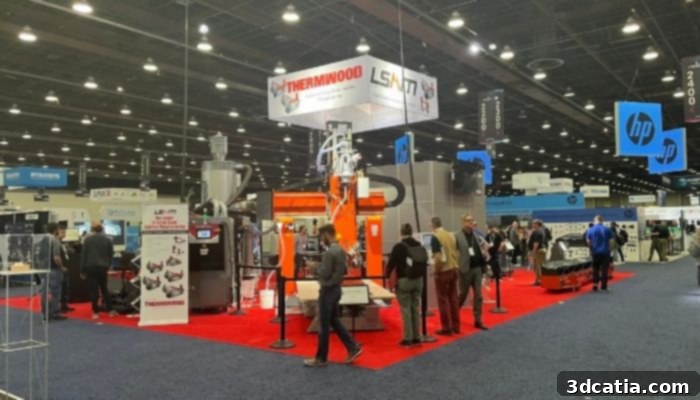
RAPID + TCT 2022 felt like a return to normality for many in the 3D printing industry (photo credits: 3Dnatives)
The Additive Manufacturing Industry Puts a Spotlight on Diversity, Equity, and Inclusion (DEI)
Diversity emerged as a central and compelling theme at RAPID + TCT 2022, underscoring a growing awareness and commitment within the additive manufacturing sector. This focus began with a landmark announcement: the strategic partnership between Women in 3D Printing (Wi3DP) and SME, a collaboration set to propel initiatives throughout 2022 and 2023. This impactful alliance will see SME playing a pivotal role in producing and powering the TIPE 2023 Conference, ensuring it retains its celebrated all-women format. Additionally, the partnership will launch the Wi3DP Showcase at RAPID + TCT 2023, implement the NextGen Mentorship Pilot to significantly expand Wi3DP’s existing programs, and co-author the comprehensive Diversity for Additive Manufacturing 2023 Annual Report. These initiatives demonstrate a robust commitment to fostering a more inclusive and representative industry.
Angie Szerlong further elaborated on SME’s proactive decision to champion diversity through this partnership and other strategic endeavors. She shared, “On Tuesday on the MainStage we announced our partnership with Women in 3D Printing. It’s something that I’ve personally seen the growth of: From seeing zero females to growing to where it is today, though it is still not where it needs to be. And this is not just even just for gender equality, but for DEI as a whole. In this technology, we all think in different ways. And if you have just one ethnicity or one gender designing products then it will only be done with one lens. You will get a better outcome when we have people with different backgrounds and it is important as a whole for the world.” This powerful statement underscores the fundamental belief that diverse perspectives are not merely ethical, but essential for driving innovation and achieving superior outcomes in additive manufacturing.
The commitment to diversity extended far beyond initial announcements. Reflecting an industry increasingly willing to engage in critical, often challenging, conversations, RAPID + TCT 2022 prominently featured diversity as a core subject across numerous conferences throughout the four-day event. This included a well-attended Women in 3D Printing event held after the second day of the show. The final day was particularly dedicated to this imperative, with the solutions track hosting three distinct talks exclusively focused on the concept of Diversity, Equity, and Inclusion (DEI) and its profound importance within additive manufacturing. These sessions featured insights from prominent organizations like Women in 3D Printing, Nexa 3D, Siemens, and Xometry. The discussions culminated in a compelling panel titled “Creating a DE&I Framework in the Additive Manufacturing Industry.” This esteemed panel featured Michael Jones from Xometry, SJ Jones (no relation) from Velo3D, Sarah Goehrke, Kristin Mulherin from Nexa 3D, and Jeannine Kunz from SME, all passionately debating the critical necessity of integrating DEI principles into additive manufacturing practices and providing actionable strategies for companies to begin implementing these frameworks effectively.
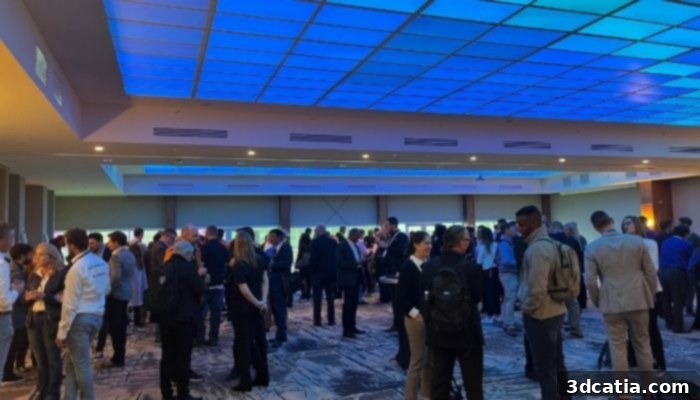
The Women in 3D Printing Event was widely attended (photo credits: 3Dnatives)
During his insightful presentation, Michael Jones Jr., Director of Talent Acquisition and Diversity, Equity and Inclusion at Xometry, expanded on these crucial themes. He underscored the importance of seeking out varied perspectives, stating, “We need to make sure that we are looking for people with diverse mindsets. This might mean making someone who does not agree with you and your perspectives. 9 times out of 10 we will naturally hire someone we are comfortable with and who is like us. So get comfortable with being uncomfortable and accept that achieving diversity is not easy. Having accountability for change is also important because having that is what will spur on inclusivity and transformation within companies.” His message resonated deeply, stressing that true diversity often requires stepping outside comfort zones and embracing challenges to foster genuine change and innovation.
While the conversations around DEI are undoubtedly gaining traction and becoming more frequent, it is essential to acknowledge that the work is far from complete. Many discussions at RAPID + TCT 2022 highlighted the ongoing need to convince companies to actively invest in and commit to DEI initiatives, a commitment that, regrettably, is not yet universal. Sarah Goehrke, reflecting on the overall response from the additive manufacturing community, observed, “There is a great deal of outward but then in private there remains the question of ‘is this actually something that we need.’ Clearly there is still work to be done, but for example Alexander Daniels Global is now building DEI into their reports, which is a direct response from the community. It’s a mixed response of course and it’s learning together but there will always be critics of everything but there is a beautiful and heartwarming amount of support across the industry and a need for this to continue.” This nuanced perspective illustrates that while progress is being made and support is growing, sustained effort and ongoing advocacy are vital to embed DEI deeply within the industry’s fabric.
Accelerating Towards Automation in Additive Manufacturing
The rapid industrialization of 3D printing is an undeniable reality, and with this evolution comes an urgent need for advanced tools that can ensure the production of high-quality parts at reduced costs and accelerated speeds. Consequently, a pronounced shift towards automation is sweeping across the entire additive manufacturing industry, a trend that was conspicuously evident throughout RAPID + TCT 2022. A significant emphasis was placed on both software development and post-processing solutions at the event, both of which are absolutely critical for the efficient and reliable production of end-use parts. This dual focus underscores the industry’s drive to optimize every stage of the AM workflow, from design to the final product.
Lisa Hannon, Marketing Manager at InkBit and a respected industry veteran, provided valuable insights into this transformation. She explained, “There is a lot more post-processing choices than there has been in the past. I remember when post-processing technologies started there were not many at all and now there are many more.” Hannon attributes this remarkable growth in post-processing options, alongside advancements in materials and software, directly to increasing customer demand. This demand is clearly serving as a powerful catalyst, relentlessly pushing innovation within the additive manufacturing sector. Companies specializing in these critical areas, such as AMT, PostProcess Technologies, and Solukon, were prominently featured at the event, attracting considerable interest from attendees eager to discover how they could more efficiently and effectively post-process their 3D printed parts. Post-processing and post-machining were also frequently discussed and highlighted topics in various conference talks, reinforcing their importance in achieving industrial-grade quality and performance.
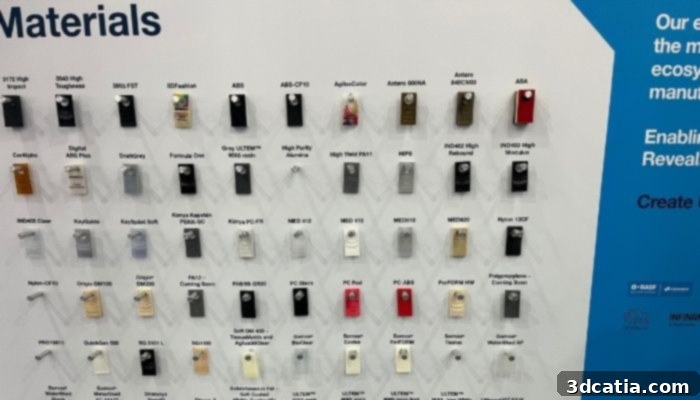
Expanded material choice is also a sign of the increased industrialization of the the industry (photo credits: 3Dnatives)
Software solutions also commanded a significant presence at the show, reinforcing their integral role in the industrialization of additive manufacturing. Shortly before the commencement of RAPID + TCT, Stratasys made a notable announcement: its GrabCAD software platform would be seamlessly integrated across all its machines. David Yang, a Healthcare Solutions Engineer at Stratasys, eloquently articulated the profound importance of this integration. He explained, “Customers come to us and say we have the Stratasys machine and we want to do this application. What’s really nice is that all our machines are within the same network, the same software so it’s easier for the different machines and technologies to see them all. They all use GrabCAD so you can see what they are running, costs, etc all at once.” This unified software ecosystem greatly simplifies managing diverse 3D printing operations, offering unparalleled visibility and control over the entire production process.
Indeed, this initiative by Stratasys is part of a broader and accelerating trend within additive manufacturing: the development and adoption of integrated software platforms designed to streamline and simplify the creation of high-quality parts using 3D printing technologies. Materialise, another industry leader, pursued a similar strategic direction, announcing their CO-AM open software platform just prior to RAPID + TCT 2022. This innovative platform aims to manage the entire additive manufacturing production process more efficiently, offering a cohesive solution for complex workflows. As the industry continues its rapid evolution, we can undoubtedly anticipate a surge in further innovations and strategic partnerships in software, originating from both specialized software companies and established additive manufacturing equipment manufacturers, in the coming months and prominently at RAPID + TCT 2023. These advancements are crucial for unlocking the full potential of industrial-scale 3D printing.
The Changing Face of Fused Deposition Modeling (FDM) Technology
While selecting just one final key trend was challenging amidst a multitude of innovations, the clear evolution of Fused Deposition Modeling (FDM) technology stood out as a significant development at RAPID + TCT 2022. Traditionally perceived in the broader community as a more “affordable” technology, with numerous companies worldwide offering machines for under $300, it appears that FDM is undergoing a distinct and growing segmentation. On one hand, many desktop FDM machines are becoming even more cost-effective and accessible. Simultaneously, however, an increasing number of manufacturers, particularly those based in the United States, are innovating to create more robust, expensive, and distinctly industrial-grade FDM machines. This bifurcation signals a maturing market where FDM is simultaneously catering to entry-level users and highly demanding industrial applications.
This compelling trend was vividly demonstrated at RAPID + TCT 2022. Notably, manufacturers specializing in low-cost, consumer-grade FDM 3D printers were largely absent from the exhibition floor. Instead, the spotlight shone brightly on manufacturers showcasing their advanced, industrial FDM machines and a variety of cutting-edge innovations designed for professional use. A prime example of this industrial shift is Stratasys’ new “composite-ready” printer. As its name suggests, this innovative machine is specifically engineered to print exclusively with composite materials, enabling the production of significantly stronger and more durable parts suitable for high-performance applications. Furthermore, AON3D made a major announcement and presented their high-performance duplication mode on their Fused Filament Fabrication (FFF) machines. This latest software update represents a significant industry first, as printing with high-performance materials – though critical for sectors like aerospace and automotive – traditionally presents considerable challenges. This groundbreaking innovation from AON3D is expected to dramatically enhance user productivity by enabling simultaneous printing, thereby accelerating part production. In essence, RAPID + TCT 2022 powerfully underscored that innovation remains vibrant and thriving within the additive manufacturing community, driven equally by human ingenuity and technological advancements across all segments, including FDM.
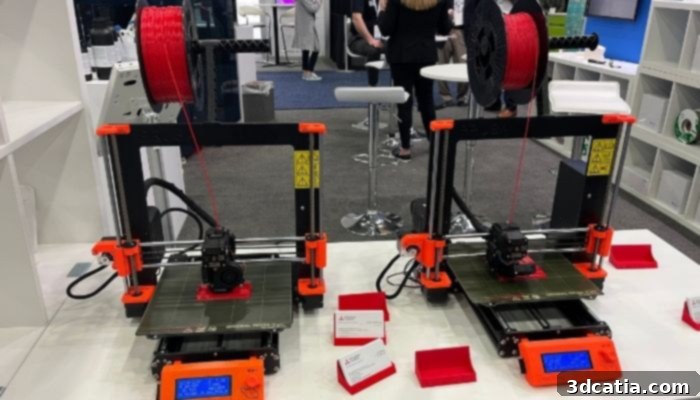
Many of the FDM options at RAPID + TCT 2022 were more industrial options (photo credits: 3Dnatives)
What are your thoughts on these key trends from RAPID + TCT 2022? Did you attend and observe any other significant developments? We encourage you to share your insights in a comment below or join the conversation on our Linkedin, Facebook, and Twitter pages! Don’t forget to sign up for our free weekly Newsletter here to receive the latest 3D printing news directly in your inbox. You can also explore all our videos and interviews on our dedicated YouTube channel for more in-depth coverage of the additive manufacturing world.
*Cover Photo Credits: 3Dnatives