
Innovating 3D Printing Materials: The Promise of Chitosan from Terrestrial Insects
The rapid evolution of additive manufacturing, commonly known as 3D printing, has revolutionized various industries, offering unprecedented design freedom and manufacturing efficiency. However, this growth has also brought to light a pressing need for more sustainable and environmentally friendly materials. Traditional plastics like ABS and PLA, while versatile, often pose challenges regarding their end-of-life impact. It’s this critical juncture that has inspired a pioneering team of researchers from Malaysia, Singapore, Thailand, and India to look towards nature for innovative solutions.
Their ambitious project explores the potential of chitosan, a remarkable natural polymer, to develop advanced composite thermoplastics. The primary goal is to engineer materials that are not only compatible with common extrusion-based 3D printing processes, such as Fused Filament Fabrication (FFF), but also contribute to a greener production and consumption cycle. This initiative aims to address the environmental footprint of 3D printing head-on, promoting a shift towards materials that are more sustainable, biodegradable, and biocompatible. Their diligent research has culminated in the development of several promising polymers, including a novel PLA composite that boasts enhanced density and improved temperature resistance, marking a significant step forward in eco-conscious additive manufacturing.
Understanding Chitosan: Nature’s Versatile Biopolymer
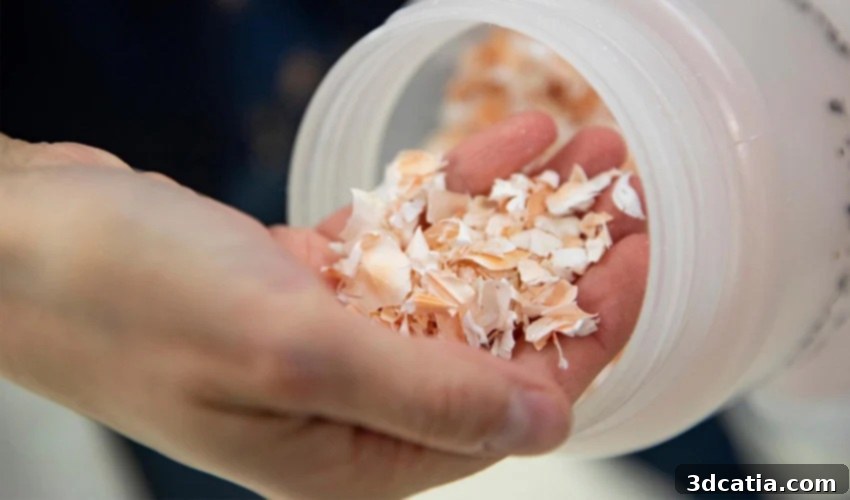
Chitosan stands out as a highly compelling natural polymer, derived from chitin, which is one of the most abundant biopolymers on Earth, second only to cellulose. Chitin forms the robust and often impermeable exoskeleton of various organisms, including crustaceans like crabs and shrimp, as well as insects. The process of converting chitin into chitosan typically involves deacetylation, which removes acetyl groups from the chitin molecule, rendering it soluble and more reactive. This natural polymer is celebrated for its unique properties, including exceptional biodegradability, meaning it can break down naturally in the environment without harmful residues, and biocompatibility, making it safe for interaction with living tissues and organisms.
Due to these advantageous characteristics, chitosan has already found widespread applications across numerous industries. In cosmetology, it’s used in skincare products for its film-forming and moisturizing properties. The agri-food sector utilizes it as a natural preservative, a clarifier for beverages, or even as a coating to extend the shelf life of fruits and vegetables. Medically, its biocompatibility and antimicrobial properties make it suitable for wound dressings, drug delivery systems, and tissue engineering scaffolds. Given its proven track record in diverse fields, the exploration of chitosan as a sustainable raw material for advanced manufacturing, particularly 3D printing, represents a logical and highly promising pathway towards a more sustainable future.
A Sustainable Sourcing Strategy: Focusing on Terrestrial Insects
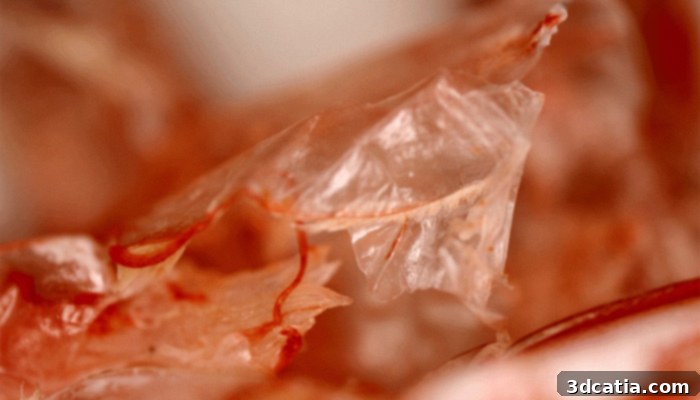
Chitosan is often recovered from crustacean shells, but researchers are exploring more sustainable sources for 3D printing.
While chitosan is commonly extracted from the shells of marine crustaceans, the research team made a conscious decision to pivot towards terrestrial insects as their primary source. This strategic choice was driven by a commitment to maximizing environmental sustainability. The conventional extraction process for chitosan often involves deacetylation, which, depending on the method, can be energy-intensive and produce chemical waste that is not entirely eco-friendly. By focusing on terrestrial insects, the researchers aimed to bypass or significantly minimize the need for such environmentally impactful processes.
Terrestrial insects offer a highly sustainable and scalable source of chitin and subsequently chitosan. They can be cultivated in controlled environments with a significantly smaller ecological footprint compared to traditional agricultural or fishing practices. Insect farming requires less land, water, and feed, and produces fewer greenhouse gas emissions. Furthermore, the rapid reproductive cycles of many insect species allow for continuous and abundant supply, making them an ideal renewable resource. This approach not only sidesteps the environmental concerns associated with crustacean-derived chitosan but also taps into a vastly underutilized bioresource, paving the way for truly regenerative material cycles in manufacturing.
Overcoming Challenges: Developing Robust Chitosan-PLA Composites
Despite the clear advantages of chitosan, integrating it effectively into existing 3D printing plastics presented significant material science challenges. The research team embarked on a rigorous series of experiments and tests to achieve satisfactory results. Initially, their findings indicated that a PLA (Polylactic Acid) matrix enriched with chitosan and chitin derived from terrestrial insects exhibited reduced mechanical resistance and rigidity. Counter-intuitively, higher concentrations of the natural additives correlated with a decrease in these critical properties. This initial hurdle highlighted a common challenge in composite material development: simply adding a new component doesn’t always lead to immediate improvements; careful formulation and understanding of material interactions are paramount.
This preliminary observation raised a crucial question: if adding this natural resource diminishes strength, what is its actual benefit to the plastics currently on the market? The answer lay in a deeper exploration of other mechanical and thermal properties. Material scientists often encounter such complexities, where initial direct reinforcement might not occur, but other beneficial characteristics emerge through precise adjustments and characterization. This necessitated a shift in focus from mere reinforcement to optimizing for a broader spectrum of performance attributes that align with sustainable applications.
Breakthroughs in Performance: Ductility, Thermal Stability, and Compression
Undeterred by initial results, the researchers continued their experimentation, delving deeper into the rheological and mechanical properties of the composites. Their persistence paid off, leading to significant breakthroughs. Further tests revealed that while initial stiffness might have been compromised, the PLA/chitosan and PLA/chitin composites demonstrated markedly better ductility compared to pure PLA. Ductility, a critical material property, represents a material’s ability to deform plastically under tensile stress without fracturing. This means that parts made from these new composites could be more resilient to impact and stress, bending rather than breaking outright.
This enhanced ductility is a highly desirable trait for many 3D printing applications, as it can improve the overall toughness and resilience of printed objects. Furthermore, the comprehensive tests also indicated that these novel composites possessed excellent thermal stability, meaning they could withstand a wider range of temperatures without degrading or losing structural integrity. This is particularly important for applications where printed parts might be exposed to varying thermal conditions. Alongside thermal stability, the materials exhibited interesting compression properties, suggesting their suitability for applications requiring resistance to crushing forces. These combined properties make the chitosan-enhanced PLA composites particularly promising for applications such as food packaging, where materials need to be safe, durable, and capable of protecting contents under various conditions.
Future Directions and Broader Impact on Additive Manufacturing
One of the most exciting aspects of this research is that the developed composite is fully compatible with the widely utilized FFF 3D printing (Fused Filament Fabrication) process. FFF printers are prevalent in both industrial and consumer markets due to their accessibility and cost-effectiveness. This compatibility means that the adoption of these environmentally friendlier materials could be relatively seamless, requiring minimal changes to existing manufacturing infrastructure. The ability to produce functional and sustainable objects using readily available 3D printing technology significantly lowers the barrier to entry for eco-conscious manufacturing practices.
Looking ahead, the research team is eager to explore how chitosan would react and perform when combined with other thermoplastic matrices, such as ABS (Acrylonitrile Butadiene Styrene) or polycarbonate. Expanding the range of compatible polymers could unlock an even wider array of applications and properties, further solidifying chitosan’s role as a versatile biomaterial in additive manufacturing. Beyond material development, future efforts will likely focus on scaling up production of insect-derived chitosan, optimizing extraction methods for industrial efficiency, and conducting lifecycle assessments to fully quantify the environmental benefits.
This research represents a pivotal step towards a more sustainable future for 3D printing. By harnessing natural resources like chitosan from terrestrial insects, it demonstrates that high-performance materials do not have to come at the expense of our planet. The development of biodegradable and biocompatible composites, especially those compatible with mainstream 3D printing technologies, moves the industry closer to a circular economy model, where materials are responsibly sourced, utilized, and ultimately returned to nature. This not only mitigates plastic waste but also fosters innovation at the intersection of material science, entomology, and advanced manufacturing. For those interested in the technical specifics, more in-depth information can be found HERE.
Engage with Us on Sustainable 3D Printing
What are your thoughts on the groundbreaking use of chitosan from terrestrial insects in 3D printing? Do you envision this leading to a new era of sustainable additive manufacturing? We would love to hear your perspective! Share your comments below or join the conversation on our LinkedIn, Facebook, and Twitter pages! Don’t forget to sign up for our free weekly Newsletter here to get the latest 3D printing news delivered straight to your inbox! You can also find all our innovative videos and more insights on our YouTube channel.
*Cover Photo Credits: David Boily / La Presse