
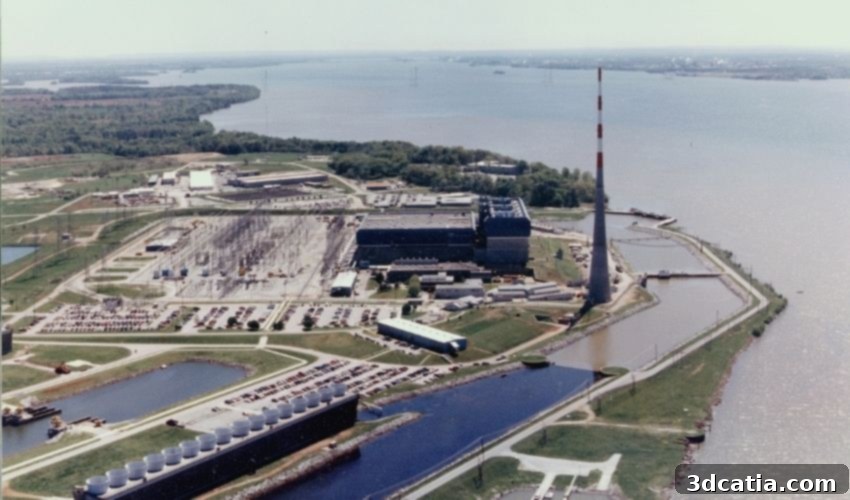
Revolutionizing Nuclear Energy: ORNL Installs 3D-Printed Components at Browns Ferry Nuclear Plant
A significant leap forward in nuclear energy innovation has been achieved with the successful installation and operation of four 3D-printed fuel assembly brackets at the Tennessee Valley Authority’s (TVA) Browns Ferry Nuclear Plant Unit 2 in Athens, Alabama. This landmark development, announced recently by the Oak Ridge National Laboratory (ORNL), represents a pivotal moment for both the nuclear power industry and the field of additive manufacturing. These safety-critical components, meticulously tested and rigorously examined, are expected to perform reliably within the reactor for the next six years, marking a crucial step in the long-term viability and modernization of the U.S. nuclear fleet.
This pioneering project is the culmination of a collaborative effort between ORNL, the Tennessee Valley Authority (TVA), and Framatome, a global leader in nuclear reactor technology. Crucially, the initiative is also supported by the U.S. Department of Energy (DOE) Office of Nuclear Energy-funded Transformational Challenge Reactor (TCR) program, which is headquartered at ORNL. The overarching goal of developing and deploying these advanced 3D-printed components is to accelerate the maturation of additive manufacturing technologies for nuclear applications. This strategic focus aims to bolster the performance and extend the operational lifespan of the existing nuclear power plant fleet across the United States, which currently comprises 56 plants in 28 states, down from its peak in the early 2000s.

A 3D-printed channel fastener for Framatome’s boiling water reactor fuel assembly. Four of these components were installed at the TVA Browns Ferry nuclear plant (Image credits: Framatome)
The Strategic Importance of Additive Manufacturing in Nuclear Energy
The successful deployment of 3D-printed parts within an active nuclear reactor signifies a profound paradigm shift. It not only promises to revolutionize the nuclear industry within the United States but also unequivocally validates the growing viability of additive manufacturing for producing safety-critical components in highly regulated and demanding environments. Ben Betzler, the TCR program director at ORNL, underscored this momentous achievement, stating, “Deploying 3D-printed components in a reactor application is a great milestone. It shows that it is possible to deliver qualified components in a highly regulated environment. This program bridges basic and applied science and technology to deliver tangible solutions that show how advanced manufacturing can transform reactor technology and components.” This sentiment highlights the dual impact of the project: proving the robustness of 3D printing and offering tangible solutions for modernizing nuclear infrastructure.
The integration of additive manufacturing into the nuclear energy sector offers a multitude of benefits, from enhanced design flexibility and rapid prototyping to improved supply chain resilience and potential cost reductions. Traditional manufacturing methods for nuclear components are often complex, time-consuming, and limited by design constraints. Additive manufacturing, particularly technologies like laser powder bed fusion, can overcome these limitations, enabling the creation of intricate geometries and optimized designs that were previously impossible. This innovation is crucial for a sector that demands the highest standards of safety, reliability, and efficiency, paving the way for advanced reactor designs and extended operational lifetimes for existing plants.
Unpacking the 3D-Printed Nuclear Components: Technology and Testing
The installed components are channel fasteners, specifically safety-critical brackets designed for the reactor’s fuel assembly. Each part was meticulously fabricated using Laser Powder Bed Fusion (LPBF) technology. LPBF is an advanced metal additive manufacturing process where a high-powered laser selectively melts and fuses metallic powders layer by layer, building a three-dimensional part from a digital design. This technology is highly favored in industries with stringent requirements, such as aerospace and aviation, due to its ability to produce parts with superior mechanical properties, high precision, and intricate internal structures. The choice of LPBF and specific metal powders was critical to ensure the components could withstand the extreme conditions within a nuclear reactor, including high temperatures, radiation, and corrosive environments.
Researchers involved in the project noted that these channel fasteners were ideal for this inaugural additive manufacturing application in a nuclear reactor due to their straightforward yet non-symmetric nature. This characteristic perfectly leverages one of additive manufacturing’s key advantages: the ability to produce parts with complex geometries, including asymmetrical designs, without the constraints and high costs associated with traditional machining or molding. This design freedom allowed for an optimized component structure, enhancing its functionality and performance within the fuel assembly.
A cornerstone of this project was the unparalleled emphasis on design optimization and rigorous, multi-layered testing. Utilizing advanced computer topography, the researchers optimized every aspect of the part, including critical interfaces and load-bearing sections, to ensure maximum strength and integrity. However, the true innovation lay in the comprehensive validation process. The components underwent an extensive battery of tests to characterize their material properties and structural integrity. This included:
- CT-scans (Computed Tomography): Providing a non-destructive, detailed internal view of the material to detect any subsurface defects or anomalies, ensuring homogeneity and integrity.
- Optical and Scanning Microscopy: Offering microscopic examination of the material’s microstructure and surface finish, crucial for understanding mechanical properties and potential failure points.
- Spatially Tracking Data: Comparing the performance and characteristics of the 3D-printed components against traditionally manufactured materials, establishing equivalence or superiority.
- Digitization and AI-powered Analysis: A pioneering approach where digital twins of the parts were created. This allowed for analysis using artificial intelligence algorithms to identify and predict all possible defects, including those that might be subtle or difficult for human inspection to detect. This advanced analytical capability significantly enhances safety assurances.
This meticulous testing regime, combining traditional methods with cutting-edge digital analysis, was paramount in qualifying these components for deployment in such a highly regulated and safety-conscious environment as a nuclear power plant. The ability to guarantee the integrity and predictability of performance under extreme operating conditions is what ultimately enabled this breakthrough.
Long-Term Vision and the Future of Nuclear Additive Manufacturing
The 3D-printed fuel assembly brackets were successfully installed in April and are slated to remain in the Browns Ferry Unit 2 reactor for the next six years. Throughout this period, regular inspections will be conducted to continuously monitor their optimal operation and performance. This extended deployment phase is critical for gathering real-world operational data, which will further validate the technology and inform future applications of additive manufacturing in nuclear energy. The success of this installation opens the door for other nuclear components to be produced using similar advanced manufacturing techniques, promising a more agile, cost-effective, and resilient supply chain for the nuclear industry.
Beyond extending the life of current reactors, advanced manufacturing techniques like 3D printing are fundamental to the development of next-generation nuclear energy systems. These include small modular reactors (SMRs) and advanced microreactors, which often feature complex, integrated designs that can greatly benefit from the geometric freedom and material customization offered by additive manufacturing. This innovation reduces the lead times for component production, allows for faster iterations in design, and potentially lowers overall manufacturing costs, making nuclear power more competitive and adaptable to future energy needs. The collaboration spearheaded by ORNL, TVA, and Framatome, under the umbrella of the TCR program, is not just about replacing parts; it’s about strategically positioning the United States at the forefront of nuclear energy innovation and ensuring a secure, clean energy future.
To delve deeper into this groundbreaking initiative, you can watch the video below, which provides further insights into the process and significance of this achievement. Additionally, the official press release from ORNL offers more detailed technical information HERE.
What are your thoughts on ORNL’s pioneering installation of 3D-printed fuel assembly brackets at the Browns Ferry Nuclear Plant? Share your comments below or engage with us on our Facebook and Twitter pages! Don’t forget to subscribe to our free weekly newsletter to receive all the latest updates and news in the world of 3D printing directly to your inbox!
*Thumbnail Image Credits: Nuclear Regulatory Commission, Public domain, via Wikimedia Commons