
L’Oréal’s Additive Manufacturing Journey: Innovating Beauty Through 3D Printing and Customization
In today’s rapidly evolving industrial landscape, numerous sectors have embraced additive manufacturing, commonly known as 3D printing, to achieve greater agility, foster innovation in product development, and streamline often cumbersome production processes. For the consumer goods market, and particularly within the competitive beauty industry, this technology primarily offers unprecedented levels of customization. This capability is a significant competitive advantage, enabling brands to provide tailor-made solutions and personalized products that would be impractical or impossible to create using traditional manufacturing methods. L’Oréal, a global leader in cosmetics and beauty, recognized the transformative potential of 3D technologies early on. Their interest began nearly 26 years ago, initially focused on designing more innovative and complex packaging. Since those early explorations, the French multinational group has profoundly diversified its applications of additive manufacturing and now boasts an impressive network of approximately 60 3D printers deployed across its global operations. To delve deeper into L’Oréal’s strategic adoption of additive manufacturing and understand their future ambitions in enhancing product development and consumer experience, we sat down with Anne Debauge, Additive Community Leader, and Matthew Forrester, Additive Technical Leader, for an exclusive interview.
Meet the Visionaries: L’Oréal’s Additive Manufacturing Leaders
Matthew Forrester: Hello, I’m Matthew Forrester. My core responsibility involves the strategic deployment of additive manufacturing across our various sites worldwide. My focus is on integrating this technology wherever it can enhance agility, particularly in critical areas such as rapid prototyping for new product concepts, the creation of specialized industrial tools for our production lines, and even direct production applications. More broadly, I aim to identify and implement innovative 3D printing solutions that generate substantial benefits and drive efficiency throughout our entire value chain, from design to delivery.
Anne Debauge: And I’m Anne Debauge. My mission at L’Oréal is centered around accelerating the implementation of cutting-edge technologies to significantly reduce the development timelines for our diverse product portfolio. Within this dynamic framework, my specific role involves leading and fostering the entire additive manufacturing community within the organization, ensuring knowledge sharing, promoting best practices, and driving continuous innovation across all relevant teams involved in 3D printing initiatives.

Matthew Forrester and Anne Debauge, key figures in L’Oréal’s pioneering additive manufacturing initiatives.
L’Oréal’s Additive Manufacturing Evolution: A Quarter-Century of 3D Printing Innovation
Anne Debauge: Our journey with additive manufacturing at L’Oréal is quite extensive and visionary, tracing back to an impressive 1993. That year, we acquired our very first FDM printer, installing it at our packaging design site in the United States. This early adoption demonstrates L’Oréal’s foresight in exploring new production paradigms and its commitment to innovation. For many years, specifically until 2018, our various design centers primarily utilized additive manufacturing through specialized subcontractors. This was predominantly for the crucial validation of packaging models, encompassing everything from intricate make-up compacts to uniquely shaped bottles and various other cosmetic containers. During this period, three of our factories were also equipped with FDM and SLA machines, specifically from Formlabs, marking our initial, albeit limited, in-house integration efforts in manufacturing operations.
However, 2018 marked a pivotal and strategic shift for L’Oréal. We initiated a comprehensive program for the digital transformation of our operations. This ambitious strategic move was driven by a profound observation: consumer behaviors and expectations had evolved more dramatically in the preceding three years than in the previous three decades combined. The modern consumer demands personalization, speed, and sustainability like never before. A paramount objective of this transformation program was to halve our product development time, a monumental task requiring radical technological shifts. It was in this critical context that we made the strategic decision to extensively internalize additive manufacturing across all our plants and packaging design centers globally. Today, our commitment is clear and impactful: 23 out of our 40 factories are now equipped with advanced 3D printing capabilities, and impressively, 100% of our major design centers – including key innovation hubs like Clichy, Chevilly, as well as those in the US, China, Japan, Mexico, and India – each host a dedicated 3DLab. Our global fleet now comprises around seventy 3D printers, encompassing a diverse array of technologies to meet various needs: FDM (Fused Deposition Modeling) for robust functional prototypes, SLA (Stereolithography) for high-resolution models, DLP (Digital Light Processing) for speed and fine details, and MultiJet for multi-material and full-color applications. This diverse technological arsenal allows us unparalleled flexibility and precision in our development and production processes.
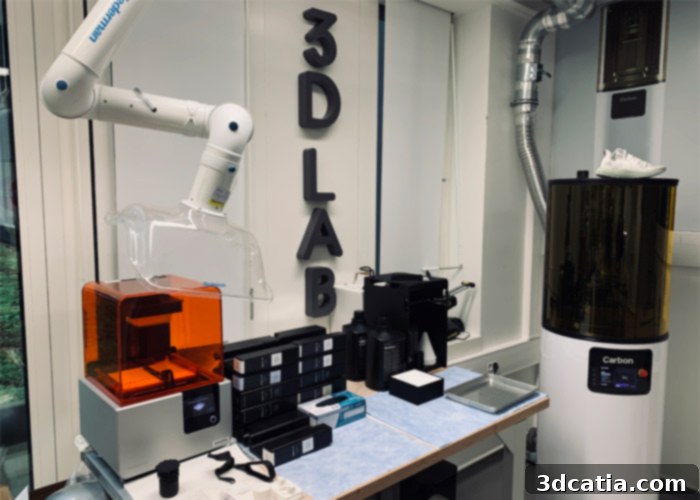
The state-of-the-art 3DLab in L’Oréal’s Clichy center, one of many global facilities leveraging advanced 3D printing technology for innovation. | Credits: 3Dnatives
Diverse Applications: What L’Oréal Creates with 3D Printing Across the Beauty Value Chain
Matthew Forrester: Our applications for 3D printing are incredibly varied and touch multiple facets of our operations, showcasing the technology’s immense versatility. Primarily, we leverage it for creating a wide range of prototypes essential for product development. This includes highly detailed packaging prototypes, allowing us to visualize and validate designs rapidly. We also produce prototypes for point-of-sale furniture, ensuring effective retail presentation, and even internal furniture prototypes. Beyond aesthetics and form validation, 3D printing is crucial for functional components like prototype injection molds, which significantly accelerate our tooling development cycles. We also produce essential quality control tools, vital for maintaining product standards, and, importantly, spare parts for our factory packaging lines, enabling quicker repairs and minimizing costly downtime. A more advanced and technical application involves using 3D printing for creating complex conformal cooling channels within our injection molds, which dramatically enhances mold efficiency, reduces cycle times, and improves final product quality. Occasionally, we also utilize this technology for crafting specialized make-up powder compaction tools, demonstrating its adaptability even in direct product manufacturing aids for specific cosmetic formulations.
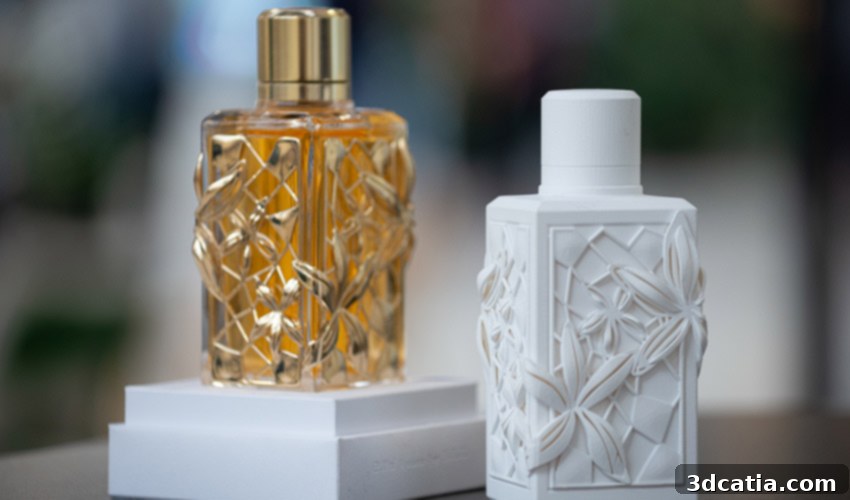
Anne Debauge: Expanding on our innovative uses, April 2019 marked a significant milestone with our first official product launch featuring packaging created using advanced laser powder bed fusion. This was for the exquisite La Maison Jasmins Marzipane Lancôme collection, a limited series of just 50 ultra-luxury, individually numbered perfume bottles. The intricate Jasmine flower designs on the packaging, characterized by delicate geometries and precision, were impossible to achieve with traditional methods. This project perfectly exemplifies how additive manufacturing elevates product aesthetics, exclusivity, and perceived value within the highly demanding luxury sector, creating unique experiences for our discerning consumers.
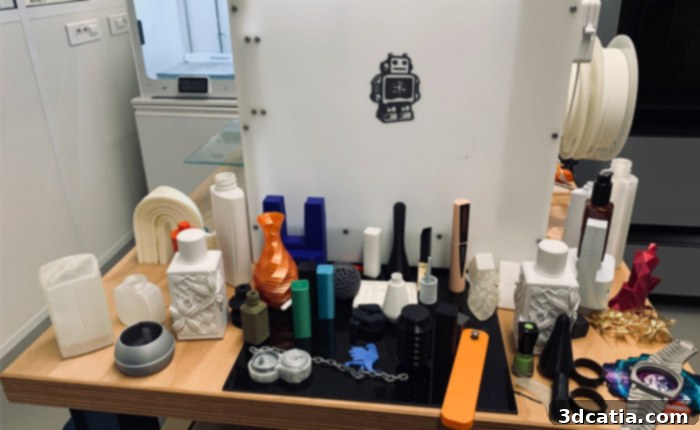
Additive manufacturing enables L’Oréal to design a vast array of prototypes, specialized tools, and intricate molds, fostering innovation across its product lines. | Credits: 3Dnatives
Furthermore, in the groundbreaking and ethically conscious field of bioprinting, L’Oréal’s Research & Innovation team is actively engaged in developing sophisticated bioprinted skin models. These highly advanced in-vitro models are meticulously designed to enable a more predictive and accurate evaluation of our cosmetic formulas and ingredients than current existing models allow. This pioneering research not only significantly advances our understanding of both normal and pathological human skin at a cellular and tissue level but also offers a powerful and humane ethical alternative to traditional animal testing, aligning perfectly with L’Oréal’s unwavering commitment to responsible innovation and cruelty-free product development.
Tangible Benefits: How L’Oréal Profits from Strategic Additive Manufacturing Integration
Anne Debauge: The benefits of additive manufacturing for L’Oréal are truly multifaceted and extend across our entire organization, driving significant value. These advantages positively impact our internal operational efficiency, significantly boost employee engagement through hands-on innovation and problem-solving, and crucially enhance our ability to create novel and compelling experiences for our discerning consumers.
Matthew Forrester: From an internal organizational perspective, additive manufacturing has fundamentally revolutionized our design and development cycles, injecting unprecedented speed and flexibility. We now possess the remarkable capability to design a product component – be it a new bottle cap or a unique applicator – and rigorously test its ergonomics, its feel, fit, and overall usability, all within the same day. This rapid prototyping cycle is invaluable. During the technical design phase, engineers frequently explore multiple design assumptions to perfect an assembly or integrate a new feature into a product. With 3D printing, we can rapidly iterate through many more design variations than ever before, allowing us to quickly identify and select the most relevant, efficient, and effective solutions, drastically reducing overall product development lead times and significantly improving the quality and functionality of the final product.
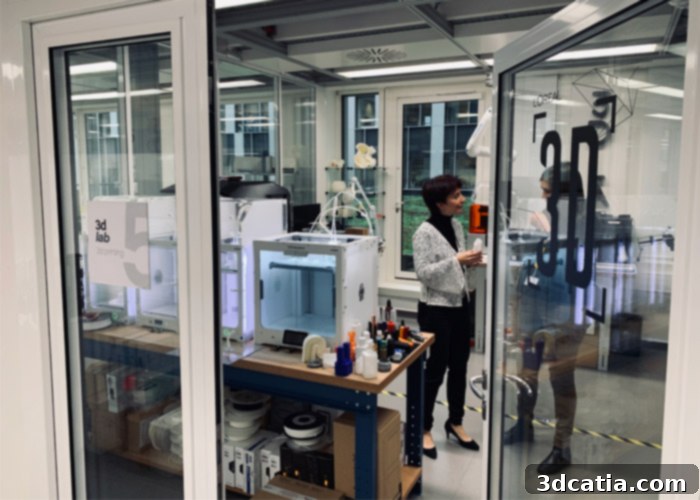
L’Oréal’s Clichy lab, one of seven dedicated 3DLabs globally, plays a crucial role in the company’s additive manufacturing ecosystem for rapid prototyping and tool development. | Credits: 3Dnatives
In our manufacturing facilities, the demand for adapting to new packaging formats and product variations is ever-increasing in response to dynamic market trends. The internalization of manufacturing for format-specific parts and specialized tooling has dramatically enhanced our operational agility and responsiveness. For instance, a factory technician can now design and 3D print a precise format part – such as a custom insert or guide rail to facilitate the filling or handling of a new bottle design – within a matter of days. This capability eliminates the previous need to outsource these components, which traditionally involved much longer lead times, complex logistics, and higher costs. This internal capacity allows us to respond to market demands and introduce new product formats with unparalleled speed and efficiency.
Beyond speed and efficiency, additive manufacturing grants us unparalleled freedom to innovate and create entirely new functionalities and solutions that were previously unthinkable with conventional manufacturing. A prime example is the development of a 2-position bottle conveying bucket. This ingenious 3D printed solution means that when we switch formats on a high-speed packaging line, our operators no longer have to manually remove and replace hundreds of individual bottles or change entire sets of complex tooling. Instead, the adjustable bucket streamlines the process, leading to significant time savings, reduced labor, enhanced operational safety, and minimal disruption to production. This kind of bespoke tooling, precisely tailored to our specific needs, is a powerful testament to the transformative power of 3D printing in optimizing complex manufacturing processes and driving operational excellence.
Navigating Obstacles: Challenges in L’Oréal’s 3D Technology Adoption and Future Outlook
Matthew Forrester: While the promise of 3D technologies is immense, especially for large-scale industrial production, we are still navigating certain inherent limitations that require careful consideration. One significant challenge lies in the choice of materials, which remains relatively limited today for widespread industrial applications, particularly when considering the stringent requirements of the beauty sector. At L’Oréal, our requirements for material safety, particularly concerning consumer contact, product integrity, and regulatory compliance, are extraordinarily stringent. Furthermore, our unwavering commitment to environmental preservation means we demand high standards for recyclability, biodegradability, and overall sustainability from any material used in our processes. These high bars currently restrict the range of viable application cases for direct, high-volume production using additive manufacturing.
The second notable hurdle is the manufacturing time and scalability. Currently, 3D printing processes, while excellent for prototyping and specialized tools, are generally slower than established high-volume techniques like plastic injection molding for mass production. This speed differential can translate into additional production costs per unit, potentially impacting consumer prices in the mass market. However, it’s crucial to recognize that the landscape of additive manufacturing is evolving at an incredibly rapid pace. New, high-performance materials are constantly being developed, and printing speeds are continually improving through technological advancements. We are highly optimistic that this gap in manufacturing time and associated costs will be significantly reduced in the near future, paving the way for even broader and more economical adoption across our production lines for consumer-facing products.
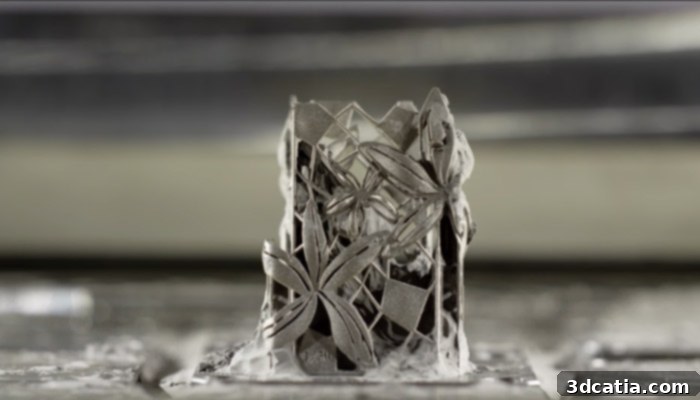
The sophisticated packaging for L’Oréal’s La Maison Jasmins Marzipane Lancôme perfume exemplifies the potential of metal additive manufacturing in luxury product design, enabling intricate details.
L’Oréal’s Vision: Future Projects and the Expanding Role of Additive Manufacturing
Anne Debauge: Additive manufacturing truly unlocks a realm of infinite possibilities for L’Oréal, fundamentally reshaping how we envision our future in product creation and consumer engagement. Looking ahead, this technology will enable us to manufacture our packaging with unprecedented agility, allowing us to be ever closer to the dynamic needs and desires of our global consumers. For example, 3D printing facilitates localized manufacturing, which has significant environmental and logistical advantages by reducing transportation costs and supply chain complexities, contributing to our sustainability goals. Furthermore, it empowers us to offer extreme customization and hyper-personalization for our products, moving beyond traditional mass production to genuinely tailor-made solutions for individual preferences. Critically, it allows us to conceptualize and realize designs and complex geometries that are simply impossible to achieve with conventional manufacturing techniques, pushing the boundaries of aesthetic and functional innovation in beauty products, from unique forms to integrated functionalities.
The Future of 3D Printing in the Luxury Sector: L’Oréal’s Perspective on Innovation and Sustainability
Anne Debauge: For the luxury sector, the synergy between additive manufacturing and sustainability is particularly compelling and a core focus for L’Oréal. By 2025, L’Oréal has made a firm public commitment to ensure that 100% of our packaging is either recyclable, compostable, or reusable. Within this ambitious sustainability framework, additive manufacturing offers an ocean of opportunities, particularly for advanced personalization and bespoke creations. The ability to print on demand, using sustainable and innovative materials, and to create unique, high-value components that reflect luxury aesthetics aligns perfectly with the ethos of high-end brands seeking both exclusivity and environmental responsibility.
The pace of innovation in additive manufacturing is exponential across all critical areas, from advanced materials science to groundbreaking new printing processes and improved hardware. This relentless progression fuels our optimism that we will very quickly have access to a broader spectrum of solutions that not only meet but far exceed our rigorous quality and material requirements for luxury goods. The future promises materials that are not only safe for consumers and sustainable for the planet but also capable of delivering the exquisite finishes, tactile sensations, and superior performance demanded by high-end cosmetics, fragrances, and beauty accessories, all while enabling unprecedented design freedom.
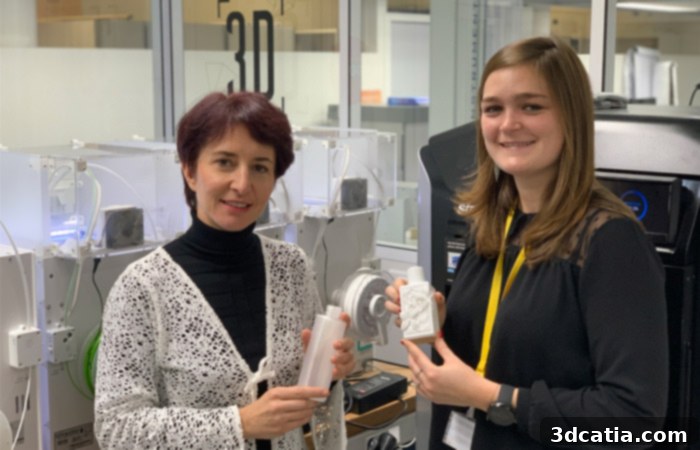
The 3Dnatives team had the exclusive opportunity to visit the L’Oréal 3DLab in Clichy, gaining firsthand insight into the advanced additive manufacturing technologies employed by the group. | Credits: 3Dnatives
A Call to Action: Embracing the Maker Mindset for a Better Future
Matthew Forrester: We are truly living through the nascent, yet incredibly exciting, stages of what is widely being called the fourth industrial revolution, and with it, the ‘maker mindset’ is steadily growing in prominence and impact. We all have the incredible opportunity to be part of these transformative beginnings, shaping the future of manufacturing and innovation. At L’Oréal, we have proactively embraced and successfully deployed this innovative mindset internally, fostering a vibrant and interconnected network of ‘makers’ throughout our organization. This culture actively encourages experimentation, rapid prototyping, creative problem-solving, and continuous learning, empowering our employees at all levels to actively contribute to our technological advancement and find innovative solutions to complex challenges.
Anne Debauge: The transformative benefits we’ve realized through the strategic integration of additive manufacturing are genuinely impressive, and we deeply believe in the power of open collaboration and shared knowledge. For this reason, we have made a conscious decision to openly share the fruits of our progress, our challenges, and our learnings with our counterparts in other industries and, importantly, with the broader global maker community. We are profoundly convinced that by joining forces, by sharing insights, best practices, and technological advancements across sectors, we can collectively invent and build a better world, driving sustainable progress, fostering groundbreaking solutions, and addressing global challenges more effectively for everyone. For more detailed information on our initiatives, commitment to innovation, and our sustainability goals, we invite you to explore our official L’Oréal website.
What are your thoughts on L’Oréal’s extensive and innovative use of 3D printing technology within the beauty industry? We encourage you to share your insights in a comment below or join the conversation on our Facebook and Twitter pages! Don’t forget to sign up for our free weekly Newsletter to receive all the latest news, expert analyses, and updates in the dynamic world of 3D printing directly in your inbox!
We also want to remind you about an upcoming essential webinar on the 26th of February, which will focus on practical strategies for successfully adopting additive manufacturing for your specific projects and business needs. This is a valuable opportunity for anyone looking to integrate 3D printing into their operations or scale their existing capabilities. You can register for this insightful and informative webinar for free starting today HERE.