
From Waste to Wonder: 3D Printing Wool for a Circular Economy
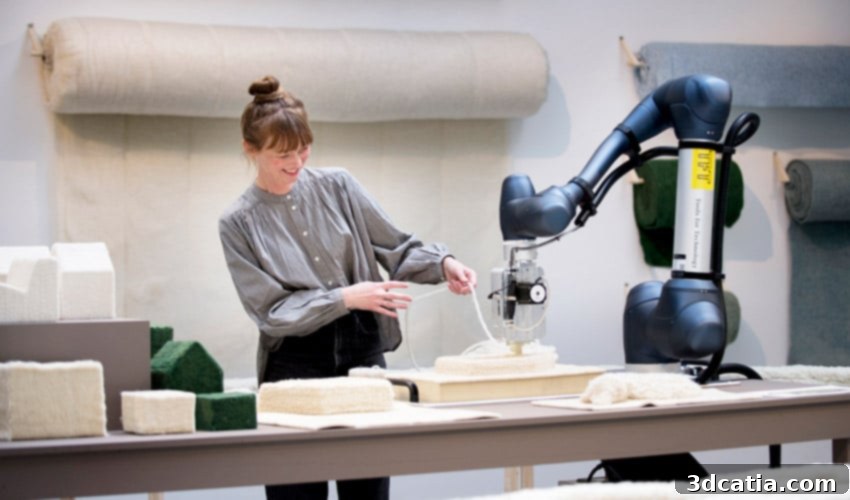
Imagine a future where the warmth and versatility of wool are harnessed by cutting-edge additive manufacturing. What if you could 3D print wool, transforming discarded fibers into valuable objects? This once-distant concept is now a tangible reality, thanks to pioneering innovations in the world of 3D printing materials. While the industry continues to surprise us with everything from coffee to beer being utilized in additive processes, a groundbreaking project spearheaded by Dutch designer Christien Meindertsma is setting a new standard for sustainable manufacturing. Her visionary approach has led to the creation of a tailor-made robotic arm, aptly named FLOCKS Wobot, capable of precisely depositing wool fiber by fiber, layer by layer. This revolutionary system forms intricate objects without the need for water, binders, or any additional materials, offering an unprecedented method for materializing designs while simultaneously addressing a significant environmental challenge. The FLOCKS Wobot specifically targets wool that is deemed too fine or unsuitable for traditional textile production, giving a vital second life to material that would otherwise be discarded as waste.
The ambition behind this project extends far beyond novel material application; it is a profound commitment to fostering a truly circular economy. Christien Meindertsma’s work highlights a critical issue: the enormous quantity of wool that goes to waste annually. According to her research, a staggering 1.5 million kilograms (approximately 3.3 million pounds) of wool are thrown away each year in the Netherlands alone. This problem is not confined to one region; in the United States, 2022 saw 11.9 million pounds of wool discarded. These figures underscore a global predicament with dire ecological consequences if such vast quantities of natural fiber end up in landfills. Landfilled wool, while biodegradable, contributes to methane emissions under anaerobic conditions and represents a significant squandering of a valuable natural resource. Meindertsma’s innovative solution directly confronts this wastefulness, proposing a practical and scalable method to divert wool from the waste stream and reintegrate it into a productive lifecycle.
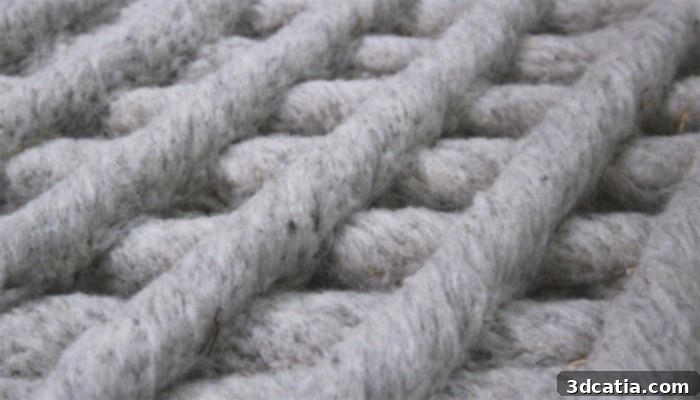
3D-printed wool offers many advantages
The Unparalleled Benefits of Wool in Additive Manufacturing
Beyond its environmental advantages in waste reduction, wool itself possesses a remarkable array of inherent properties that make it an ideal candidate for innovative applications, especially when combined with 3D printing technology. Unlike many synthetic materials or even other natural fibers, wool stands out for its exceptional characteristics. It is not only completely recyclable but also fully biodegradable, meaning that products made from 3D-printed wool can eventually return to nature without leaving a lasting ecological footprint. This contrasts sharply with widely used materials like polystyrene, which persist in the environment for centuries. Furthermore, wool is renowned for its natural strength and solidity, offering structural integrity suitable for various applications. It boasts excellent insulating properties, making it an effective thermal and acoustic barrier. Its natural crimp and elasticity provide resilience, while its ability to manage moisture makes it permeable to water vapor, preventing condensation and promoting breathability. Perhaps one of its most impressive attributes is its inherent fire resistance, capable of withstanding temperatures up to 560°C before igniting, offering a safer alternative in many contexts. These combined properties elevate wool from a traditional textile material to a high-performance, sustainable choice for advanced manufacturing, particularly when its form and function can be precisely controlled through 3D printing.
Innovating with the FLOCKS Wobot: Technology and Collaboration
The realization of 3D printing with wool is a testament to collaborative innovation. Christien Meindertsma partnered with TFT (Tools for Technology), a firm specializing in advanced robotics, to bring the FLOCKS Wobot to life. This partnership was crucial in developing the customized robotic arm that forms the core of this additive manufacturing system. The robotic arm is ingeniously attached to a cobot – a collaborative robot. Cobots are designed with advanced sensors and safety features, allowing them to work in close proximity to human operators without risk, fostering a more interactive and flexible manufacturing environment. This setup allows the Wobot to precisely deposit successive layers of wool, mimicking the layer-by-layer deposition seen in traditional 3D printers that use plastic filaments. However, unlike conventional methods that often rely on heat-based extrusion or liquid binders, the FLOCKS Wobot operates solely by mechanically depositing and compacting raw wool fibers. This unique approach ensures the purity of the material and eliminates the need for energy-intensive processes or chemical additives.
A significant advantage of this technology is its versatility with wool types. The designer emphasizes its compatibility with virtually any European wool, underscoring its potential to address wool waste across various regions. While tests have shown particularly conclusive and sustainable results with raw wool, the system is not limited. Meindertsma elaborates, stating, “It’s a technique you can use with any European wool. The wool doesn’t have to be particularly fine and it doesn’t even need to be processed, just washed.” This simplicity in material preparation dramatically reduces the energy and chemical input typically associated with textile manufacturing, further solidifying the project’s commitment to ecological responsibility. By utilizing wool in its most natural, minimally processed state, the FLOCKS Wobot not only tackles waste but also preserves the inherent sustainable qualities of the fiber, offering a truly eco-conscious manufacturing solution.
Broadening Horizons: Applications and Impact of Wool 3D Printing
The potential applications for 3D-printed wool are incredibly diverse and promise to revolutionize numerous sectors. Given wool’s exceptional properties, from superior insulation to fire resistance, its integration into additive manufacturing opens up exciting possibilities far beyond traditional textiles. One primary area where 3D-printed wool is expected to excel is in the design and production of acoustic and insulation products. Its natural fiber structure provides excellent sound absorption and thermal regulation, making it ideal for creating high-performance sound-dampening panels for architectural spaces, offices, or even automotive interiors. Similarly, its insulating capabilities could lead to innovative building materials, offering sustainable alternatives for energy-efficient construction.
Beyond these functional applications, the design and furnishing sector stands to benefit immensely. Imagine custom-printed furniture components, unique decorative objects, or bespoke interior elements that combine natural aesthetics with advanced performance. The precision of 3D printing allows for complex geometries and intricate textures that would be challenging or impossible to achieve with traditional wool processing methods. This could unlock entirely new forms of sustainable product design, fostering creativity while minimizing environmental impact.
Looking further, the possibilities expand into areas such as packaging, where wool’s biodegradability offers an eco-friendly alternative to plastics. In art and sculpture, artists could utilize the FLOCKS Wobot to create intricate, textural pieces with a unique natural feel. The technology also holds promise for creating lightweight, insulating components for industries like aerospace or automotive, where material efficiency and performance are paramount. As the technology matures, we may even see its application in protective gear, or as a sustainable material for temporary shelters in disaster relief scenarios, leveraging its inherent resilience and insulating properties. The versatility and eco-credentials of 3D-printed wool position it as a truly transformative material for a wide array of future-forward industries seeking sustainable, high-performance solutions.
Experiencing the Innovation: Exhibitions and Future Engagement
To share this groundbreaking innovation with the public and foster further discussion, Christien Meindertsma is actively exhibiting the FLOCKS Wobot and its creations. Until March 2024, visitors can experience this sustainable technology firsthand at the Cuypershuis in Roermond, the Netherlands. Following this, the exhibition will move to the renowned V&A (Victoria and Albert Museum) in London, where it will be on display until October 2024, providing a wider international audience with the opportunity to engage with the project. These exhibitions serve not only to showcase the technical achievement but also to provoke thought about sustainable consumption, circular design, and the untapped potential of natural materials in advanced manufacturing. For those eager to delve deeper into the designer’s visionary portfolio and learn more about the FLOCKS Wobot and her other projects, you can click HERE to explore her official website.
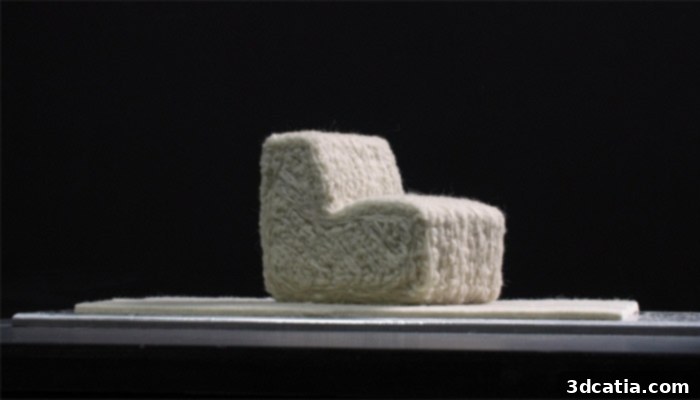
Example of a 3D printed structure made using wool
The advent of 3D printing with wool, pioneered by Christien Meindertsma, represents a significant leap forward in sustainable additive manufacturing. By transforming discarded natural fibers into valuable, high-performance objects, this innovation tackles textile waste, promotes a circular economy, and unlocks the inherent advantages of wool in a novel way. What are your thoughts on wool 3D printing and its potential to shape a more sustainable future? We invite you to share your insights in a comment below or join the conversation on our LinkedIn, Facebook, and Twitter pages! Don’t forget to sign up for our free weekly Newsletter here to receive the latest 3D printing news straight to your inbox! You can also find all our compelling videos on our YouTube channel for more visual content and interviews from the world of additive manufacturing.
*All Photo Credits: TFT Tools for Technology, Sara Alvarez, Bart Harteloh, Doosan Robotics, Dormac Cobots, Martin Oosthoek, De Wassum, Havivank, Gelderland, Rotterdam Circulair, Lisa Hardon, Creative Industries Fund NL and Stichting DOEN