
Driving Innovation: Porsche’s Journey with 3D Printing and Additive Manufacturing in Automotive Performance
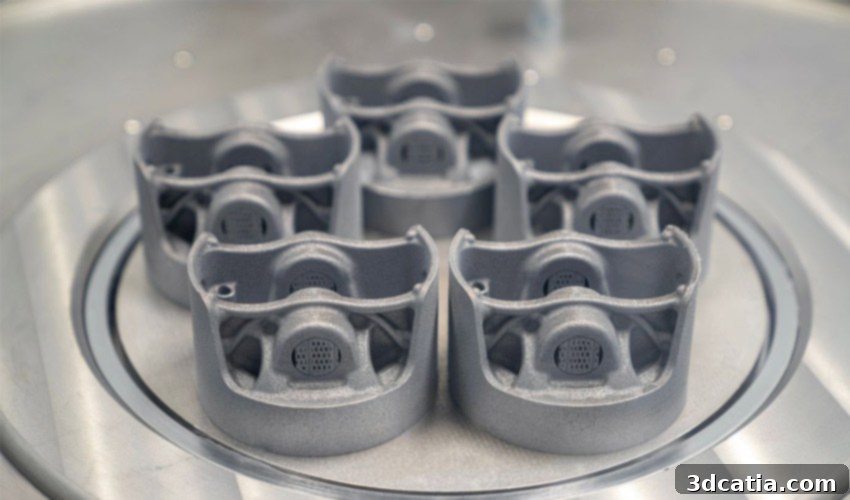
In a significant stride towards advanced automotive engineering, luxury car manufacturer Porsche recently unveiled its groundbreaking 3D printed pistons designed for the formidable engine of its iconic 911 GT2 RS model. This innovative application of additive manufacturing has enabled Porsche to achieve remarkable results, including a substantial reduction in the overall weight of the component, accelerated production lead times, and a tangible increase in the vehicle’s final performance capabilities. These benefits are not merely incremental; they represent critical advancements highly coveted within today’s intensely competitive automotive sector. The industry is increasingly turning to 3D printing and additive manufacturing due to their unparalleled capacity to facilitate greater design complexity, foster innovation, and offer a level of customization simply unattainable through conventional production methods. To delve deeper into Porsche’s strategic adoption of additive manufacturing and understand its impact on their daily operations, we had the privilege of interviewing Frank Ickinger, a key member of Porsche’s advanced engine development department. His insights shed light on the cutting-edge processes and future visions driving Porsche’s leadership in high-performance automotive manufacturing.
An Introduction to Porsche’s Additive Manufacturing Vision with Frank Ickinger
My name is Frank Ickinger, and my work at Porsche centers around Advanced Powertrain Development. In this role, I am primarily responsible for the conceptual development of powertrains, as well as overseeing all new development methods and emerging technologies pertinent to powertrain systems. Currently, a major focus of our department is to thoroughly explore and harness the full potential of additive manufacturing within Porsche, particularly for critical components within our vehicles’ powertrains. This exploration is not just about adopting new tools; it’s about fundamentally rethinking design, production, and performance to push the boundaries of what’s possible in high-performance automotive engineering.
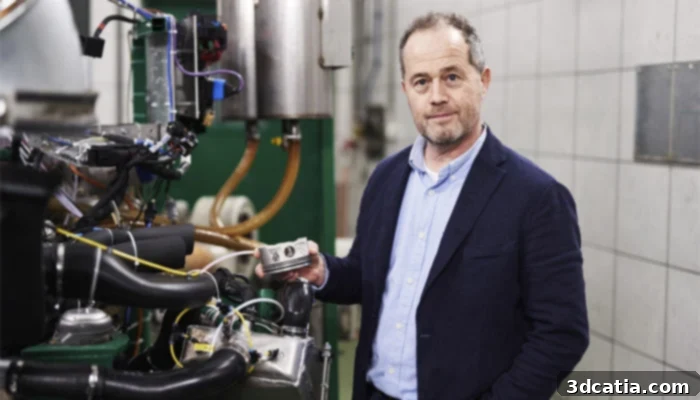
Frank Ickinger proudly displaying a 3D printed piston, a testament to Porsche’s innovation. (Image credits: Porsche)
Porsche’s Long-Standing Engagement with Additive Manufacturing
Porsche’s journey with additive manufacturing technology dates back much further than many might assume, stretching into the early 1990s. During that period, the technology was more commonly known as “Rapid Prototyping,” and it quickly became an invaluable tool for our prototyping efforts in the development processes for both plastic and metal components. From those early days, we recognized its transformative potential. Today, what was once a prototyping tool is rapidly evolving into an industrialized production method, and we are committed to realizing its comprehensive capabilities across various facets of Porsche’s operations.
Our approach to additive manufacturing at Porsche is structured around three core industry groups: product innovation, process innovation, and new business models. Each group represents a distinct avenue through which we leverage this technology to enhance our offerings and operations:
- Product Innovation: This area focuses directly on enhancing the product itself. For example, additive manufacturing allows us to create components that are significantly lighter, incorporate advanced functional integrations, and achieve optimized geometries. This is particularly crucial for our small series productions and specialized vehicles, such as our acclaimed GT cars, where every gram and every performance advantage counts. The ability to create complex internal structures or optimize material distribution directly translates into superior vehicle dynamics and efficiency.
- Process Innovation: Here, the emphasis is on revolutionizing our development and manufacturing workflows. Additive manufacturing enables more agile development cycles, allowing for quicker iterations and design refinements. It also facilitates decentralized production strategies, meaning we can potentially produce parts closer to the point of need or customize production runs more efficiently. This agility greatly reduces lead times and enhances our responsiveness to design changes or market demands.
- New Business Models: This group explores innovative ways to interact with our customers and deliver unique value. A prime example is the ability to 3D print bespoke, specialized products or components for customers who have ordered specific cars. This opens up possibilities for unprecedented levels of personalization and aftermarket support, further cementing the emotional connection between our brand and our clientele. Imagine a custom-designed interior component or a performance-optimized part tailored precisely to a customer’s preferences.
While we actively utilize a diverse range of additive manufacturing technologies and materials, it’s important to note that Porsche does not maintain an extensive in-house machine park for large-scale production. We do operate a smaller number of 3D plastic printers, primarily dedicated to our prototyping department, allowing for rapid iteration in early design phases. For more complex or production-oriented metal additive manufacturing, we collaborate closely with specialized partners. This strategic approach allows us to remain highly agile and leverage the most advanced capabilities available in the market without the immense overhead of managing a vast array of proprietary systems. We meticulously monitor the latest news and technological advancements across various additive manufacturing processes to ensure we are always at the forefront of innovation.
The Genesis of 3D Printed Pistons: Why Additive Manufacturing?
Our initial strategic focus for deploying additive manufacturing in a production context is on our small series vehicles, particularly our GT cars, which are produced in limited quantities. These vehicles inherently demand superior performance and exceptional efficiency, pushing the boundaries of engineering. To achieve these lofty goals, it becomes imperative to optimize certain critical engine components for peak performance. The 3D printed pistons project for the 911 GT2 RS served as a crucial exploratory initiative. Our primary objective was to rigorously assess the feasibility and benefits of utilizing 3D printing to design and produce powertrain components that endure extreme stress, such as pistons. We aimed to capitalize on every advantage that additive manufacturing technology could offer.
Through this project, we successfully leveraged additive manufacturing to achieve two primary, impactful improvements:
- Significant Weight Reduction: We managed to make the piston 10% lighter than its conventionally manufactured counterpart. This reduction in reciprocating mass directly contributes to higher engine rev limits, improved throttle response, and overall enhanced engine dynamics. Less mass moving up and down means less inertia to overcome, translating to a more responsive and powerful engine.
- Integrated Cooling Duct: Perhaps even more critically, additive manufacturing allowed us to incorporate a highly intricate, closed cooling duct directly into the piston’s internal structure. This complex internal geometry, impossible to achieve with traditional casting or forging methods, significantly reduces the piston’s temperature during operation. Lower operating temperatures enhance engine efficiency, improve durability, and allow for higher performance outputs without compromising reliability. This innovative design directly contributes to the GT2 RS’s unparalleled performance and efficiency benchmarks.
These advancements validate our belief that additive manufacturing is not just an alternative production method, but a vital enabler for next-generation automotive performance.
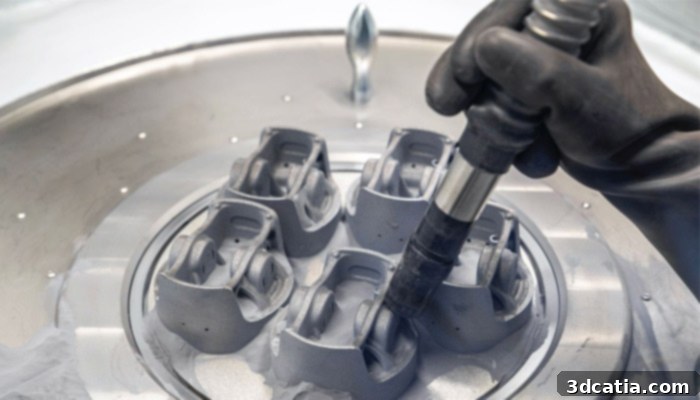
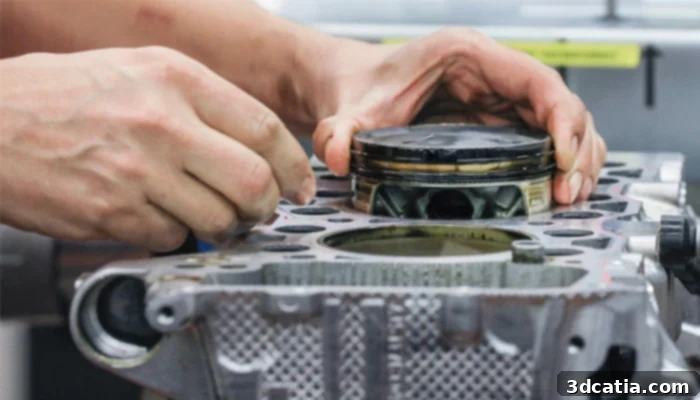
Close-up view of the intricately designed 3D printed pistons. (All image credits: Porsche)
Navigating the Challenges of Additive Manufacturing for High-Performance Components
While additive manufacturing offers immense advantages, its implementation for critical, highly stressed components like pistons is not without its challenges. The primary difficulties we encountered revolved around the precise calibration of material parameters and process development. For this specific application, we opted for a specialized aluminum alloy, developed in collaboration with Mahle, an industry leader in engine components. This alloy was chosen for its superior properties, specifically tailored to withstand the extreme thermal and mechanical loads experienced by a piston in a high-performance engine. However, working with such a specialized material in an additive process meant that established printing parameters were insufficient.
Consequently, we had to embark on an intensive development phase to establish entirely new, optimized parameters for the printing process. This crucial work was expertly carried out by our manufacturing partner, Trumpf, a renowned specialist in laser technology and metal 3D printing. The process of fine-tuning laser power, scan speed, layer thickness, and other variables to achieve the desired material density, surface finish, and mechanical properties was incredibly complex and demanding. It required extensive experimentation, testing, and iterative adjustments to ensure the final 3D printed piston met Porsche’s stringent quality, durability, and performance standards. This collaborative effort underscored the importance of strong partnerships and deep expertise in both material science and additive manufacturing processes to overcome such advanced engineering hurdles.
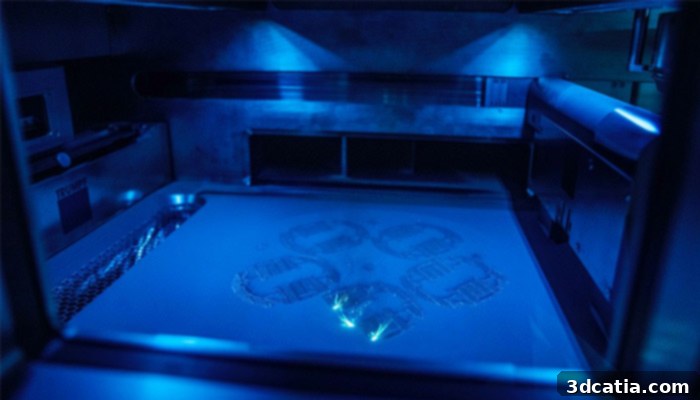
Trumpf’s advanced 3D printers were instrumental in the precise manufacturing of the Porsche pistons.
The Design for Additive Manufacturing (DfAM) Process for Porsche Pistons
To successfully design and produce these highly optimized pistons, we implemented a sophisticated, end-to-end Design for Additive Manufacturing (DfAM) workflow. This method is highly iterative and leverages advanced digital tools to fully exploit the design freedom offered by 3D printing:
- Initial Design in CATIA: The process begins in CATIA, our primary CAD software, where the initial conceptual design of the piston is established. This stage defines the fundamental geometry and functional requirements.
- Topological Optimization: From CATIA, the design data is then fed into a topology optimization software. This powerful tool algorithmically generates an optimized shape by removing unnecessary material, based on predefined load cases and boundary conditions. The goal is to achieve maximum structural efficiency with minimum material, resulting in complex, organic geometries that are inherently lightweight and strong.
- STL File Generation: The topologically optimized geometry is then converted into an STL (Standard Tessellation Language) file, which is a standard format for 3D printing, representing the surface geometry as a collection of triangles.
- Redesign and Refinement in CATIA: The optimized STL data is then brought back into CATIA. Here, our engineers perform a “redesign” of the topologically optimized shape. This step involves smoothing the organic forms, ensuring manufacturability within the constraints of the 3D printing process, and integrating any features that were not fully captured during the algorithmic optimization. It’s a crucial stage for translating theoretical optimization into a practical, high-quality component.
- 3D Printer Software and Support Structure Generation: Finally, the refined CATIA model is imported into the 3D printer’s proprietary software. At this stage, engineers define print parameters and, critically, design the necessary support structures. These temporary structures are essential for anchoring the part to the build plate and supporting overhanging features during the printing process to prevent deformation. The optimal placement and design of supports are vital for print success and post-processing efficiency.
This entire sequence constitutes an iterative loop. After each design and simulation cycle, the part is analyzed, and adjustments are made until the team achieves the final, validated geometry that meets all performance, durability, and manufacturing requirements. This comprehensive and iterative DfAM methodology has proven to be highly effective in unlocking the full potential of additive manufacturing for such demanding applications.
The Future of Additive Manufacturing in the Automotive Industry
My conviction is firm: additive manufacturing will, without a doubt, become an indispensable and integral component of both automotive development and production. I anticipate this transition will be complete within the next ten years at the very latest, and I urge everyone to “stay curious,” as I believe it will surely happen even sooner than generally expected. The pace of innovation in this field is accelerating rapidly, and its implications for the automotive sector are profound.
Beyond high-performance pistons, additive manufacturing offers a myriad of applications that will reshape the industry. We can foresee its extensive use in:
- Prototyping and Tooling: Further enhancing rapid prototyping capabilities and creating complex, customized tools and jigs for conventional manufacturing lines, reducing costs and lead times.
- Spare Parts and Legacy Car Support: Producing on-demand spare parts for older or classic car models, ensuring their longevity and reducing the need for extensive inventory. This also applies to highly specialized or low-volume components.
- Customization and Personalization: Offering unprecedented levels of interior and exterior customization for consumers, from bespoke trim pieces to ergonomically tailored components.
- Functional Integration: Designing multi-material components or parts with integrated electronics, sensors, or fluid channels, leading to more compact and efficient systems.
- Weight Reduction Across the Board: Applying DfAM principles to more and more components beyond powertrains, significantly contributing to vehicle efficiency and performance through extensive lightweighting.
The ability to produce complex geometries, integrate multiple functions into a single part, and respond with agility to design changes makes additive manufacturing a game-changer. It represents a paradigm shift from traditional subtractive and formative manufacturing, offering unparalleled design freedom and production efficiency. Porsche’s pioneering work with 3D printed pistons is just one example of how this technology is not only meeting current demands but also paving the way for the future of mobility. You can find more detailed information about our innovative 3D printed pistons HERE.
What are your thoughts on Porsche’s strategic adoption of additive manufacturing in its high-performance vehicle production? We encourage you to share your insights and comments below, or engage with us on our Facebook and Twitter pages! For all the latest news and developments in the fascinating world of 3D printing, remember to sign up for our free weekly Newsletter, delivered straight to your inbox!