
Revolutionizing Wearable Tech: Direct 3D Printing of Electronics on Human Skin
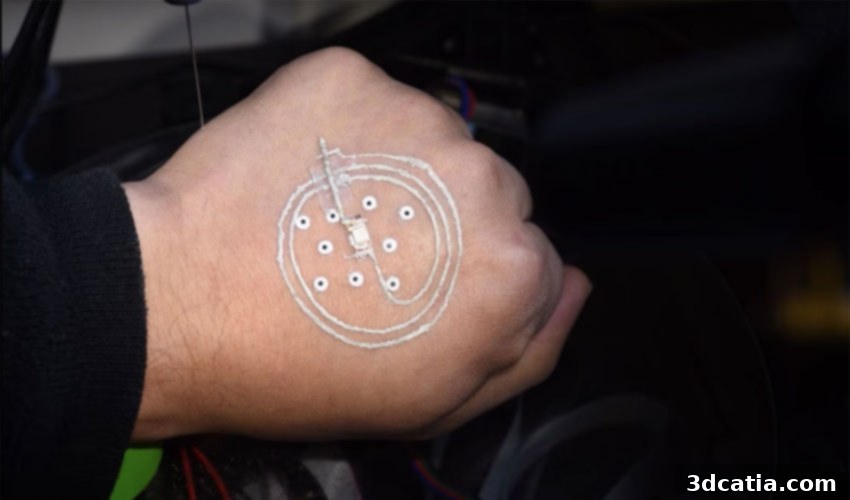
Pioneering researchers at the University of Minnesota have achieved a remarkable scientific breakthrough, successfully developing a method to 3D print functional electronic components directly onto human skin. This groundbreaking innovation utilizes a low-cost, portable desktop 3D printer to produce custom electronics right on the back of a person’s hand. While the profound implications of this technology might not be immediately obvious, the research team highlights its potential to enable the creation of chemical sensors or other electronic devices directly on the user, irrespective of their environment or specific needs. This capability opens up a world of possibilities for personalized, on-demand electronics, pushing the boundaries of what was previously considered achievable in the realm of wearable technology.
The field of 3D printed electronics has been rapidly advancing, with key players such as Nano Dimension and Nascents Objects driving innovation to create smaller, faster, and more responsive electronic parts. However, integrating this technology directly onto human skin presents unique challenges and opportunities. Traditionally, 3D printing electronics involves precise manufacturing processes in controlled environments. The University of Minnesota’s achievement signifies a paradigm shift, combining the advantages of 3D printed electronics with the unprecedented capability of direct-to-skin application. This fusion of technologies promises to unlock immense potential, paving the way for truly adaptive and personalized electronic solutions that conform to the body’s natural contours and movements.
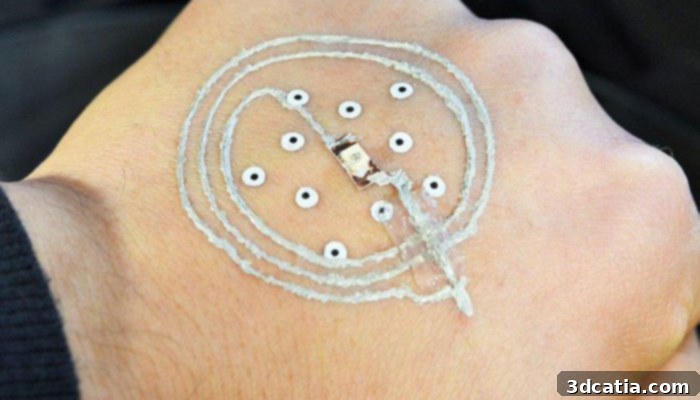
The lead author of the study, Michael McAlpine, a Benjamin Mayhugh professor of mechanical engineering at the University of Minnesota, expressed profound enthusiasm for this novel technology. “We are incredibly excited about the potential of this new 3D printing technology, particularly because it utilizes a lightweight, portable printer that costs less than $400,” McAlpine stated. He vividly illustrated the transformative impact, adding, “Imagine a soldier deploying a 3D printer from their backpack and instantly fabricating a chemical sensor or other vital electronics directly onto their skin. This is the future ‘Swiss Army knife’ – all you would need is this portable 3D printing tool to address diverse challenges in the field. It represents a significant leap towards truly flexible and adaptive technology that can be deployed anywhere, anytime, to meet immediate demands.” This vision underscores the practicality and versatility of the invention, moving beyond static lab environments to dynamic, real-world applications where rapid, on-demand electronic fabrication can be life-saving or profoundly beneficial.
The Ingenious Process Behind Direct-to-Skin 3D Printing
Understanding how this revolutionary process functions reveals the innovative solutions developed by the research team. The first crucial step involves creating temporary markers directly on the skin. These markers serve as precise reference points, enabling the 3D printer to accurately digitize the three-dimensional contours of the skin. This initial mapping is critical because human skin, particularly on areas like the hand, is not a flat, static surface. Furthermore, even when an individual attempts to remain perfectly still, minor involuntary movements are inevitable.
To counteract these natural movements and ensure printing accuracy, the 3D printer is ingeniously equipped with a sophisticated motion sensor. This sensor actively tracks the temporary markers on the skin, allowing the printer to adjust its trajectory and printing parameters in real-time. This dynamic compensation mechanism is vital for preventing errors during the 3D printing process, ensuring that even with slight, unintentional hand movements, the electronic components are deposited with precision. This adaptive capability is a cornerstone of the technology, differentiating it from conventional 3D printing methods that demand absolute stillness and controlled environments.
McAlpine elaborated on this critical feature, stating, “No matter how hard you try to stay still, you’re still going to move your hand slightly. Besides, every hand is different, with its own unique topology.” He continued, “Our 3D printer follows the markers along the hand, allowing it to adjust in real time to the movements and contours of the hand.” This ability to dynamically adapt to the skin’s surface and movement is what makes direct-to-skin printing feasible and reliable. Once printed, the electronic components demonstrate remarkable convenience: they can be effortlessly removed with tweezers or simply washed away with water, offering a temporary yet highly functional solution.
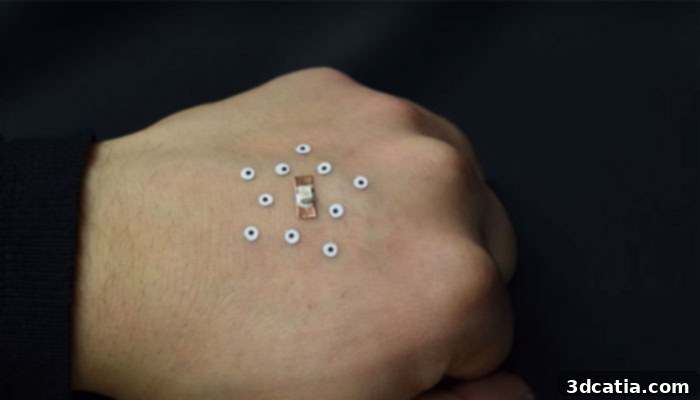
The markers are first placed on the hand to guide the 3D printing process.
This innovative process would not have been possible without the development of a highly specialized ink. The research team specifically formulated a silver flake ink that possesses unique properties tailored for direct-to-skin application. Unlike many conventional electronic inks, which typically require high temperatures to cure and solidify – a process that would undoubtedly cause severe burns to human skin during extrusion – this novel ink polymerizes efficiently at room temperature. This crucial characteristic ensures the safety and comfort of the user, making it perfectly suitable for direct application onto the skin. The development of this biocompatible, low-temperature curing ink represents a significant material science achievement, enabling the practical realization of on-skin electronics.
The Medical Revolution: How On-Skin 3D Printing Could Transform Healthcare
Beyond immediate field applications, the potential for this 3D printing technology to usher in a medical revolution is particularly compelling. The same engineering team collaborated with Jakub Tolar, a distinguished expert in treating rare skin conditions within the Department of Pediatrics at the University of Minnesota. This collaboration has already yielded significant advancements, particularly in the realm of direct 3D printing on skin for biological applications. Through the use of biotin, the researchers successfully demonstrated the ability to print organic cells directly onto a wound on the skin of a mouse. This groundbreaking experiment showcased the technology’s capability to not just print electronics, but also to facilitate biological regeneration.
The future implications for wound healing are immense. Imagine a portable 3D printer being used in emergency situations or remote areas to apply custom-designed layers of cells and growth factors directly to a wound, accelerating the healing process and minimizing scarring. This personalized approach could bypass the need for complex bandages or grafts, offering immediate and precise biological intervention. Furthermore, the development of this 3D technology could lead to entirely new medical treatments for a wide range of dermatological conditions. For instance, customized patches for delivering medication directly into the skin, or sensors that monitor wound progression and infection markers in real-time, could become commonplace.
Direct 3D printing on skin also holds promise for facilitating skin transplants and intricate skin treatments. By precisely mapping and printing living cells or scaffolds directly onto damaged areas, the technology could reduce the complexity and improve the success rates of skin grafting procedures. It could enable the creation of personalized skin substitutes that perfectly match a patient’s genetic makeup, minimizing rejection risks. For chronic skin conditions or extensive burn victims, this technology offers a vision of customized, on-demand skin regeneration that adapts to the unique contours and needs of each patient, fundamentally transforming the landscape of regenerative medicine and personalized healthcare.
Broader Implications and Future Outlook
The University of Minnesota’s achievement in 3D printing electronics directly on human skin represents a significant leap forward in several fields, from military applications and remote sensing to medical diagnostics and regenerative medicine. The development of low-cost, portable printers coupled with adaptable motion-sensing technology and biocompatible inks addresses critical challenges that have previously limited the widespread adoption of on-skin electronics. This innovation paves the way for a future where electronic devices are not merely worn, but seamlessly integrated with the human body, providing real-time data, immediate intervention, and personalized solutions.
While the initial focus has been on chemical sensors and wound healing, the potential applications extend far beyond. This technology could enable continuous health monitoring systems, capable of tracking vital signs, glucose levels, or other biomarkers with unprecedented accuracy and comfort. Imagine flexible displays printed onto the skin for augmented reality applications, or communication devices that eliminate the need for cumbersome handheld gadgets. The ability to print complex circuits directly onto a dynamic, living surface unlocks possibilities for highly customized prosthetics, smart bandages that release medication as needed, or even biosensors that detect early signs of disease through minute changes in sweat composition.
However, with such transformative technology come important considerations. Long-term durability and the exact biocompatibility of the printed electronics need further extensive testing. Questions regarding data privacy for continuously monitored biometric data, and the ethical implications of body-integrated electronics, will also need to be carefully addressed as the technology matures. Nevertheless, the foundation laid by the University of Minnesota researchers is robust, suggesting a future where our skin becomes an interactive canvas for personalized, intelligent, and adaptive electronic functionalities, blurring the lines between the biological and the technological in truly innovative ways.
The full study detailing these findings can be accessed through the Wiley Online Library. For a visual overview and further insights into the technology, you can watch the following video:
What are your thoughts on the revolutionary potential of direct 3D printing of electronics on human skin? We invite you to share your perspectives and comments below, or engage with us on our Facebook and Twitter pages! Don’t forget to sign up for our free weekly Newsletter to receive all the latest news and innovations in 3D printing directly to your inbox!