

Revolutionizing Infrastructure: Nijmegen Unveils Europe’s Longest 3D Printed Concrete Pedestrian Bridge
The future of sustainable infrastructure is taking tangible form in the Netherlands, with the installation of a groundbreaking 3D printed concrete bridge in Nijmegen. Known as The Bridge Project, this innovative structure, measuring an impressive 29 meters (approximately 31.7 yards), stands as one of the longest concrete bridges ever built using additive manufacturing specifically for pedestrians and cyclists. Launched in 2019 through a collaborative effort between Rijkswaterstaat, the Dutch Directorate-General for Public Works and Water Management, Studio michiel van der kley, and the Technical University Eindhoven, this project is far more than just a new piece of urban infrastructure. It represents a significant leap forward in construction technology, pushing the boundaries of concrete 3D printing and fostering new models of collaboration within the building sector.
The selection of Nijmegen as the bridge’s location is highly symbolic and strategic. The city earned the prestigious title of European Green Capital in 2018, underscoring its commitment to environmental sustainability and innovative urban development. This aligns perfectly with the project’s ambition to explore cheaper, more environmentally friendly construction methods and reduce the ecological footprint of infrastructure development. Beyond its immediate architectural appeal, The Bridge Project aims to pioneer innovative techniques that could transform how we approach building, paving the way for more efficient, sustainable, and aesthetically unique structures globally. This initiative reinforces the Netherlands’ reputation as a global leader in embracing advanced manufacturing for civil engineering challenges.
For those familiar with advancements in digital construction, the concept of a 3D printed bridge might not be entirely new, especially within the Netherlands. The nation has consistently been at the forefront of integrating 3D technologies into construction and architecture. A notable example is the pioneering work of MX3D, a company that garnered international attention for presenting one of the world’s first 3D-printed steel bridges, elegantly spanning one of Amsterdam’s historic canals. More recently, the city of Rotterdam saw the unveiling of another innovative 3D printed pedestrian bridge, this time crafted from advanced composite materials. These projects collectively demonstrate a national drive towards exploring the full potential of additive manufacturing in creating resilient, sustainable, and visually appealing infrastructure. The Bridge Project in Nijmegen continues this proud tradition, pushing the envelope further with concrete.
Michiel van der Kley, the visionary designer behind The Bridge Project, articulates the compelling rationale for choosing additive manufacturing over conventional construction techniques. He explains, “For a few years, here at the studio we keep wondering what you could do with a 3D printer that you could not do any other way. We are looking at and researching what we could do with a concrete 3D printer that hasn’t been done yet…What we did is, choosing a shape that would be almost impossible to make with a regular method. A shape that has its equivalent in Nature. The legs seem to merge into the deck, the way a branch would grow out of a tree. Only material where it is needed. Just the way any shape would evolve in nature over time.“ This statement highlights a profound commitment to biomimicry – drawing inspiration from natural forms and processes – to achieve both structural integrity and unique aesthetics. The organic merging of the bridge’s elements, reminiscent of a tree branch, showcases how 3D printing liberates designers from the limitations of traditional molds and forms, allowing for complex geometries that optimize material use and blend harmoniously with the environment. This design philosophy not only creates visually stunning structures but also inherently leads to more efficient use of resources, by placing material precisely where it is structurally required.
First impressions of the bridge (photo credits: Omroep Gelderland)
Parametric Design: The Crucial Foundation for Digital Construction
In a project of this ambition and complexity, the design phase emerges as a particularly critical and fascinating aspect. The choice of using parametric design software was fundamental, enabling the team to model and analyze all influencing factors simultaneously. This advanced approach allows engineers and designers to define relationships between various design elements and parameters, rather than creating static geometry. This means that variables such as applied loads, material resistance, anticipated pedestrian and bicycle traffic volume, environmental conditions, and even future adaptability can all be integrated and iterated within a single 3D model. Every calculation and structural analysis can be performed with unprecedented accuracy, leading to a highly optimized and robust design. This digital workflow dramatically reduces the potential for errors and facilitates a more comprehensive understanding of the structure’s performance under various conditions.
The intricate parametric modeling for The Bridge Project was expertly executed by Summum Engineering, a Netherlands-based consultancy specializing in structural design, engineering, and optimization. Their extensive portfolio includes optimizing architectural, construction, and engineering projects with a strong focus on reducing material consumption. This includes designing lightweight structures, fostering sustainable building practices, and developing intricate art installations, making them an ideal partner for such an innovative bridge. Furthermore, Witteveen+Bos, another key contributor, played a vital role in translating Van der Kley’s conceptual 3D model into a structurally feasible, 3D printable geometry. This crucial step involved rigorous analysis to ensure that the design not only met the aesthetic and functional requirements but also strictly adhered to all relevant building regulations and safety standards – a paramount consideration in any construction project, and especially so when venturing into the relatively new domain of 3D printing construction. Their expertise guaranteed that the innovative design was also practically sound and compliant with existing codes, bridging the gap between artistic vision and engineering reality.
While the initial design specifically caters to cyclists and pedestrians, with its 29-meter span, the inherent flexibility of parametric design means the underlying principle can be scaled and adapted for different applications. The project teams have already envisioned how the core design could be modified for vehicle traffic. Such an adaptation would entail adjusted dimensions, potentially larger and more numerous support piers, and different material specifications, but the foundational parametric model remains highly versatile. By simply modifying the input parameters, an entirely new structure – perhaps a car bridge or even a larger pedestrian overpass – could be generated, significantly reducing design time and costs for future projects. This adaptability underscores one of the key advantages of digital design and additive manufacturing: the ability to customize and scale designs efficiently, offering a powerful tool for addressing diverse infrastructure needs in the future.
Following the meticulous design phase, the project moves into the actual construction stage, where the strategic advantages of additive manufacturing truly come to light. Rijkswaterstaat emphasizes the broader implications of adopting such technologies: “At RWS we presume that there will be lesser and lesser hands to build the bridges we need and this technique might fill in on the matter. We talk about and discuss robotizing the building environment. The technique will be cheaper than traditional ways of building in the near future; we can reduce the costs of failure because much more is done beforehand, and with computerized processes.” This highlights a proactive approach to addressing anticipated labor shortages in traditional construction and embracing the inevitable shift towards a more automated, roboticized building environment. By leveraging 3D printing, Rijkswaterstaat aims to create a more resilient and efficient construction industry. The promise of cost reduction is significant, stemming from several factors: minimized material waste, optimized designs requiring less raw material, and the ability to detect and rectify potential issues digitally during the extensive pre-construction planning phase. Computerized processes inherently lead to fewer on-site mistakes and reworks, which are major drivers of increased costs and delays in conventional projects. This precision and predictability are invaluable.
Furthermore, 3D printing perfectly aligns with Rijkswaterstaat’s ambitious environmental goals. Concrete additive manufacturing has repeatedly demonstrated its capacity to significantly reduce CO2 emissions and conserve materials. Traditional concrete production is known for its substantial environmental impact, but 3D printing offers a paradigm shift. By depositing concrete only where it is structurally necessary, material waste can be dramatically cut – some studies suggest by as much as 30-60%. This reduction in material usage directly translates to lower embodied energy and fewer CO2 emissions associated with concrete manufacturing and transport. Moreover, the ability to use specialized, fast-setting, and sometimes recycled concrete mixes further enhances the sustainability profile of 3D printed structures. This makes the technology not just an economic advantage but a powerful tool in achieving a greener, more sustainable construction sector, vital for tackling climate change and promoting responsible resource management.
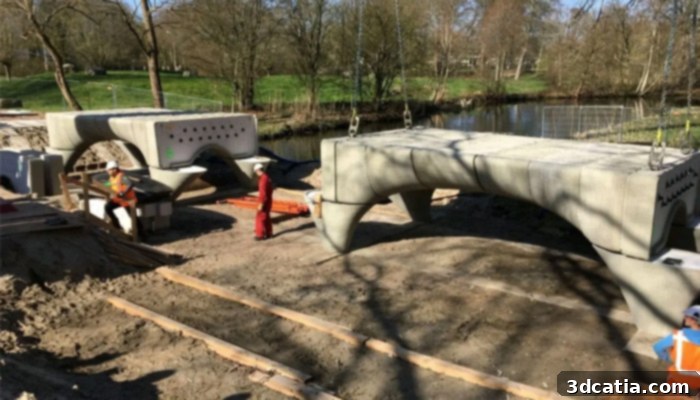
The installation of the bridge has begun
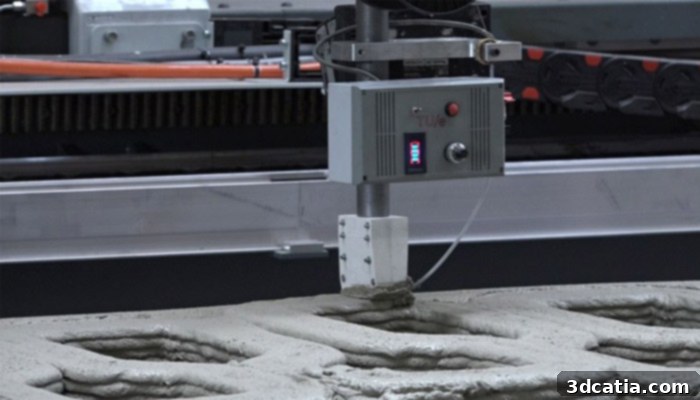
The journey from concept to physical structure began with an initial prototype printed by the Technical University of Eindhoven, serving as a crucial proof of concept and testbed for the technology and material properties. Building upon this foundational work, the final bridge sections were manufactured by BAM, a leading European construction company, at the Weber Beamix concrete 3D printing center. This state-of-the-art facility, operational since January 2019, represents a significant investment in industrial-scale concrete additive manufacturing. The bridge itself was printed in multiple modular blocks, a common strategy for large-scale 3D printed structures that allows for off-site fabrication under controlled conditions, followed by efficient assembly on site. While the exact number of parts or the precise duration of the printing and assembly process were not specified by the partners, the successful realization of this 29-meter bridge is a testament to the maturity of the technology and the effectiveness of the collaborative approach. Crucially, the project is envisioned not as a one-off experiment but as a scalable model, intended to be replicated and adapted for similar infrastructure needs in other cities across the Netherlands and potentially beyond. This replicability underscores the long-term vision of The Bridge Project: to establish a blueprint for future digital construction initiatives.
This innovative 3D printed concrete bridge in Nijmegen signifies a pivotal moment for civil engineering and sustainable urban development. It demonstrates how collaboration between government agencies, academic institutions, and private industry can push the boundaries of what’s possible, delivering not just functional infrastructure but also architectural landmarks that inspire. The project showcases the power of digital design tools, the efficiency of additive manufacturing, and the potential for a greener, more automated future in construction. As cities worldwide grapple with aging infrastructure, resource constraints, and environmental imperatives, solutions like The Bridge Project offer a compelling vision for modern, resilient, and sustainable urban landscapes. Further details and insights into this pioneering venture can be explored HERE.
What are your thoughts on this remarkable 3D printed bridge and its implications for the future of construction? Share your perspectives in the comments below or join the conversation on our Linkedin, Facebook and Twitter pages! Don’t miss out on the latest advancements in additive manufacturing – sign up for our free weekly Newsletter here, delivering the most important 3D printing news directly to your inbox! You can also find all our engaging videos and project insights on our YouTube channel.