
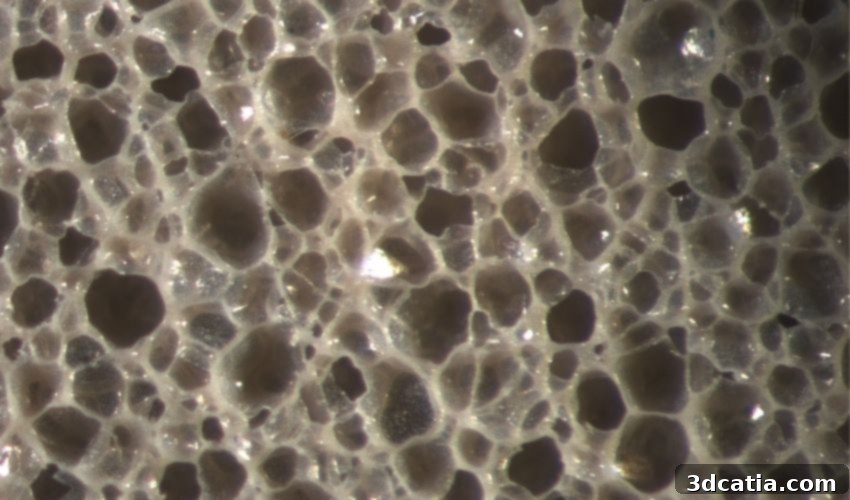
PrintFoam Revolutionizes 3D Printing with Industrial-Scale Resin Foam Technology
The dynamic landscape of additive manufacturing is constantly evolving, with innovators pushing the boundaries of what’s possible in material science and production methodologies. A significant leap forward was recently announced by PrintFoam, an innovative start-up founded by brilliant alumni from MIT in Cambridge, Massachusetts. The company has unveiled a groundbreaking development: the world’s first printer hardware specifically engineered for the industrial-scale printing of resin foams. Of all the additive manufacturing materials available on the market today, 3D printable foams have largely remained an untapped frontier, often overlooked by most 3D printing manufacturers. This oversight is particularly striking in an era where the imperative for lightweight, structurally efficient materials has reached unprecedented levels. Industries across the board, from the demanding aerospace sector, where every gram impacts fuel efficiency and payload capacity, to the burgeoning fields of 3D printed homes and furniture, are relentlessly seeking innovative materials that offer superior strength-to-weight ratios compared to traditional alternatives. Responding directly to this critical market demand, Mathew Pearlson, a visionary principal and co-founder of PrintFoam, spearheaded the development of this pioneering printing device, promising to unlock new possibilities in large-scale, lightweight material fabrication.
PrintFoam’s journey from an ambitious concept to an industrial-scale reality has been marked by persistent innovation and a clear strategic vision since its inception just a few years ago. The genesis of this revolutionary technology can be traced back to Mathew Pearlson‘s tenure at MIT’s Laboratory for Aviation and the Environment. During his research, which initially focused on the renewal of jet fuels, Pearlson experienced a profound realization. He concluded that true environmental success in aviation would not primarily hinge on altering fuel sources alone, but rather on drastically reducing the overall weight of aircraft and, by extension, the entire industry’s material footprint. This insight became the guiding principle for his subsequent endeavors, steering his focus towards lightweight materials.
With this fundamental understanding firmly in mind, Pearlson pivoted his research focus, embarking on a mission to adapt and modify the existing stereolithography (SLA) process for the purpose of printing with foam. Stereolithography, a well-established additive manufacturing technique, typically involves using a UV laser to cure photopolymer resin layer by layer, creating solid 3D objects. Pearlson’s challenge was to transform this process to accommodate the unique characteristics required for foam structures. His initial concept for the foam printing project was rigorously tested over a holiday vacation, demonstrating its feasibility. Following this successful proof of concept, he dedicated himself to perfecting the technology on an industrial desktop SLA machine. Mathew Pearlson eloquently explained their breakthrough: “By employing a unique combination of novel optical patterning techniques, and crucially, by departing from a standard vat printing process, we discovered it was indeed possible to produce plywood-sized sheets of 3D printed foam in a remarkably short period – a matter of minutes.” This innovative approach not only addressed the material challenges but also vastly improved the speed and scalability of foam production, laying the groundwork for widespread industrial adoption.
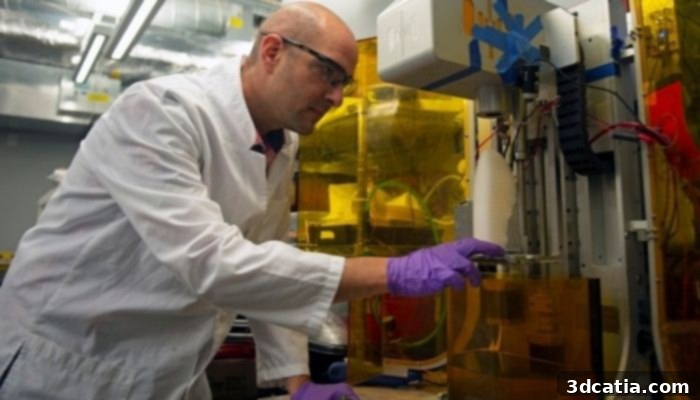
Mathew Pearlson, principal and co-founder of PrintFoam (photo credits: MIT)
Introducing Revolutionary Foam 3D Printing Technology to Broader Industrial Markets
PrintFoam’s proprietary resins have been a subject of keen interest within the additive manufacturing community for several years, consistently demonstrating remarkable performance enhancements and accelerating production speeds across a multitude of applications. These unique resins have showcased amazing capabilities, from superior cushioning properties to improved thermal insulation, making them ideal for various specialized uses. Despite these evident advantages, a significant hurdle persisted: larger 3D printing platforms faced considerable challenges in effectively integrating this distinct resin technology into burgeoning new markets. This limitation underscored a critical void in the industry that PrintFoam’s new hardware now aims to comprehensively fill.
Dr. David Walker, a respected authority in the field, co-founder of Azul 3D, and the executive chairman of the Photopolymer Additive Manufacturing Alliance, provided profound insight into the significance of PrintFoam’s innovation. He remarked, “It really is remarkable, and I haven’t seen anything like it. Everyone in the field is attempting to mimic the behavior of traditional foams using plastic lattices produced by computational models. These models keep telling engineers to generate lattices with smaller struts and smaller unit-cell. In essence, the computer is screaming at the engineer to stop what they’re doing and use a foam for the application. As a community, we haven’t been listening and acting on this.”
Dr. Walker’s statement highlights a fundamental disconnect within the industry. For years, engineers have utilized complex computational modeling to design intricate lattice structures out of solid plastics, hoping to achieve the lightweight and energy-absorbing properties of foams. However, these models invariably point towards designs that become increasingly difficult, if not impossible, to produce with conventional 3D printing methods – requiring infinitesimally small struts and unit cells that push the limits of resolution and structural integrity. PrintFoam’s technology directly addresses this by enabling the direct 3D printing of actual foams, bypassing the need for computationally intensive and manufacturing-challenging lattice approximations. This paradigm shift means industries can finally leverage the inherent benefits of foam – including superior cushioning, robust thermal insulation, effective acoustic dampening, and significantly reduced weight – without the compromises typically associated with solid plastic alternatives. This capability is not just an incremental improvement; it represents a foundational change in how lightweight functional materials can be designed and manufactured, paving the way for innovations in sectors ranging from automotive and aerospace to medical devices and consumer goods, where weight reduction and specific material properties are paramount.
The specialized 3D printer, which leverages PrintFoam’s unique resin foam technology, is currently undergoing meticulous design and refinement to precisely align with the diverse and demanding needs of its future customers. A primary focus in the production phase is ensuring that the final launched version of the device achieves optimal scale and speed, critical factors for widespread industrial adoption. PrintFoam recognizes that for truly industrial applications, speed of production combined with the ability to produce large parts is non-negotiable. While this pioneering technology is presently accessible through a limited beta program, PrintFoam is proactively engaging with and accepting a select number of new partnerships. This strategic approach allows the company to collaborate closely with industry leaders and innovative businesses, gathering invaluable feedback on real-world applications and performance. These collaborations are crucial for exploring specific design details, material properties, and operational parameters that will further enhance the 3D printer’s capabilities, making it even more effective and indispensable for widespread use within the broader additive manufacturing industry. The insights gleaned from these early partnerships are instrumental in fine-tuning the printer to meet the rigorous demands of various applications, ensuring it delivers unparalleled performance, reliability, and cost-effectiveness. PrintFoam anticipates that this collaborative development process will solidify its position as a leader in foam additive manufacturing, opening doors to unprecedented material possibilities for product development and industrial processes. To discover more about their transformative technology and partnership opportunities, interested parties are encouraged to visit the company’s official website HERE.

Photo Credits: MIT
PrintFoam’s innovative approach to industrial-scale 3D foam printing represents a significant milestone in additive manufacturing. This technology promises to unlock new frontiers for lightweight design and efficient production across countless sectors, from aerospace and automotive to construction and consumer goods. What are your thoughts on PrintFoam’s groundbreaking development and its potential impact on various industries? We invite you to share your insights and predictions in the comments section below. Stay connected and join the conversation on our Linkedin, Facebook, and Twitter pages. To ensure you never miss out on the latest advancements and news from the dynamic world of 3D printing, remember to sign up for our free weekly Newsletter here, delivering the most pertinent updates straight to your inbox. For a visual exploration of our content, you can also find all our compelling videos on our YouTube channel.
*Cover Photo Credits: Mdiproducts