
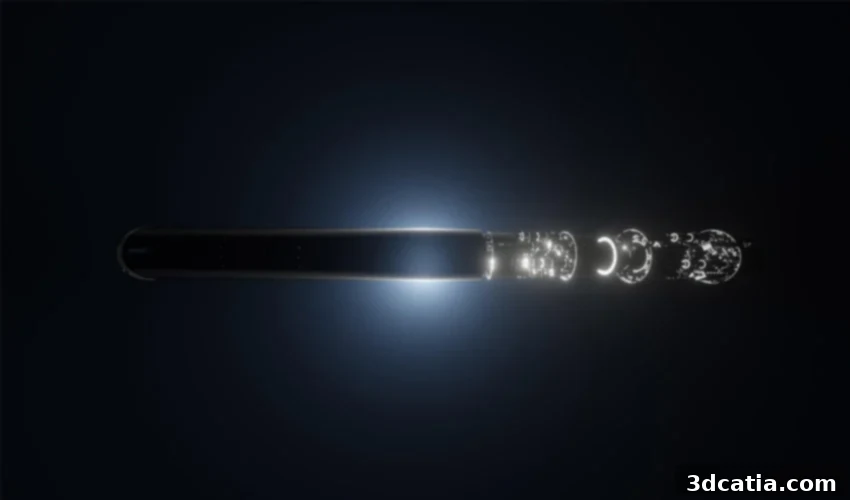
Swissloop Tunneling’s Groundhog Alpha: Revolutionizing Hyperloop Tunnel Construction with Integrated 3D Printing
The future of high-speed transportation hinges not only on innovative vehicle designs but also on the infrastructure that supports them. At the forefront of this infrastructural revolution is Swissloop Tunneling, an ambitious association of students from ETH Zurich. Their groundbreaking work aims to fundamentally transform the way tunnels are constructed, particularly for visionary projects like the Hyperloop. For many months, this dedicated team has been meticulously developing their “Groundhog Alpha” model, an impressive 7-meter (nearly 23-foot) long tunneling machine designed to carve out the subterranean pathways necessary for the Hyperloop system. Initiated by Elon Musk in 2013, the Hyperloop concept promises to redefine inter-city travel, linking distant locations in a matter of minutes.
What truly sets the Groundhog Alpha apart, and indeed makes it a fascinating leap forward in civil engineering, is its ingenious integration of advanced manufacturing technology. The machine incorporates an on-board polymer 3D printer, a feature that enables it to construct the tunnel wall as it excavates. This innovative process utilizes a high-strength, glass fiber reinforced composite material, allowing for the immediate creation of robust and structurally sound tunnel linings. This pioneering invention and the immense potential it represents earned Swissloop Tunneling a coveted spot in the finals of the “Not-a-Boring Competition,” a global challenge organized by Elon Musk himself in Las Vegas, aimed at fostering faster and more efficient tunneling solutions.
The Hyperloop concept is undeniably captivating, envisioning a world where major cities are connected within mere minutes, significantly reducing travel times and fostering economic growth. However, realizing this ambitious vision demands an equally ambitious and monumental undertaking in terms of infrastructure development. The sheer speed and power of the Hyperloop capsules necessitate entirely new systems, far beyond the capabilities of conventional rail networks currently prevalent in regions like the United States. A completely new infrastructure, based on a network of evacuated tubes, must be meticulously constructed to propel these magnetically levitated capsules at phenomenal velocities. This brings us to one of the most significant hurdles: the excavation of appropriate tunnels. Conventional tunneling methods are notoriously expensive, time-consuming, and logistically complex. The tubes themselves are often heavy, requiring extensive transportation over hundreds of miles to the digging site, further exacerbating costs and environmental impact. This intricate web of challenges has historically made it incredibly difficult to envision the Hyperloop concept in areas requiring extensive tunneling, as the process would be prohibitively slow and financially unsustainable. Recognizing these immense obstacles, innovators like the Swissloop Tunneling team are actively exploring and developing groundbreaking alternatives to traditional tunneling.
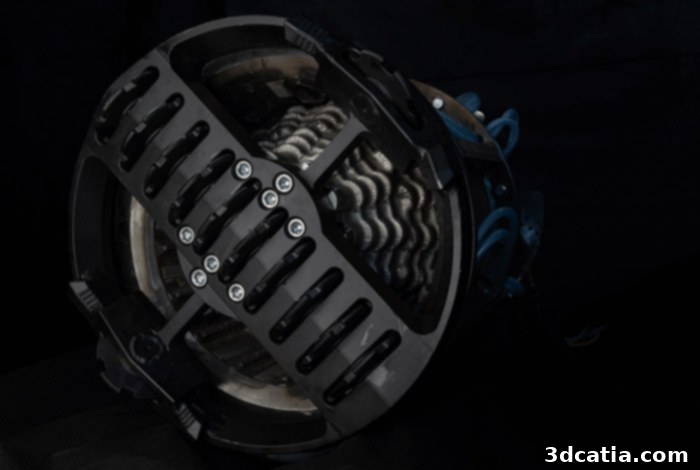
Photo Credits: Swissloop Tunneling
The impetus for many of these innovative tunneling projects stems directly from the initiatives led by The Boring Company, an enterprise also founded by Elon Musk. The Boring Company is dedicated to developing “Loop,” an ambitious underground public transport system designed to shuttle both people and goods at exceptionally high speeds, ranging from 200 to 240 kilometers per hour (approximately 125 to 150 mph). A critical bottleneck for The Boring Company’s vision is the speed and cost of tunnel construction. To address this, the company launched its international “Not-a-Boring Competition,” inviting teams from across the globe to develop and demonstrate more efficient and revolutionary tunneling solutions. Swissloop Tunneling’s participation and subsequent success in this competition underscore the potential of their Groundhog Alpha machine to meet these demanding requirements.
The Groundhog Alpha is not just a concept; it’s a meticulously engineered piece of machinery designed for optimal performance. Beyond its notable 7-meter length, the machine weighs 2.5 tons and boasts a diameter of 0.56 meters (56 cm), an appropriate size for its intended purpose of digging Hyperloop-compatible tunnels. Its powerful engine is capable of reaching an impressive speed of 3600 revolutions per minute (rpm), a rotational velocity comparable to that of a turbine blade in a Boeing 747, as highlighted by the Swissloop Tunneling team. This high-speed rotation is crucial for efficient excavation through various ground conditions. To ensure superior control and maneuverability during tunneling, the team has implemented six high-precision hydraulic cylinders for steering. Furthermore, sixteen additional hydraulic cylinders provide robust propulsion force, driving the machine forward with exceptional power. However, the most innovative aspect lies in its ability to create a strong, durable tunnel lining through integrated 3D printing.
The embedded polymer 3D printer within the Groundhog Alpha represents a paradigm shift in tunnel construction. This cutting-edge system is capable of designing and fabricating a 15 mm thick tunnel wall layer by layer, directly at the excavation front. This on-site, in-process manufacturing approach offers numerous advantages over traditional methods. By immediately applying a robust lining, the system ensures structural integrity throughout the tunnel, minimizing risks associated with ground instability and significantly enhancing worker safety. The material of choice for this innovative lining is fiberglass-reinforced composite, a popular and highly effective material known for its exceptional strength-to-weight ratio and cost-effectiveness. This composite material provides superior resistance to stress, moisture, and environmental degradation, guaranteeing the longevity and stability of the constructed tunnels. The ability to print tunnel walls on demand eliminates the logistical complexities and environmental footprint associated with transporting heavy, pre-fabricated concrete segments to remote digging sites. This streamlined process promises not only faster construction times but also substantial cost reductions, making projects like the Hyperloop more feasible than ever before. Furthermore, this additive manufacturing approach allows for greater flexibility and adaptability to varying geological conditions, potentially enabling the machine to adjust the wall structure or thickness in real-time if necessary.
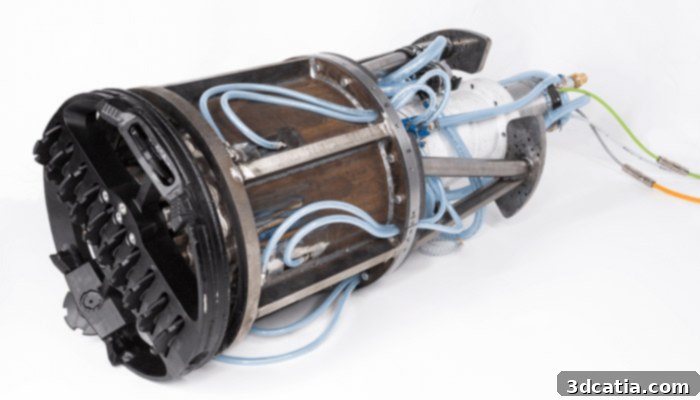
Part of the digging machine (photo credits: Swissloop Tunneling)
While the Swissloop Tunneling team has made incredible strides, the journey to full-scale Hyperloop tunnel construction is still ongoing. The team continues to refine their project, conduct extensive research, and perform rigorous testing to perfect their groundbreaking technology. However, the initial results and the proven concept are exceptionally promising, demonstrating a clear path towards a more efficient and sustainable future for tunneling. The integration of 3D printing into such a complex civil engineering endeavor is a testament to human ingenuity and the power of interdisciplinary collaboration. This approach could not only unlock the potential of Hyperloop but also revolutionize underground infrastructure development for various applications worldwide, from urban subways to utility conduits, reducing disruption and accelerating project timelines significantly. The potential economic and environmental benefits, including reduced material waste and emissions from transport, are immense.
For those keen to follow the ongoing advancements of this remarkable machine and its journey, you can visit the Swissloop Tunneling website HERE for detailed updates and technical insights into their progress. In the meantime, we eagerly await your thoughts and perspectives on the revolutionary integration of 3D printing technology into tunneling machines. Share your insights in the comments section below, or engage with us on our Facebook and Twitter pages. Don’t miss out on the latest innovations and breakthroughs in additive manufacturing; remember to sign up for our free weekly newsletter, delivering all the essential news in 3D printing directly to your inbox!