
Direct Ink Writing (DIW): A Comprehensive Guide to Materials, Processes, and Applications
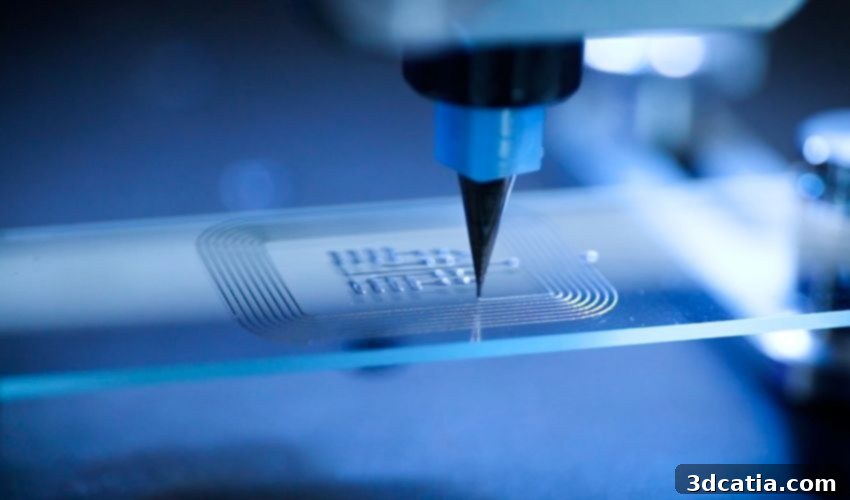
Direct Ink Writing (DIW) represents a cutting-edge additive manufacturing technique that leverages the extrusion of specialized inks. In this process, ink is meticulously dispensed through a fine nozzle, precisely following a digitally defined path. This allows for the creation of three-dimensional structures, built layer upon layer with remarkable accuracy. DIW distinguishes itself through its capability to print customizable inks at the meso- and microscale, catering to projects that demand intricate detail and precision, rather than large-scale production.
The foundation of DIW technology was laid in 1997, when Joe Cesarano and Paul Calvert at Sandia National Laboratory secured a patent for their innovative technique. They envisioned DIW as a method for constructing complex ceramic structures. Since its inception, DIW has evolved beyond its initial scope and found applications in diverse research areas and fabrication processes, extending beyond ceramics. While its primary use has been in research laboratories for small-scale fabrication and prototyping, DIW possesses the potential to produce efficient, industrial-grade parts. This comprehensive guide will delve into the intricacies of DIW, exploring its processes, materials, and applications, while also shedding light on its advantages and limitations.
How Direct Ink Writing Works: Processes and Materials
The fundamental workflow of DIW mirrors that of other 3D printing methodologies. It starts with a three-dimensional model, typically generated using computer-aided design (CAD) software. Subsequently, a slicing software is employed to create a movement path file, which dictates the nozzle’s trajectory during the printing process.
One of the key advantages of DIW is its material versatility. It can accommodate a broad spectrum of materials, provided that the ink exhibits the appropriate rheological behavior. Specifically, the ink must possess a suitable yield stress under shear and compression, coupled with desirable viscoelastic properties. This unique characteristic enables DIW to print a wide range of inks into complex 3D structures, characterized by high-resolution patterning, architectural flexibility, and tailored material characteristics. This flexibility sets DIW apart from other AM technologies like Fused Deposition Modeling (FDM) and Stereolithography (SLA), which are often constrained by material class limitations. The ability to utilize multiple nozzles further enhances DIW’s versatility, allowing for the creation of multi-material structures.
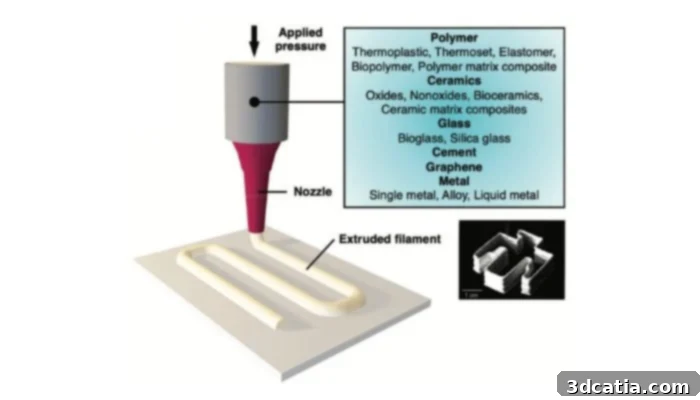
Overview of the direct ink writing process. (Image Credits: Sandia National Laboratory)
In DIW, the application of pressure forces liquid inks through the nozzle, and this pressure can influence the ink’s viscosity. Unlike some other 3D printing techniques that rely on heat, DIW operates at room temperature, making the rheological properties of the ink paramount. As the ink exits the nozzle, it is not entirely at rest but undergoes bending and stretching, influenced by the ratio between the extrusion rate and the speed of the printhead movements. Upon deposition, the ink undergoes solidification, either naturally or through external processes such as evaporation, phase changes, heat treatment, or gelation.
Researchers have explored a wide array of materials for DIW, including polymers, ceramics, cement, graphene, glass, waxes, hydrogels, alloys, pure metals, and even food. However, these materials typically require processing into gel-based viscoelastic inks that exhibit shear-thinning behavior. Shear-thinning behavior refers to the phenomenon where a fluid’s viscosity decreases under shear strain. A typical viscosity range for DIW inks falls between 102 and 106 millipascal seconds (mPa·s) at a shear rate of approximately 0.1 s-1. This characteristic makes the ink printable via DIW. The specific post-processing steps vary depending on the material and the intended application.
Advantages and Disadvantages of DIW
As previously mentioned, DIW stands out for its remarkable ability to process a wide range of materials, contingent upon achieving the correct rheology. This versatility is a significant advantage. However, the same characteristic also presents a challenge. Any new material intended for DIW printing must undergo meticulous formulation to meet strict rheological requirements. This can potentially slow down the adoption of new systems and materials.
Another key advantage of DIW is its ability to extrude materials at room temperature, making it suitable for working with heat-sensitive compounds. This circumvents the limitations imposed by other extrusion methods that rely on high temperatures. Despite these advantages, printing speeds in DIW are often relatively slow, and the quality of the interface between layers can be compromised when the printing speed is increased. Striking a balance between efficiency and structural performance can be challenging.
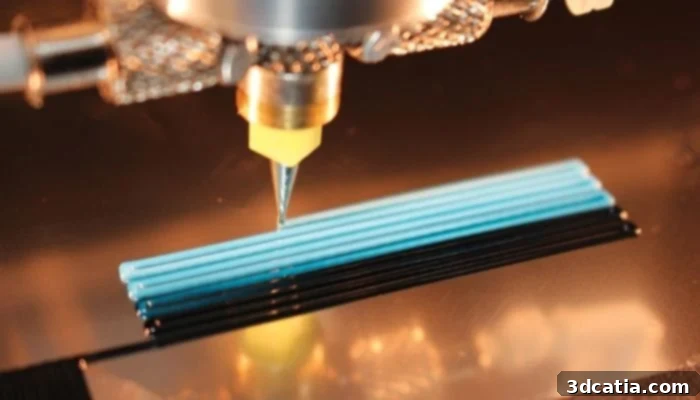
Photo Credits: Lincoln Laboratory
DIW offers considerable flexibility in terms of system configuration. It can be modified with affordable components and easily adapted to various applications. This hardware flexibility is remarkable. However, the technique remains largely confined to small-scale manufacturing and research environments, as its production rate and resolution do not meet the stringent standards required for high-volume industrial processes. While advancements are continually being made, limitations still exist concerning scalability and speed.
The ability to generate complex geometries is another attractive feature of DIW. It can create self-supporting structures and freeform shapes without the need for additional molds or supports. However, when attempting to build vertically or produce long overhangs, the weight of the part can cause deformation or failure, particularly in large structures. Support structures are sometimes still necessary, which adds a level of complexity to the process.
Key Applications of Direct Ink Writing
The wide range of materials compatible with DIW translates into a diverse range of applications. Some of the most common applications include energy storage, optics and photonics devices, and biomedical and tissue engineering. The adaptability of the process has cemented its position in numerous cutting-edge research endeavors.
In the realm of energy storage, DIW has been instrumental in the fabrication of electrochemical energy storage (EES) devices, such as lithium-ion batteries and supercapacitors. DIW’s ability to create structures at the micro/nano-scale facilitates the efficient movement of electrons and ions through the porous structure, resulting in exceptional electrochemical performance. This technology enables the creation of devices with high conductivity and a highly specific surface area, which is particularly desirable for electronic components and devices.
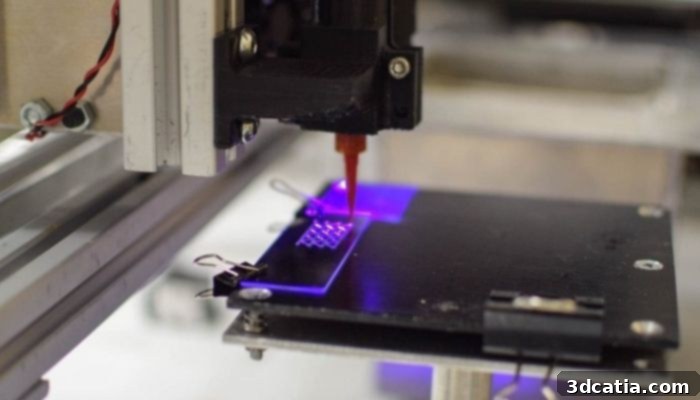
The DIW process is mainly used in research for small-scale manufacturing and prototyping. (Photo Credits: Virginia Tech).
In the medical field, researchers have harnessed DIW to create biodegradable scaffolds, stretchable self-healing shape-memory elastomers, soft robotics, wearable devices, and more. One of the most promising DIW applications lies in the use of hydrogels to emulate biological tissues. Many hydrogels exhibit biocompatibility, making them suitable for interacting with living cells and tissues. These hydrogels can also incorporate bioactive molecules, growth factors, pharmaceuticals, or even living cells, enabling targeted drug delivery or tissue regeneration. Thanks to the precision that DIW ensures, it can also be used to create organ-on-a-chip devices and microfluidic systems. By replicating tissue microenvironments, these structures can facilitate the study of drug responses and the progression of diseases in a controlled and reproducible manner.
Beyond medical and electrical applications, DIW has found uses in soft robotics, food applications, and structural engineering.
Manufacturers and Pricing of DIW Systems
The direct ink writing (DIW) ecosystem differs from that of other established additive manufacturing technologies. It is characterized by a blend of startups and platforms originating in academic environments. Several prominent manufacturers stand out in this space. Avay, an Indian company, specializes in machines geared toward the deposition of conductive inks and other insulating materials. Sygnis, a Polish company, offers systems tailored for materials research and for flexible electronics and robotics. One of its most popular printers, the SYGNIS F-NIS, is priced between $10,759 and $13,350. Another notable brand is MakerPi, a Chinese company that offers printers focused on multi-material printing using bioinks and gels for biomedical laboratories, priced at approximately $68,526.
In addition to these manufacturers, there are low-cost, open-source platforms such as Printess, designed to democratize DIW printing and facilitate its use in bioprinting, soft robotics, and educational projects. PowerDIW, a Spanish startup and spin-off of the CIM UPC technology center, has developed the PowerDIW platform, a hybrid system designed for ceramics, polymers, and functional materials in advanced R&D projects. Pricing information for the PowerDIW system is not publicly available and requires direct contact with the manufacturer.
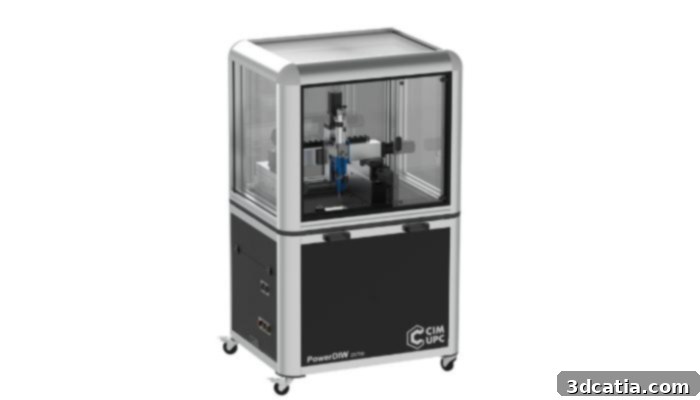
The direct ink writing platform from Power DIW. (Photo Credits: Power DIW).
DIW printers are generally known for their relatively low cost and the simplicity of their extrusion mechanisms, especially when compared to more complex 3D printing technologies. It’s important to recognize that many direct ink writing systems are tailored to specific applications. Research centers and laboratories often develop or customize their platforms to meet their unique needs. This specialization helps explain why there are fewer commercial brands in the DIW sector compared to other 3D printing segments.
Direct ink writing represents a valuable additive manufacturing technique that is poised to make significant contributions across various industries. As material science and printing technologies continue to advance, DIW will undoubtedly play an increasingly prominent role in research, prototyping, and even the production of specialized components. Further research and development will be key to unlocking its full potential and overcoming existing limitations.