
ETRI Spearheads Global Standardization in Medical 3D Printing and 3D Scanning for Personalized Healthcare
The rapid evolution of additive manufacturing, commonly known as 3D printing, has profoundly transformed various industries, and its impact on the healthcare sector is particularly significant. This groundbreaking technology offers unparalleled flexibility and the unique ability to create highly customized solutions, making it an invaluable asset in modern medicine. From intricately designed surgical guides that enhance precision during complex operations to custom-fitted prostheses that dramatically improve patients’ mobility and quality of life, and even the development of patient-specific implants and detailed anatomical models for meticulous pre-surgical planning, 3D printing is at the forefront of personalized medicine. Its capacity to tailor devices to the exact anatomy and specific needs of each individual patient is immensely valued, promising a future where medical interventions are more precise, effective, and patient-centric than ever before.
Despite its immense potential and burgeoning adoption across various medical applications, the full integration of additive manufacturing throughout all facets of healthcare has encountered significant hurdles. A primary challenge stems from the notable absence of comprehensive and universally accepted international standards for medical 3D printing and 3D scanning. Without a robust and globally recognized regulatory framework, ensuring consistent quality, unwavering safety, and proven efficacy of 3D-printed medical devices across diverse manufacturers and healthcare providers becomes an arduous and complex task. This lack of standardization can hinder widespread adoption, complicate regulatory approval processes, and raise concerns about product reliability and interoperability. However, this critical bottleneck is now being actively addressed by the visionary researchers at South Korea’s Electronics and Telecommunications Research Institute (ETRI). ETRI is boldly leading the global charge in developing these much-needed international standards for both medical 3D printing and 3D scanning. This monumental undertaking is anticipated to fundamentally transform the landscape, paving the way for the efficient and reliable creation of innovative, customized medical devices readily available for every patient, ushering in a new era of truly personalized and advanced healthcare solutions.
For those unfamiliar with its profound and diverse contributions, ETRI stands as a preeminent government-funded research institution, strategically situated in Daejeon, South Korea. Its core mission, as prominently articulated on its official website, is to vigorously contribute to South Korea’s sustained economic and social advancement through groundbreaking research, meticulous knowledge distribution, and extensive development in crucial industrial core technologies. In perfect alignment with this overarching national mission, ETRI has, for several years, been diligently exploring and pushing the boundaries of standardization for both 3D printing and 3D scanning technologies, with an unwavering and particular focus on their transformative applications within the highly sensitive and regulated medical field. Their profound commitment to this critical area dates back to 2015, when ETRI became a central and instrumental figure in establishing and guiding an international committee specifically tasked with spearheading global standardization efforts for additive manufacturing in healthcare. Furthermore, recognizing the intricate and demanding requirements of surgical applications, since 2019, the institute has been diligently developing specialized standards for sophisticated surgical 3D printing modeling and pioneering artificial intelligence-based automation processes designed to streamline and optimize these complex medical procedures. The most recent and highly significant announcement of the official approval of three new international standard development tasks, coupled with the imminent finalization of several other pivotal international standards, unequivocally underscores ETRI’s unwavering intent to solidify and strengthen South Korea’s leadership position in this rapidly evolving and strategically vital sector on the global stage, further cementing its role as an innovator in advanced healthcare technology.
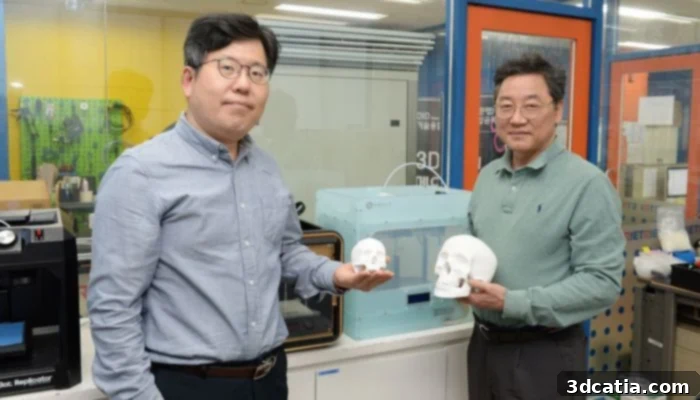
The ETRI research team shows the result of medical 3D printing (photo credits: ETRI)
The Indispensable Role of Standardization in Advancing Medical 3D Printing
The discourse surrounding standardization, particularly within a dynamic and rapidly innovating field like additive manufacturing in healthcare, can sometimes be met with varied perspectives. Critics occasionally voice concerns that rigid standards might inadvertently stifle innovation by imposing overly strict guidelines that could potentially limit creative freedom or new technological advancements. However, the reality, particularly within the highly regulated and patient-centric medical domain, reveals a fundamentally different and more nuanced picture. Medical standards are not merely bureaucratic hurdles; they are, in essence, critically important safeguards meticulously designed to ensure paramount patient safety, consistent product efficacy, and the overall well-being of the public. Through a rigorous, transparent, and collaborative process, healthcare products and services—including those revolutionary solutions produced via advanced 3D printing techniques—are meticulously evaluated by an array of key stakeholders. These stakeholders typically include influential regulatory bodies, highly skilled medical professionals, and seasoned industry experts. This comprehensive evaluation is absolutely paramount to guaranteeing the highest possible levels of quality, reliability, and safety for patients, thereby building trust and accelerating the adoption of new medical technologies.
In this crucial context, the dedicated researchers at ETRI hold a firm conviction that establishing comprehensive international standardization for both medical 3D printing and 3D scanning is not merely beneficial but is, in fact, absolutely essential for the future of healthcare. Far from hindering progress or innovation, these strategically developed standards are viewed as foundational elements that will significantly promote global public health by ensuring reliable, predictable, and consistently high-quality outcomes from personalized medical devices. Furthermore, ETRI anticipates that these standardization efforts will play a pivotal role in revitalizing and expanding the entire medical equipment industry. By providing clear, unambiguous guidelines for the design, manufacturing processes, rigorous testing, and robust validation of 3D-printed medical devices, standardization can dramatically reduce uncertainties, significantly accelerate complex regulatory approval processes, foster wider market adoption both domestically and internationally, and ultimately drive sustainable economic growth within the advanced medical technology sector. This robust and internationally recognized framework builds invaluable confidence among medical practitioners, device manufacturers, regulatory bodies, and patients alike, effectively paving the way for medical 3D printing to realize its full, transformative potential in delivering cutting-edge patient care worldwide.
ETRI’s relentless dedication and proactive approach to this critical field are powerfully reflected in the tangible and impressive progress they have already achieved. According to their recent press release, three specific and critically important standardized items have been meticulously developed, rigorously tested, and are now on the verge of official adoption, marking a significant milestone in medical additive manufacturing. These pioneering initiatives are strategically designed to address some of the most pressing and long-standing challenges in the development, manufacturing, and practical application of 3D-printed medical devices:
- Standard Evaluation Process for Precision and Accuracy in Implant Manufacturing: This groundbreaking standard establishes a rigorous and universally applicable evaluation process for meticulously assessing the precision and accuracy achieved during the manufacturing of medical 3D printing implants. Crucially, it leverages standardized CT (Computed Tomography) images as a common baseline for comparison and validation. This unified approach ensures that every implant produced, irrespective of the specific 3D printer model, manufacturing facility, or geographic location, consistently meets stringent geometric and material property requirements. Such consistency directly impacts the long-term success rates of surgical procedures, significantly enhancing patient safety and improving overall clinical outcomes by providing a reliable benchmark for implant quality.
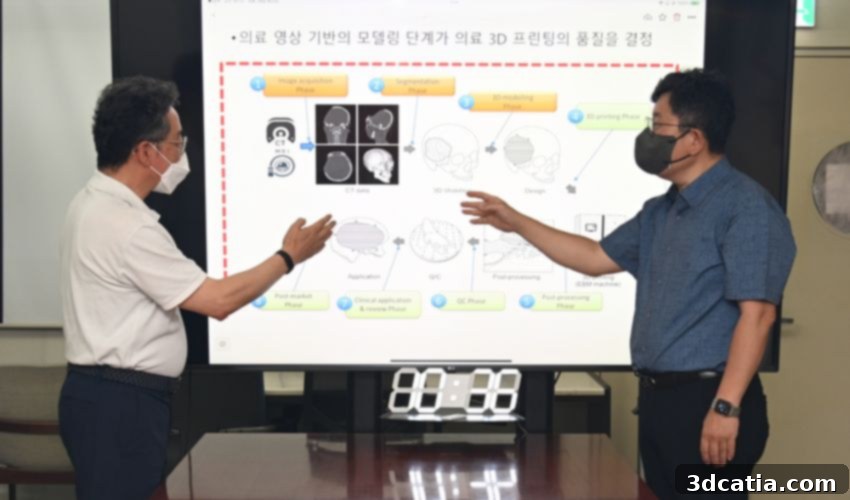
- Precision and Accuracy Error Evaluation Method in Tissue Segmentation and 3D Modeling: This particular standard directly addresses the intricate and often challenging stages of human tissue segmentation and subsequent 3D modeling from patient scans. Prior to this innovation, accurately distinguishing and isolating specific tissue parts from complex medical images for the creation of a precise 3D model was frequently a manual, highly time-consuming, and unfortunately, error-prone process. The introduction of this new, standardized methodology provides a reliable and objective way to evaluate, quantify, and ultimately minimize errors during these foundational steps. This ensures that the digital models utilized for 3D printing are as precise and accurate as scientifically possible, which directly translates to significantly better surgical planning, more predictable intraoperative results, and ultimately, the creation of more effective customized medical devices.
- Standard Operating Procedure (SOP) for Creating Comprehensive Data Sets: The development of a clear, comprehensive, and universally applicable Standard Operating Procedure (SOP) for creating robust and consistent datasets represents a true game-changer in the medical 3D printing ecosystem. This standard mandates that all data collected and subsequently used for training advanced Artificial Intelligence (AI) models, validating novel 3D printing techniques, and ensuring stringent quality control across the entire workflow is consistently structured, accurately formatted, and meticulously documented. This eliminates the pervasive discrepancies and inconsistencies that frequently arise from disparate and uncoordinated data collection methods, which are absolutely vital for the accelerated advancement of automated processes, the development of reliable AI-driven solutions, and the guaranteed consistency of future medical 3D printing software and hardware platforms.
The practical implications of these remarkable advancements are truly profound and far-reaching for the healthcare industry. Currently, the laborious process of preparing 3D printing models for patient-specific devices often necessitates extensive manual intervention, particularly in the highly challenging task of precisely distinguishing various tissue parts within complex medical images. This traditionally labor-intensive process can consume significant amounts of valuable time and resources, extending design times considerably and potentially delaying critical patient care. With the strategic introduction of these newly standardized procedures and validated methods, medical 3D printing modeling software will be empowered to operate with unprecedented levels of efficiency, accuracy, and reliability. The transformation in workflow efficiency is projected to be striking: design time for highly complex, patient-specific devices, which might currently span up to 24 hours of meticulous manual work, is anticipated to be drastically reduced to a mere 3 hours. This remarkable gain in efficiency not only accelerates the delivery of patient care but also liberates highly skilled medical professionals to allocate their invaluable expertise to other critical aspects of diagnosis and treatment. Crucially, this robust standardization concurrently ensures comprehensive quality control at every single stage of the process, from the initial medical scan to the final printed product, thereby minimizing potential errors and maximizing the safety, functionality, and overall effectiveness of the end medical device. The overarching significance of ETRI’s pioneering work is further amplified by the expected active participation of esteemed experts from renowned international regulatory bodies and professional organizations such as the FDA (U.S. Food and Drug Administration), RSNA (Radiological Society of North America), and DICOM (Digital Imaging and Communications in Medicine) in this ongoing standardization effort. Their invaluable involvement guarantees that the profound effects of these standards will resonate globally, establishing a universally recognized foundation for widespread international acceptance, regulatory harmonization, and seamless interoperability in the rapidly evolving field of medical 3D printing.
Echoing the visionary scope and monumental significance of ETRI’s mission, Hyung-Jun Kim, the esteemed head of ETRI’s Intelligent Convergence Research Institute, offered a compelling and forward-looking conclusion on the institute’s remarkable achievements: “It is very meaningful to develop more than 5 medical 3D printings essential for patient-tailored medical care led by Korea, establish a 3D scanning group, and lead the core international standards that can lead to digital twins and metaverse.” This powerful statement encapsulates the profound and multifaceted impact of their work, highlighting not only the immediate and tangible benefits for highly personalized medical care but also envisioning a transformative future where these meticulously developed standards lay the essential groundwork for cutting-edge technological integrations. These include revolutionary concepts like digital twins in healthcare—virtual replicas of a patient’s anatomy, specific organs, or even entire physiological systems—which could fundamentally revolutionize diagnostics, personalize treatment planning, and even accelerate drug discovery by allowing complex simulations and interventions in a virtual environment before ever being applied to the real patient. Furthermore, the integration with the nascent metaverse could unlock unprecedented new avenues for highly immersive remote surgical training, facilitate collaborative diagnostics among geographically dispersed specialists, and enable engaging, immersive patient education experiences, thereby truly transforming the landscape of modern medicine and patient engagement.
ETRI’s proactive and visionary leadership in establishing these vital international standards for medical 3D printing and 3D scanning marks a truly pivotal moment in the ongoing advancement of personalized healthcare globally. By meticulously ensuring unprecedented levels of precision, unwavering consistency, and paramount safety in the manufacturing and application of medical devices, these dedicated efforts are not merely optimizing existing manufacturing processes; they are fundamentally building the essential trust, interoperability, and robust regulatory framework absolutely necessary for additive manufacturing to fully realize its immense potential in delivering innovative, life-changing, and truly patient-specific solutions for individuals worldwide. This proactive and globally impactful approach demonstrated by South Korea is unequivocally setting a new international benchmark, promising a future where customized medical devices are not merely a distant possibility but a standardized, accessible, and reliable reality for patients everywhere.
To delve deeper into this groundbreaking initiative and access the official announcement, you can find more comprehensive information in the press release available HERE. We warmly invite you to share your insightful thoughts and perspectives on ETRI’s strategic and impactful move to significantly enhance standardization in medical 3D printing and 3D scanning. How do you foresee these critical developments shaping the future of patient care, influencing the trajectory of the medical device industry, and impacting global healthcare accessibility? Please feel free to let us know your insights and comments below, or engage with us and join the conversation on our LinkedIn, Facebook, and Twitter pages! Don’t forget the opportunity to sign up for our completely free weekly Newsletter here, ensuring you receive the very latest and most compelling 3D printing news directly to your inbox! Additionally, you can find all our engaging and informative videos on our dedicated YouTube channel, offering visual insights and expert discussions into the fascinating and rapidly evolving world of additive manufacturing.
*Cover Photo Credits: ETRI