
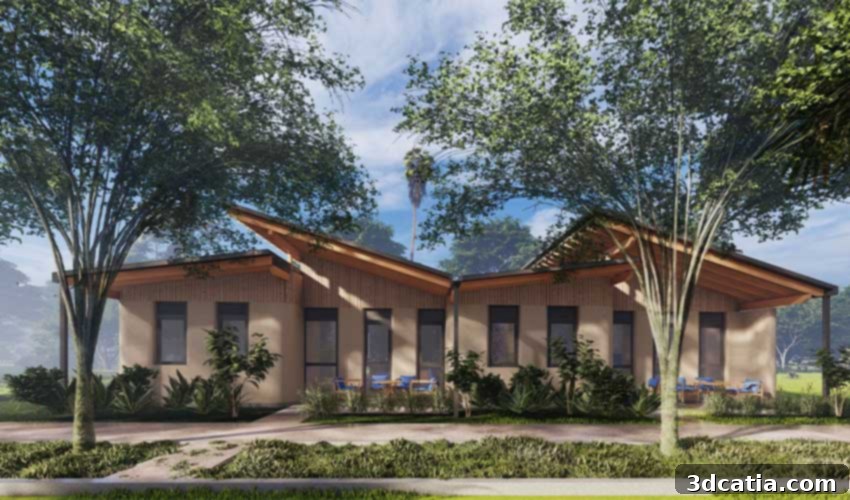
Transforming African Housing: 14Trees Pioneers Continent’s Largest 3D Printed Affordable Housing Project in Kenya
The global community is facing an escalating housing crisis, with projections indicating a significant worldwide shortage by 2030. This challenge is driven by a confluence of factors, including rapid population growth, increasingly stringent building permit regulations, and the imperative to meet rising environmental standards in construction. While developed nations grapple with these issues, the problem is particularly acute in developing regions, with Africa standing at the forefront of this critical need. In a groundbreaking initiative to mitigate the impact of this impending shortage, 14Trees – a visionary joint venture between Holcim, a world leader in sustainable construction solutions, and CDC Group, the UK Government’s impact investor – has embarked on a monumental project. This partnership aims to revolutionize affordable housing solutions by launching Africa’s largest 3D printed affordable housing development in Kenya. Named Mvule Gardens, this innovative neighborhood is set to feature 52 houses, all constructed using advanced additive manufacturing techniques.
This ambitious project in Kenya is not 14Trees’ inaugural foray into leveraging cutting-edge technology to address critical infrastructure deficits in Africa. Earlier this summer, the company garnered international attention by successfully 3D printing a school in Malawi. This earlier endeavor directly tackled the severe classroom shortage plaguing the African nation, demonstrating the tangible benefits of construction 3D printing in providing rapid, cost-effective, and durable educational facilities. Building on this proven success, Mvule Gardens, strategically located in the Kenyan town of Kilifi, represents a significant contribution to Kenya’s ambitious “Big 4” agenda. This national program is specifically designed to significantly increase the availability of affordable housing across the country, making Mvule Gardens a cornerstone in this vital developmental effort.
Jan Jenisch, the esteemed CEO of Holcim, articulated the profound significance of this venture, stating: “We are excited to be building one of the world’s largest 3D printed affordable housing projects in Kenya. With today’s rapid urbanization, over three billion people are expected to need affordable housing by 2030. This issue is most acute in Africa, with countries like Kenya already facing an estimated shortage of two million houses.” His comments underscore the urgency of the situation and highlight 14Trees’ commitment to delivering innovative, scalable solutions that can genuinely transform lives and communities across the continent. This project is not merely about constructing homes; it’s about pioneering a sustainable future for urban development in Africa, setting a new benchmark for speed, efficiency, and environmental responsibility in construction.
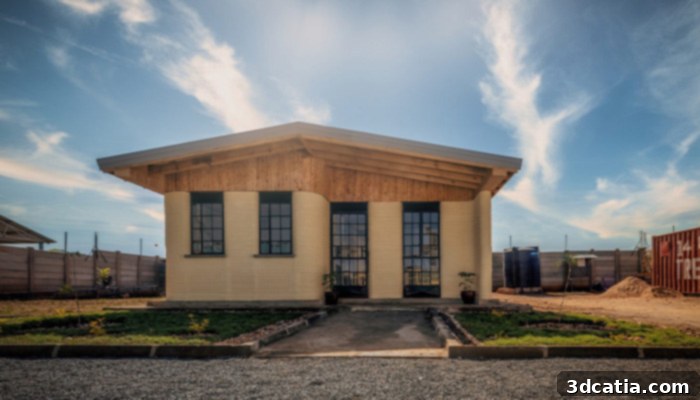
An example of the sustainable 3D printed houses in Mvule Gardens, Kenya (Photo credits: 14Trees)
The Vision Behind Mvule Gardens: A Sustainable 3D Printed Neighborhood by 14Trees
The development of Mvule Gardens represents a paradigm shift in addressing the housing deficit, showcasing the immense potential of modern construction methodologies. At the core of this ambitious project, which aims to deliver 52 much-needed homes, is the cutting-edge BOD2 printer. This state-of-the-art additive manufacturing system is supplied by COBOD, a globally recognized leader in 3D printing and construction technology. COBOD’s expertise in this field is well-documented, with their innovative 3D printers having been instrumental in numerous high-profile projects worldwide.
The BOD2 printer, specifically, has a remarkable track record. It was utilized in the construction of an impressive three-story residential building in Germany, demonstrating its capability for multi-story structures. Furthermore, it has successfully completed several homes across the United States, proving its versatility and reliability in diverse construction environments. The printer boasts an impressive operational envelope, capable of fabricating structures up to 10 meters in both length and width, offering significant architectural flexibility. Beyond its speed and precision, the BOD2 printer is also lauded for its environmental benefits. 14Trees proudly highlights that utilizing this technology can reduce the carbon footprint of construction by an astounding 50%, making it a truly viable and sustainable alternative for the future of building.
Innovation in Materials: TectorPrint for Sustainable 3D Construction
The success of any advanced construction method relies heavily on the materials used. For Mvule Gardens, 14Trees selected one of the latest and most innovative material ranges developed by Holcim: TectorPrint. This specially formulated dry mortar is designed for 3D printing applications, providing the printed walls with exceptional strength and structural integrity required to support the entire load of the housing units. The development of TectorPrint underscores Holcim’s commitment to not only pioneering new construction techniques but also ensuring that these methods are inherently sustainable.
Beyond its structural advantages, TectorPrint plays a crucial role in significantly reducing the environmental footprint of the Mvule Gardens project. By optimizing material usage and minimizing waste inherent in traditional construction, this innovative dry mortar contributes directly to the project’s ambitious sustainability goals. The combination of COBOD’s advanced 3D printing technology and Holcim’s TectorPrint material creates a powerful synergy, enabling the construction of durable, high-quality, and environmentally responsible homes at an accelerated pace. This holistic approach, integrating both technological and material innovation, positions Mvule Gardens as a model for future sustainable development initiatives across Africa and beyond.
Impact and Future Implications: Addressing Africa’s Infrastructure Deficits with Additive Manufacturing
The Mvule Gardens project, much like the earlier school in Malawi, exemplifies how 14Trees is at the forefront of assisting countries facing severe housing and infrastructure shortages through the strategic deployment of additive manufacturing. This technology offers a compelling solution to a range of challenges, including the speed of construction, cost-effectiveness, and the ability to build in remote or difficult-to-access areas. By dramatically cutting construction times and reducing labor costs, 3D printing makes affordable housing a more attainable reality for millions. Furthermore, the localized nature of 3D printing allows for greater resilience in supply chains and can foster local job creation through training in new, advanced construction techniques.
The environmental benefits are equally profound. The precise deposition of material in 3D printing significantly reduces construction waste, a major contributor to landfills and environmental degradation in conventional building practices. The stated 50% reduction in carbon footprint for Mvule Gardens is a testament to the sustainability potential of this technology, aligning perfectly with global efforts to combat climate change. By building homes faster, cheaper, and with a lower environmental impact, 14Trees is not just constructing buildings; it is laying the groundwork for sustainable community development and empowering local economies.
Projects like Mvule Gardens highlight a promising path forward for addressing critical housing needs on a continental scale. They demonstrate that sustainable and innovative solutions are not just theoretical possibilities but practical realities that can be implemented today. The collaboration between Holcim’s material expertise and COBOD’s printer technology, facilitated by 14Trees, sets a powerful precedent for future developments. As these projects gain momentum, they inspire confidence in the potential of additive manufacturing to truly revolutionize the construction industry and deliver tangible benefits to communities worldwide.
The Mvule Gardens project in Kenya stands as a beacon of innovation and hope, showcasing how advanced additive manufacturing can be harnessed to deliver sustainable and affordable housing at scale. It represents a significant step towards alleviating the global housing crisis, particularly in regions where the need is most critical. This initiative by 14Trees, supported by the combined strengths of Holcim and CDC Group, is not just building houses; it’s building a foundation for a more sustainable and equitable future for communities across Africa. To learn more about this transformative project and 14Trees’ broader mission, you can explore the video above and visit the official 14Trees website HERE.
What are your thoughts on Mvule Gardens and the role of 3D printing in addressing global housing shortages? We’d love to hear your perspective. Share your comments below or engage with us on our Linkedin, Facebook, and Twitter pages! Don’t forget to sign up for our free weekly Newsletter here to receive the latest 3D printing news directly to your inbox. You can also find all our compelling videos on our YouTube channel for more insights into the world of additive manufacturing.
*Cover Photo Credits: 14Trees