

HP Metal Jet S100: Unleashing Industrial Metal 3D Printing for Unprecedented Mass Production
At the close of 2018, HP made a significant announcement regarding its ambitious intention to enter the burgeoning metal additive manufacturing market. Four years later, after extensive development and rigorous testing by a carefully selected group of pioneering companies, HP’s highly anticipated metal 3D printing machines are finally available commercially. This launch has generated immense excitement across the industry, with many stakeholders expecting HP’s metal solutions to replicate the groundbreaking success and efficiency achieved by their plastic 3D printing solutions, which leverage Multi Jet Fusion (MJF) technology. The flagship machine, the Metal Jet S100, which spearheads HP’s innovative Metal Jet Fusion process, officially debuted at the prestigious IMTS exhibition in Chicago, marking a pivotal moment for industrial digital manufacturing.
HP’s strategic decision to commercialize its metal 3D printing solution comes at a time of robust growth within the industrial additive manufacturing sector. Industry reports highlight an accelerating trend towards digital production methods. A comprehensive analysis published by Allied Market Research, for instance, projects that the industrial additive manufacturing market is set to expand dramatically, potentially exceeding an astonishing $105 billion by 2031. This forecast indicates an impressive estimated compound annual growth rate (CAGR) of 21.9%. This exponential growth is fueled by diverse and evolving manufacturing needs across various industries. Users are increasingly seeking additive manufacturing solutions not only for rapid prototyping and the creation of specialized tooling but also, and significantly, for the production of functional, end-use parts. The introduction of HP’s Metal Jet S100, positioned as a comprehensive, turnkey solution, is expected to be a major catalyst for this market expansion, empowering manufacturers to design and produce complex metal components with greater speed, consistency, and repeatability than ever before, thereby accelerating their digital transformation journeys.

The distinct modular units comprising HP’s Metal Jet S100 3D metal printing solution (photo credits: HP)
Key Features and Modular Architecture of the Metal Jet S100
The HP Metal Jet S100 solution is engineered as a complete, integrated system designed to streamline the metal additive manufacturing workflow. It consists of four primary, interconnected units, each meticulously optimized to contribute to a seamless and efficient digital production process. These units include: a sophisticated powder management block responsible for precise material handling; the core printer unit where the binder jetting process occurs; a dedicated heat treatment unit crucial for initial part robustness; and finally, a specialized de-powdering machine designed for easy and thorough removal of unbound metal powder. HP’s overarching vision with this integrated approach is to establish a truly turnkey digital manufacturing workflow, simplifying the entire process from design to finished part. Ramon Pastor, Global Head and General Manager of 3D Metals at HP Inc., emphasized this strategic imperative, stating, “Since announcing the breakthrough Metal Jet technology in 2018, we have been working to develop the industry’s most advanced commercial solution for 3D metals mass production. 3D printed metal parts are a key driving force behind digital transformation and the new Metal Jet S100 Solution provides a world class metals offering for our customers, from the first designs right through to production, but more importantly helps them to realize the unlimited potential for digital manufacturing.” This statement underscores HP’s commitment to enabling manufacturers to unlock new levels of innovation and productivity through metal additive manufacturing.
The foundational technology behind the HP Metal Jet Fusion process is a sophisticated form of binder jetting. In this method, a liquid binding agent is selectively deposited onto successive layers of metal powder, effectively “gluing” the powder particles together layer by layer to form a green part. This differs significantly from laser-based methods which melt the powder. After the printing phase, the parts undergo a series of crucial post-processing steps to achieve their final mechanical properties. The first of these is a controlled heat treatment phase. During this stage, the build plate, hosting the newly printed green parts, is carefully heated. This heating serves a dual purpose: it completely evaporates any residual liquid from the binder and cures the HP plastic agents, resulting in a more robust and handleable “green part” that maintains its shape and integrity. Following this, a meticulous de-powdering step is performed. This process efficiently removes all the unbound metal powder surrounding the green parts within the build chamber. Importantly, the HP solution is designed to recover and recycle this excess powder, significantly minimizing material waste and contributing to a more sustainable and cost-effective production cycle. Finally, the green parts undergo a critical sintering step. During sintering, the parts are subjected to high temperatures, just below the melting point of the metal. This causes the metal particles to fuse together, densifying the part and imparting the desired mechanical properties, strength, and integrity essential for functional components.
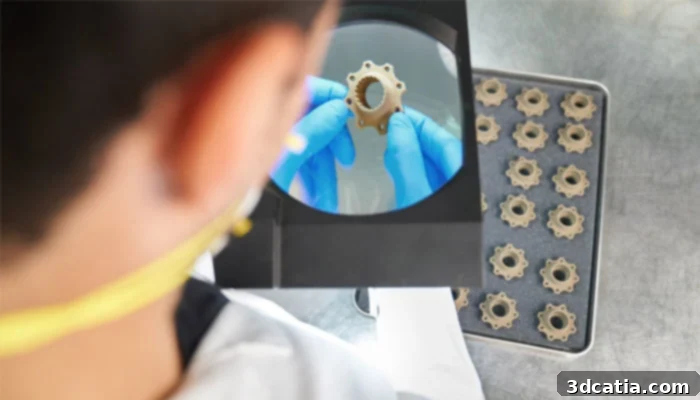
Diverse examples of metal parts 3D printed using the HP Metal Jet S100 solution (photo credits: HP)
HP emphasizes that its advanced binder jetting process delivers substantial advantages in terms of productivity and cost-efficiency compared to traditional or other additive manufacturing methods. A key benefit is the ability to build parts layer by layer across the entire build area simultaneously, rather than the slower, point-by-point approach characteristic of laser-based technologies. This parallel processing capability drastically speeds up production. Furthermore, unlike many metal additive manufacturing processes, the Metal Jet Fusion technology typically does not require extensive printing support structures, which simplifies post-processing and reduces material consumption. The metal powder utilized in the HP system is also designed to be more economically viable, further enhancing the overall cost-effectiveness of the solution. Regarding material options, HP has launched the Metal Jet S100 with support for two types of stainless steel, a widely used and versatile material in various industrial applications, known for its strength, corrosion resistance, and broad utility. This initial offering is expected to expand over time to include a wider range of engineering-grade metals, catering to an even broader spectrum of industrial requirements and applications.
HP’s Strategic Partnerships for Market Adoption
HP has long understood the importance of real-world validation and collaborative innovation. Over the past four years, prior to the commercial launch, the manufacturer strategically partnered with a select group of renowned industry leaders to rigorously test its Metal Jet solution. These partnerships were instrumental in gathering crucial feedback, facilitating necessary modifications, and ensuring the development of a robust, high-quality, and market-ready machine. Notable early collaborators included automotive giant Volkswagen, consumer sports equipment innovator Cobra Golf, and the specialized Legor Group, known for its precious metal alloys in the jewelry industry. These diverse partnerships highlighted the versatility and applicability of HP Metal Jet technology across a wide range of sectors.
Building on this foundation of successful collaborations, HP utilized the official launch of the Metal Jet S100 to announce exciting new strategic partnerships, prominently featuring Schneider Electric. Michael Lotfy, SVP of Power Products & Systems, North America, Schneider Electric, shared his enthusiasm for the collaboration: “We are excited about the new possibilities for our business as a result of this collaboration with HP. We are constantly in pursuit of solutions that will enable more sustainable, agile innovations development. Leveraging HP Metal Jet our teams have delivered a proven use case showcasing the benefits of digital manufacturing and 3D printing, and we look forward to uncovering many more applications that meet the evolving demands from our customers addressing the challenges around sustainability and Electricity 4.0.” This statement clearly articulates the shared vision between HP and its partners: leveraging advanced additive manufacturing to drive sustainable innovation, enhance supply chain resilience, and accelerate the transition to a more digital and electric future.
The extensive testing and validation by these industry leaders underscore the Metal Jet S100’s readiness for demanding industrial environments. These partnerships are not just about validation; they are about co-creating the future of manufacturing, demonstrating the technology’s capability to produce high-quality, complex metal parts at scale, thereby accelerating the adoption of metal 3D printing across various industries. From optimizing automotive components to creating custom golf club designs and innovative electrical system parts, the potential applications are vast and transformative.
Without a doubt, the industry eagerly anticipates the myriad innovative applications that will emerge from future users of the HP Metal Jet S100. The potential for this technology to redefine product design, supply chains, and manufacturing efficiency is immense. For those keen to delve deeper into the specifics of this groundbreaking solution, more information is available HERE, or through the informative video demonstration provided below:
What are your thoughts on HP’s innovative new Metal Jet S100 solution and its potential impact on industrial manufacturing? We invite you to share your insights in a comment below or join the conversation on our LinkedIn, Facebook, and Twitter pages! Don’t miss out on the latest advancements and news in the 3D printing world—sign up for our free weekly Newsletter here, delivering the freshest updates straight to your inbox! Additionally, explore a wealth of engaging content and demonstrations by visiting our YouTube channel.