
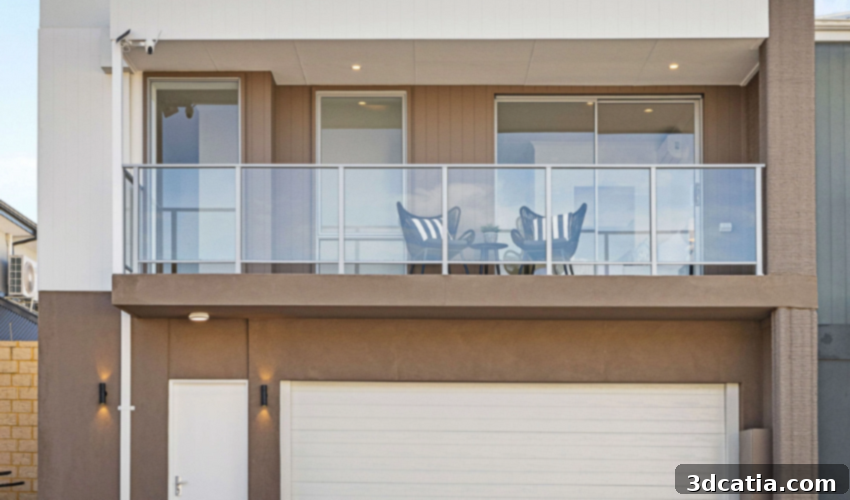
Contec Unveils Australia’s Landmark Multi-Story 3D Printed Home: The Tapping Residence
In a groundbreaking move for the construction industry, Contec, a pioneering construction and design agency based in Australia, has officially announced the completion of its innovative two-story family home in Tapping, Perth. Dubbed the Tapping Residence, this remarkable project sets a new global benchmark for additive manufacturing in residential construction. Unlike many previous 3D printed homes, this multi-story dwelling does not rely on traditional framing for its upper floors, marking it as one of the world’s first and most ambitious multi-story 3D printed homes. Astoundingly, the structural shell of the residence was completed in just under 18 hours, showcasing the unparalleled speed and efficiency that 3D printing brings to the building sector.
The Tapping Residence represents a significant leap forward, challenging conventional construction methodologies and demonstrating the viability of advanced additive manufacturing for complex, multi-level structures. This project not only highlights Contec’s commitment to innovation but also positions Australia at the forefront of sustainable and rapid housing development. The successful realization of a two-story 3D printed home without reliance on traditional supports for its second level is a testament to the robust engineering and material science advancements being made in this exciting field, opening doors for more intricate and durable architectural designs previously thought impossible or too costly with conventional methods.
Central to this achievement was the utilization of a sophisticated robotic printer supplied by the Dutch technological powerhouse, CyBE. This state-of-the-art printer operates by extruding a meticulously engineered, specialized concrete mixture layer by layer, directly on the construction site. The precision and automation offered by CyBE’s robotic system are crucial for achieving the structural integrity and design complexities of a multi-story building. This method drastically reduces human error, enhances construction speed, and minimizes material waste compared to traditional building practices.
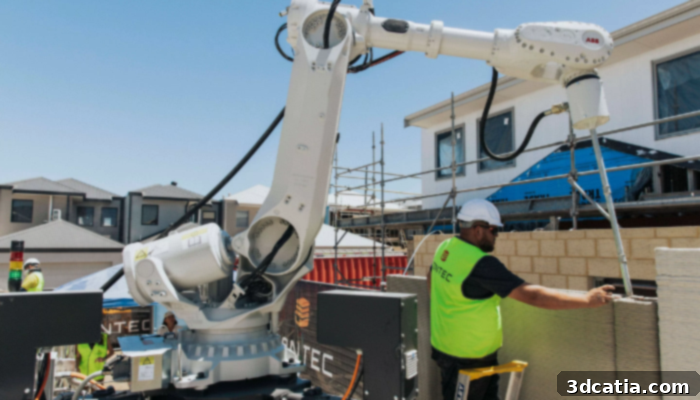
The printer used in the Tapping Residence was from the Netherlands based firm CyBe
Contec’s specialized concrete formula is a key differentiator for the Tapping Residence. This advanced material is designed to set within minutes, allowing for continuous and rapid layering, which is essential for the high-speed printing process. More impressively, the concrete achieves an extraordinary compressive strength of nearly 50 MPa. To put this into perspective, this is over three times stronger than standard brickwork, providing unparalleled structural resilience. Beyond its strength, the concrete boasts exceptional durability characteristics critical for the Australian climate: it is cyclone-rated, highly resistant to fire and water, and completely termite-proof. These properties ensure that the Tapping Residence is not only long-lasting but also requires minimal maintenance, offering peace of mind to its inhabitants.
Furthermore, the structural design and material composition contribute significantly to the home’s thermal and acoustic efficiency. The dense, layered concrete walls inherently provide superior insulation, keeping interiors cooler in summer and warmer in winter, thereby reducing energy consumption for heating and cooling. This enhanced thermal performance, coupled with the inherent noise-dampening qualities of the concrete, creates a comfortable and quiet living environment. Such features underscore the sustainable advantages of the project, making the Tapping Residence an exemplary model of sustainable and energy-efficient construction, aligning with modern environmental goals and reducing the long-term operational costs for homeowners.
While the structural shell of the house was indeed completed in an astonishingly short period – less than a day – the full realization of the home involved a meticulous integration of traditional building trades. Following the rapid printing of the external structure, the interior components, including intricate plumbing systems, electrical wiring, and sophisticated interior design elements, were completed over several months. This phased approach demonstrates that 3D printing seamlessly integrates with conventional construction practices, allowing for specialized finishes and installations to be executed with the same quality and attention to detail as any other modern home. The rapid shell construction significantly de-risks the early stages of a project and provides an accelerated timeline for subsequent interior fit-outs.
The finished Tapping Residence is a spacious and aesthetically pleasing family home, boasting three comfortable bedrooms, two modern bathrooms, a functional garage, and a charming small balcony perfect for relaxation. Architecturally, the house strikes a beautiful balance between the innovative, ribbed texture of the 3D printed walls and the sleek, modern finishes incorporated within the interior. Large windows, featuring extensive glazing, are strategically placed on the front facade. These not only flood the interiors with natural light but also serve as a contemporary counterpoint to the unique texture of the printed exterior, creating a harmonious blend of form and function. This thoughtful design ensures that the house feels both cutting-edge and invitingly familiar.
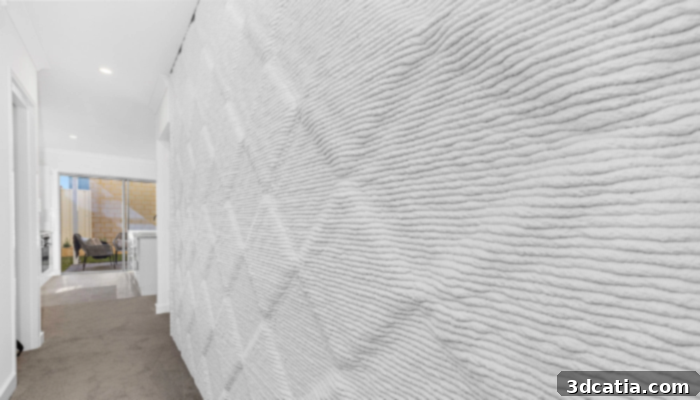
The project seeks to mesh the 3D printed walls with modern glazing and design elements.
Contec’s analysis revealed a compelling economic advantage: the Tapping Residence cost approximately 22% less to construct than an equivalent masonry house. This significant cost saving is a critical highlight of the economic benefits inherent in 3D printing houses. The primary contributors to these savings include drastically reduced labor costs due to automation, optimized material usage with minimal waste, and substantially faster construction timelines. The entire project, from initial groundbreaking to final handover, was completed in an impressive five months, showcasing how large-scale 3D printing can dramatically accelerate delivery schedules without compromising on the high standards of quality, safety, or durability. These efficiencies have profound implications for addressing housing affordability and supply challenges.
The rapid construction timeframe not only reduces financial outlay but also offers considerable benefits to developers and homeowners alike. Faster project completion means quicker returns on investment for builders and a reduced waiting period for families seeking new homes. This agility makes 3D printing a particularly attractive solution in markets experiencing high demand or labor shortages. Furthermore, the precision of robotic construction ensures consistent quality across all printed elements, leading to fewer defects and long-term maintenance issues. The combination of cost savings, speed, and quality positions 3D concrete printing as a transformative force capable of reshaping the landscape of residential and commercial development.
The Tapping Residence now stands as a pioneering benchmark for construction innovation, not just in Australia, but globally. By seamlessly integrating sustainability, unprecedented speed, and inherent resilience into a single structure, Contec’s multi-story home powerfully demonstrates how additive manufacturing is evolving far beyond mere prototypes and experimental builds. This project emphatically proves that 3D printed developments are now capable of delivering real, durable, and high-quality homes that consistently meet, and often exceed, stringent modern building standards and homeowner expectations. It signifies a maturation of the technology, moving it from niche applications to mainstream residential solutions.
With the scalable applications of 3D concrete printing now readily available across both Perth and regional Western Australia, this revolutionary technology is poised to profoundly reshape the future of affordable and sustainable housing across the continent. It offers a practical solution to address various housing challenges, including the need for rapid deployment in remote areas, the creation of cost-effective housing for growing populations, and the development of eco-friendly structures that minimize environmental impact. Contec’s Tapping Residence is a bold statement of intent, signaling a new era where innovative technology paves the way for more accessible, efficient, and environmentally responsible living spaces for communities everywhere.
What are your thoughts on this groundbreaking new housing development? Could you envision yourself living in a 3D printed house? We invite you to learn more about the Tapping Residence project here! Share your opinions in the comments section below or connect with us on our LinkedIn or Facebook pages! Don’t forget to subscribe to our free weekly Newsletter to receive the latest 3D printing news directly in your inbox. You can also explore all our videos and insights on our YouTube channel for more fascinating developments in additive manufacturing.
*All Photo Credits: Contec Australia