
Weekly Watch: Top 5 3D Printing Videos Driving Innovation and Industry Transformation
Welcome to our exclusive weekly digest, where we spotlight the most compelling videos illustrating how 3D printing and additive manufacturing are not just evolving, but actively reshaping industries and our society. This week’s selection features groundbreaking applications, visionary insights, and technological marvels – from using Artec scanners to meticulously digitalize invaluable museum pieces, to exploring the future of manufacturing through the eyes of iGo3D’s co-founder, and even venturing into the exciting realm of 3D printing in space. Each video offers a unique perspective on the immense potential and tangible benefits of this revolutionary technology. If you find these features captivating and wish to delve deeper into the world of 3D printing, we invite you to explore an even broader collection of innovative content on our dedicated YouTube channel. We hope you enjoy this curated selection and have an inspiring Sunday!
TOP 1: How 3D Printing is Changing How People Innovate
The journey of 3D printing has often been described as a rollercoaster, witnessing periods of exaggerated hype followed by periods of steady, practical application. This sentiment is vividly echoed by the Co-founder and Chairman of iGo3D, who shares his company’s dynamic history within the additive manufacturing landscape. He observes a significant shift in the industry, where the initial enthusiasm for 3D printing is now translating into more concrete, practical uses, ultimately leading to a more stable and mature market. He posits that 3D printing is fundamentally a disruptive process, not just incrementally improving existing methods but fundamentally altering them. But why is this technology considered so disruptive, and how does it empower individuals and businesses to innovate faster and more efficiently? This insightful video delves into these questions, offering a compelling vision for the future of innovation driven by additive manufacturing, and explains how this technology democratizes design and production, allowing for unprecedented creativity and rapid iteration across various sectors. Discover more about the transformative power of 3D printing and its impact on how we innovate by watching the full video below!
TOP 2: The Artec Space Spider – Preserving Heritage with Digital Precision
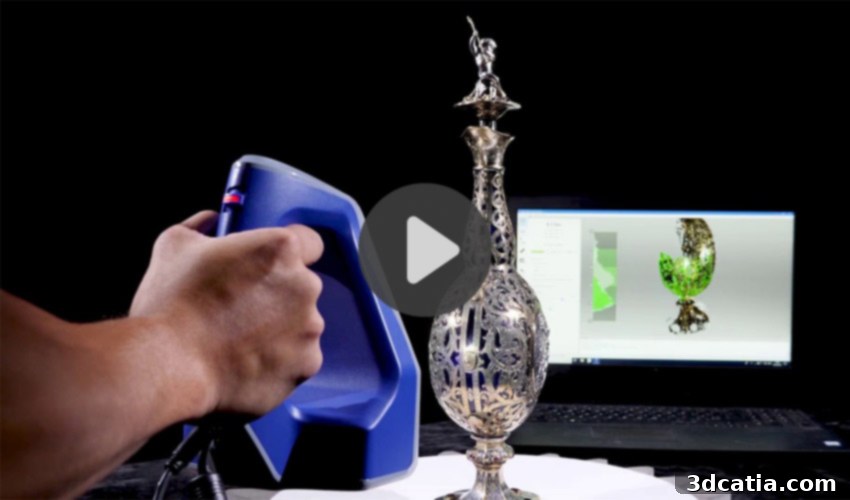
In a remarkable demonstration of how cutting-edge 3D scanning technology can serve cultural preservation, the advanced Artec Space Spider scanner was recently deployed to digitally capture two intricate pieces from the esteemed collection of the Victoria and Albert Museum. This sophisticated device allows for the creation of incredibly detailed and accurate 3D models, capturing every nuance of the original artifacts without any physical contact, thus ensuring their absolute integrity. After the entire part is meticulously scanned and a high-fidelity 3D model is generated, this digital blueprint is then sent to a 3D printer. The project teams achieved an impressive feat, successfully printing a highly realistic replica of an original artifact in just 8 hours. Following the printing process, specialized post-processing work is undertaken to apply all the correct colours and textures, bringing the replica to life with astounding accuracy. Thanks to these revolutionary 3D technologies – from high-resolution scanning to precise additive manufacturing – invaluable original works can be copied, studied, and shared globally without ever being touched or altered, thereby safeguarding them for future generations. This not only aids in conservation but also enhances accessibility for educational purposes and research, allowing for virtual exhibitions and remote study of fragile artifacts.
TOP 3: NASA & 3D Printing – Revolutionizing Space Technology
The innovative spirit of NASA continues to push the boundaries of technology, with a recent development highlighting the pivotal role of 3D printing in future space missions. A dedicated team of NASA researchers has secured crucial funding to advance the application of 3D printing for creating highly integrated components for spacecraft. Their pioneering work focuses on printing both sensors and a partial circuit for wireless communication directly onto a single, compact card, measuring a mere 5 cm by 7 cm. This remarkable integration on such a small scale is a game-changer for satellite technology, particularly for CubeSats and other small-form-factor satellites. The ability to embed complex functionalities into tiny, custom-printed structures will significantly reduce the size, weight, and power consumption of critical subsystems. This, in turn, will enable satellites to carry more scientific instruments, collect a greater volume of data, and operate more efficiently in orbit. Such advancements are crucial for making space exploration more accessible and cost-effective, allowing for more frequent launches and diverse missions. This news warrants close attention, as it strongly confirms the immense potential of 3D printing in space, not just for manufacturing tools or spare parts on demand, but for fundamentally transforming the design and capabilities of spacecraft themselves. Expect to see 3D printing play an even larger role in future missions to the Moon, Mars, and beyond.
TOP 4: Aerospace Additive Manufacturing – The Future of Flight Component Production
The aerospace industry stands as one of the earliest and most significant adopters of additive manufacturing, leveraging its unique capabilities to produce parts that are lighter, stronger, and more efficient than those made with traditional methods. Collins Aerospace exemplifies this trend, utilizing advanced 3D metal printing techniques to engineer superior finished components that meet the stringent demands of flight. The company showcases the profound advantages of this technology using the compelling example of a fuel injector. Historically, such a critical part might consist of numerous individual components requiring complex assembly. However, by embracing additive manufacturing, Collins Aerospace was able to redesign and produce this essential fuel injector with an astonishing reduction in complexity – from 18 separate components down to a mere 4. This part consolidation not only simplifies the manufacturing process but also enhances reliability by eliminating potential failure points. Furthermore, the benefits extend significantly to performance metrics: the new 3D printed design reduced the component’s weight by a remarkable 10%, cutting down fuel consumption and increasing overall aircraft efficiency. Material waste was dramatically curbed by 80%, highlighting the sustainable aspect of additive manufacturing, while production times were slashed by an impressive 75%. This case study clearly demonstrates how 3D printing is not just a manufacturing method, but a design paradigm shift, enabling the creation of intricate, optimized geometries previously impossible, thereby revolutionizing the production of aerospace parts and paving the way for more sustainable and high-performing aircraft.
TOP 5: ZEISS Helps Oerlikon Drive the Industrialization of Additive Manufacturing
For additive manufacturing to truly achieve widespread industrialization, particularly in critical sectors like aerospace, automotive, and medical, meticulous quality control and material analysis are paramount. This crucial need is addressed through strategic partnerships, such as the one between ZEISS and Oerlikon. ZEISS, a global leader in microscopy and metrology, provides a comprehensive suite of instruments essential for material analysis and quality assurance throughout the entire process chain of metal additive manufacturing. These advanced tools have been specifically chosen and implemented by Oerlikon’s innovation and technology centre in Munich. Oerlikon, a global technology group, is heavily invested in scaling additive manufacturing for industrial applications, and the precision and reliability offered by ZEISS’s equipment are indispensable for this ambition. From initial powder characterization to in-process monitoring and final part inspection, ZEISS instruments enable detailed examination of microstructure, detection of defects, and verification of dimensional accuracy. This rigorous quality control ensures that 3D printed metal parts meet the highest standards of performance, consistency, and safety, which is non-negotiable for critical applications. The collaboration between ZEISS and Oerlikon underscores the vital role of advanced metrology in transitioning additive manufacturing from a prototyping tool to a robust, repeatable, and certifiable industrial production method, thereby accelerating the widespread adoption of metal 3D printing across demanding industries.
We hope this week’s TOP 5 videos have provided valuable insights into the dynamic world of 3D printing and additive manufacturing. These innovations are continuously pushing the boundaries of what’s possible, influencing everything from historical preservation to futuristic space missions and advanced industrial production. Did any particular video stand out to you, or do you have further thoughts on the incredible advancements being made in this field? We’d love to hear your feedback! Please drop a comment below, or join the conversation on our Facebook and Twitter pages. To ensure you stay at the forefront of this rapidly evolving industry, don’t forget to sign up for our free weekly Newsletter, delivering all the latest news, analyses, and innovations in the 3D industry straight to your inbox!