
Revolutionizing Sustainable Food: 3D Printing Okara for Healthy, Additive-Free Snacks
The world of cuisine has always been a vibrant canvas for human creativity, constantly evolving and reinventing itself to delight our palates. In an era where sustainability and health consciousness are paramount, chefs and food scientists alike are pushing the boundaries, imagining innovative recipes based on ingredients one might least expect. This spirit of innovation is vividly captured by a dedicated team of researchers in Singapore, who have embarked on a pioneering journey to integrate a common by-product, okara, with cutting-edge 3D printing technology to create truly unique and sustainable dishes.
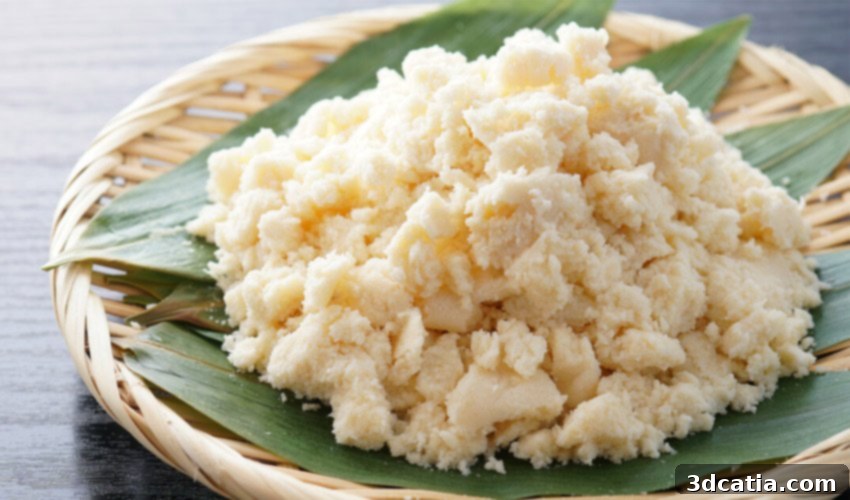
But what exactly is okara, and why is it at the heart of this gastronomic revolution? Okara is, in essence, soy pulp or tofu dregs, a nutrient-rich fibrous by-product that remains after soybeans are processed to produce plant-based milks, particularly soy milk, and also tofu. Despite its bland taste profile on its own, okara is a powerhouse of nutrients, including protein, fiber, and various minerals, making it an excellent base for numerous plant-based alternatives. Traditionally, okara is often discarded or used as animal feed, representing a significant source of food waste. However, thanks to this groundbreaking research, okara is now being recognized for its potential as a novel and sustainable material for 3D food printing.
The research team’s significant contributions were highlighted in their study, “3D Printing of Okara Ink: The Effect of Particle Size on the Printability,” published last November. This comprehensive publication delves into the intricate science behind transforming okara into a viable printing ‘ink’. A central challenge in 3D food printing, especially with natural ingredients, is achieving the correct rheological properties – how a material flows and deforms under stress. Many food producers typically rely on various additives like carob flour, glycerin, xanthan gum, κ-carrageenan gum, or whey protein isolate to manipulate these properties, ensuring the food maintains its structure and malleability during and after the printing process. However, the Singaporean team set out to achieve this without any such artificial modifiers, focusing instead on intrinsic properties of okara itself.
This ambitious research project seamlessly aligns with a growing global movement that blends advanced manufacturing techniques like 3D printing with the realm of food. From creating personalized nutritional meals to upcycling food waste into innovative products, 3D printing is poised to redefine our culinary landscape. A notable parallel can be drawn with initiatives such as those pioneered by Barbara Gollackner, who has creatively utilized food waste to design 3D printed kitchen utensils, demonstrating the broader applicability of additive manufacturing in tackling waste and fostering circular economy principles within the food industry. The potential for such technologies to revolutionize food production, reduce waste, and introduce novel dietary options is immense and continues to expand.
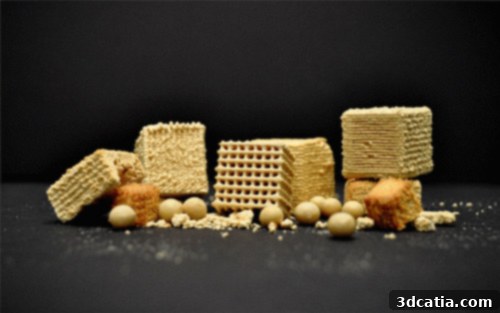
Visually appealing 3D printed okara-based foods, demonstrating the potential for innovative culinary creations (photo credit: ACS Food Science & Technology)
Crafting Healthy, Additive-Free Snacks with Precision
The core of the Singaporean team’s breakthrough lies in their meticulous analysis of different okara textures. This detailed investigation allowed them to pinpoint the optimal ‘ink’ variables crucial for enabling 3D printing without the need for external additives. Their measurements conclusively demonstrated that particle size exerted a profound influence on the material’s printability. Through a series of extensive trials and iterative adjustments, the researchers successfully formulated the perfect recipe for okara inks. The optimal composition was determined to be 33% (w/w) okara powder, with a particle size meticulously refined to be less than 100 μm. This precise ratio and particle dimension enabled the material to be printed effectively, entirely bypassing the need for additional rheology modifiers that are typically used to control flow and structure.
Achieving these specific parameters resulted in an okara ink that exhibited a flow stress of 200 ± 40 Pa and a storage modulus of 23300 ± 300 Pa. In simpler terms, these values indicate that the okara ink possessed the ideal balance of viscosity and elasticity. It was fluid enough to pass smoothly through the printer’s nozzle, yet rigid enough to hold its intricate 3D shape upon deposition, without collapsing or deforming. This precision engineering of the material’s properties is what ultimately unlocks the potential for producing structurally stable and visually appealing food items. This achievement is not merely a technical feat; it represents a significant step towards creating healthier food options by eliminating artificial additives, while simultaneously promoting the sustainable utilization of food by-products.
Reflecting on their success, the research team succinctly summarized their findings: “Using the formulated okara ink, we fabricated 3D structures to achieve different textures, which was identified by texture profile analysis (TPA). This study suggests a simple route to formulate water-insoluble powder-based foods into printable ink without additional rheology modifiers. This work also highlights a unique route to upcycle the food waste (i.e., okara powders) into visually appealing snacks with customized texture, highlighting the potential use of 3D food printing to improve food sustainability.” This statement underscores the dual triumph of the project: developing an innovative, additive-free printing method and showcasing a powerful approach to combat food waste while creating appealing, personalized food products.
The implications of this research extend far beyond the laboratory. By demonstrating a viable method to transform a discarded by-product like okara into nutritious and customizable 3D printed snacks, the team has opened new avenues for sustainable food production. This approach not only addresses the environmental challenge of food waste but also caters to the growing consumer demand for natural, wholesome, and additive-free food options. The ability to precisely control texture and shape offers unprecedented opportunities for culinary artists and food manufacturers to innovate, creating novel sensory experiences and addressing specific dietary needs. Imagine personalized snacks tailored to an individual’s nutritional requirements or appealing textures designed for those with chewing difficulties, all while making efficient use of resources that would otherwise go to waste.
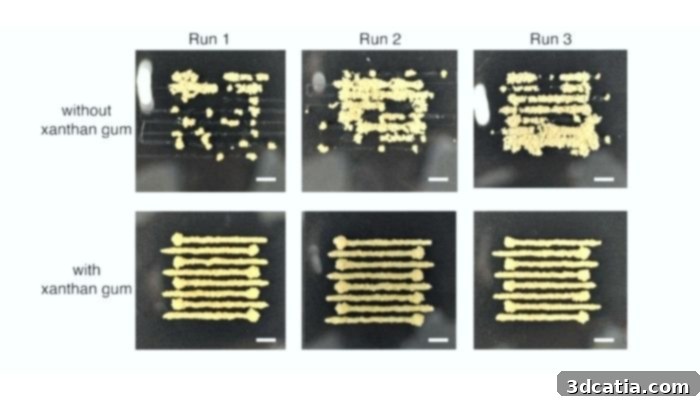
The team’s success hinged on precisely controlling particle size, ultimately discovering the optimal formula for 3D printable okara (photo credits: ACS Food Science & Technology)
Looking ahead, the potential impact of this technology on our future consumption habits is truly exciting. We are on the cusp of a paradigm shift where food production could become more localized, personalized, and sustainable. While there are still challenges to overcome, such as scaling up production from laboratory settings to industrial levels and ensuring widespread consumer acceptance of 3D printed foods, the foundation laid by this research is incredibly strong. It points towards a future where customized, nutritious, and environmentally friendly food options are not just a niche market but a mainstream reality.
Who knows, perhaps in the not-too-distant future, delicious and healthy okara-based snacks, intricately 3D printed to perfection, will grace our supermarket shelves? This research not only offers a beacon of hope for reducing food waste but also inspires a new generation of food products that are both good for us and good for the planet. For those eager to delve deeper into the scientific intricacies of this remarkable study, the full paper is available for download HERE.
What are your thoughts on this pioneering project and the future of 3D printed sustainable foods? We invite you to share your insights and engage with us in the comments section below! You can also connect with our vibrant community and stay updated on the latest innovations by following us on our social media channels: Linkedin, Facebook, and Twitter. Don’t miss out on the most recent advancements in additive manufacturing – be sure to sign up for our free weekly Newsletter here, delivering the latest 3D printing news straight to your inbox! Additionally, explore our diverse range of videos and content on our YouTube channel for more compelling stories from the world of 3D printing.