
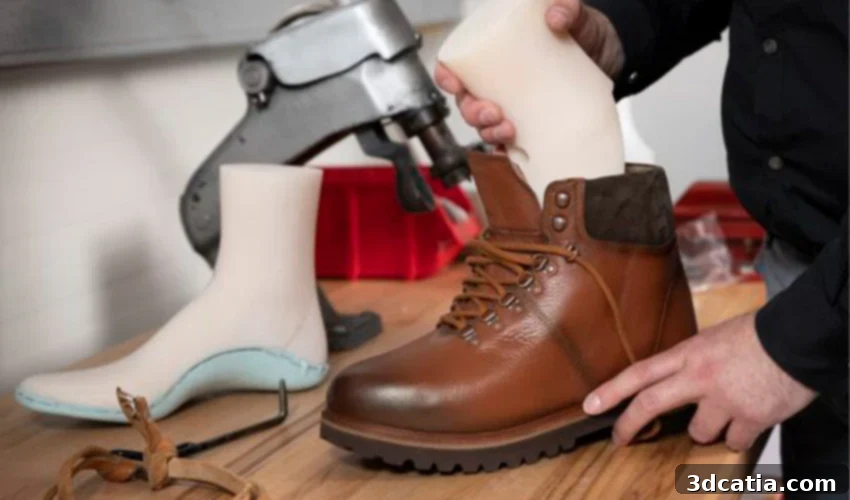
Revolutionizing Custom Orthopedic Footwear: PROTIQ’s 3D Printing Innovation with TPU and SLS
In the rapidly evolving landscape of orthopedic healthcare and the broader field of modern medicine, additive manufacturing has firmly established itself as an indispensable technological cornerstone. This revolutionary approach enables the rapid and cost-effective production of crucial medical devices, ranging from patient-specific prostheses, supportive orthoses, to complex implants. The ability of 3D printing to create highly customized and anatomically precise components has transformed patient care, offering unparalleled levels of comfort, functionality, and aesthetic appeal. However, despite these advancements, the realm of custom orthopedic footwear presented a unique challenge where additive manufacturing faced persistent limitations. Traditional orthopedic shoes rely heavily on wooden lasts, which have been the industry standard for centuries, known for their rigidity and stability. Early attempts at 3D printing shoe lasts struggled to replicate the specific material properties and structural integrity required for high-quality orthopedic footwear, often resulting in products that fell short of the traditional wooden counterparts. Recognizing this critical gap, the innovative American company PROTIQ embarked on a mission to develop a groundbreaking solution, aiming to seamlessly integrate the benefits of additive manufacturing into the demanding world of custom orthopedic shoemaking.
PROTIQ’s dedication to innovation led them to collaborate closely with a network of distinguished orthopedic experts and seasoned shoemakers. This synergistic partnership was instrumental in the development of an entirely new material specifically engineered for 3D printing high-performance orthopedic shoe lasts. The material at the heart of PROTIQ’s breakthrough is a specialized TPU (Thermoplastic Polyurethane) polymer. This advanced polymer has been meticulously formulated to mimic, and in many ways surpass, the desirable properties of traditional wood, while simultaneously introducing a host of modern advantages. PROTIQ’s TPU boasts exceptional elasticity, offering a degree of flexibility that wood cannot match, yet it maintains robust structural integrity. Crucially, it is also extremely lightweight, significantly reducing the overall weight of the orthopedic footwear without compromising support or durability. Thanks to these remarkable characteristics, PROTIQ’s proprietary TPU polymer stands as a compelling and highly viable alternative to traditional wooden lasts, poised to redefine the standards of orthopedic shoe manufacturing. To transform this innovative material into functional lasts, PROTIQ leverages Selective Laser Sintering (SLS) technology. While SLS shares similarities with metal powder-based additive manufacturing methods like laser-powder bed fusion, particularly in its layer-by-layer laser fusion principle, it is specifically optimized for working with polymer powders, enabling the creation of intricate and durable thermoplastic parts.
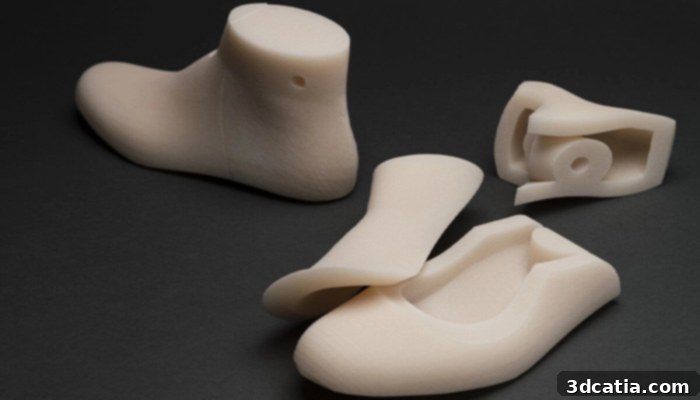
Photo Credits: PROTIQ
The strategic choice of Selective Laser Sintering (SLS) over other 3D printing technologies, such as Fused Deposition Modeling (FDM), was a deliberate decision rooted in the stringent requirements of orthopedic shoemaking. PROTIQ highlights that SLS offers significantly greater precision and superior technique, essential for producing shoe lasts with the exact anatomical accuracy and surface finish demanded by professionals. Unlike FDM, which typically produces anisotropic parts with visible layer lines, SLS creates isotropic parts with consistent mechanical properties in all directions, leading to stronger, more uniform, and aesthetically pleasing lasts. This superior precision is paramount for creating truly custom-fitted footwear that can address specific patient needs and complex foot conditions effectively. Furthermore, a critical advantage of PROTIQ’s SLS-printed TPU lasts is their compatibility with traditional shoemaking processes. The 3D printed lasts can be sanded, polished, glued, and even stapled in precisely the same manner as their wooden counterparts. This seamless integration into existing workflows minimizes the learning curve and transition challenges for experienced shoemakers, making it remarkably easier for them to adopt this advanced technology without a complete overhaul of their craft. PROTIQ firmly asserts that their innovative solution not only drastically reduces production time and material waste but also meticulously meets and exceeds the exacting standards and high demands of professional orthopedic shoemaking, ensuring both efficiency and uncompromising quality.
Empowering Orthopedic Professionals with Free 3D Modeling Software
Recognizing that sophisticated hardware and materials require equally powerful and accessible software, PROTIQ has strategically partnered with its long-standing collaborator, Trinckle. This partnership aims to provide orthopedic specialists and footwear manufacturers with a user-friendly, yet robust, software platform specifically designed for the creation and customization of 3D models for orthopedic lasts. The Trinckle software platform is engineered to empower professionals to precisely model the unique anatomical shape of each patient’s feet, ensuring a truly personalized fit. The workflow is streamlined and intuitive: users can easily upload 3D scans of a patient’s foot directly onto Trinckle’s platform. Once uploaded, the software provides a comprehensive suite of modeling tools that allow for meticulous adjustments and refinements to achieve the desired last shape. Furthermore, advanced measurement capabilities within the software ensure that every dimension is accurate and conforms to specific orthopedic requirements. One of the most significant advantages of this collaboration is that the software is offered completely free of charge. This strategic decision eliminates the substantial financial barrier often associated with acquiring expensive professional 3D modeling software licenses, thereby democratizing access to cutting-edge design tools for a wider range of orthopedists and smaller workshops. This affordability makes the digital transition more feasible for a broader segment of the industry, accelerating the adoption of 3D printing in custom orthopedic footwear.
Beyond its immediate design capabilities, the Trinckle software offers critical long-term benefits for patient care and business efficiency. Its ability to securely retain and archive all created 3D models means that orthopedists can establish comprehensive customer accounts. This allows for seamless retrieval of specific patient models months or even years later, facilitating easy re-orders, adjustments, or the creation of new footwear without the need for repeat scans or extensive remeasurements. This digital archiving not only saves significant time but also enhances the continuity of care for patients. PROTIQ’s innovative approach is not an isolated incident but rather a testament to the broader impact of 3D printing in the orthopedic sector. In recent years, numerous initiatives have emerged globally, leveraging additive manufacturing to produce highly customized medical devices. A notable example is the German company Plus Medica OT, which expertly utilizes 3D printing to create bespoke orthotics, significantly improving patient outcomes through tailored solutions. As material science advances and 3D printing technologies become even more sophisticated and accessible, this type of personalized application is rapidly moving from a niche innovation to what may very well become the industry standard. This shift promises a future where individualized care is not just a luxury but a fundamental expectation in orthopedic treatment. To delve deeper into PROTIQ’s pioneering work and explore their full range of applications in orthopedic footwear technology, interested parties are encouraged to visit their dedicated website HERE.
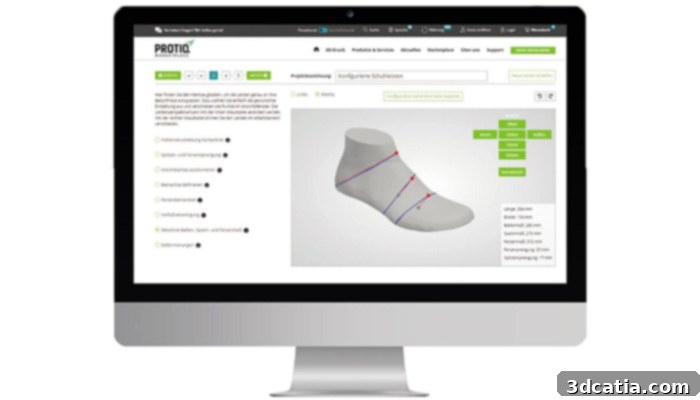
Trinckle’s software (photo credits: PROTIQ)
What are your thoughts on this groundbreaking solution developed by PROTIQ and its potential to transform custom orthopedic footwear? We invite you to share your insights and comments below, or engage with us on ourFacebook,Twitter andLinkedIn pages. Stay updated with the latest advancements in additive manufacturing by signing up for our free weeklyNewsletter here, delivering the most important 3D printing news directly to your inbox!
Thumbnail Photo Credits: PROTIQ