
Global Additive Manufacturing Market to Soar: $44 Billion by 2027 Driven by Innovation and Key Sectors
The landscape of global manufacturing is undergoing a significant transformation, with additive manufacturing, commonly known as 3D printing, at its forefront. A comprehensive study released by Research and Markets at the dawn of 2023 paints a remarkably optimistic picture for this dynamic industry. The report projects that the global additive manufacturing market will reach an impressive valuation of $44.03 billion by 2027, marking a substantial increase from an estimated $16.83 billion in the current year. This trajectory represents a robust Compound Annual Growth Rate (CAGR) of 21% between 2021 and 2027, underscoring the industry’s undeniable momentum and its pivotal role in the future of production.
This rapid expansion is not merely a statistical projection but a reflection of tangible advancements and strategic shifts across various sectors. The study meticulously identifies and analyzes the primary catalysts driving this growth, with a particular emphasis on the escalating involvement of governments and public authorities worldwide. These entities are increasingly recognizing additive manufacturing’s potential and actively fostering its adoption through targeted subsidies, dedicated funding programs, and strategic initiatives. Beyond governmental influence, the report also highlights a fascinating trend towards miniaturization, delving into the emerging capabilities and applications of micro-printing technologies, which promise to unlock new frontiers in precision manufacturing.
While the upward trajectory of the additive manufacturing market has been evident for some time, the specifics of its propulsion often remain an intriguing subject. Is the growth primarily fueled by breakthroughs in machine technology, the development of novel materials, the emergence of innovative applications, or sophisticated software solutions? Which vertical markets hold the most significant promise for future expansion? The Research and Markets report offers invaluable insights by dissecting these very questions, providing a detailed analysis of the most sought-after types of 3D printers, the materials gaining the most traction, the transformative applications, critical components, and key geographical regions. For instance, within Europe, Italy is highlighted as a forthcoming primary growth engine over the next five years, signaling localized hotspots of innovation and adoption and contributing significantly to the continent’s overall market share.
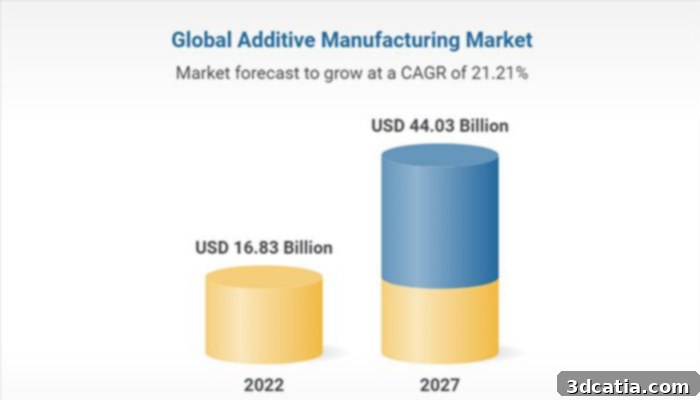
The growth of the additive manufacturing market, showcasing its dynamic expansion (photo credits: Research and Markets)
Key Drivers Propelling the Additive Manufacturing Market Forward
The Research and Markets study pinpoints several critical sectors and trends that are poised to accelerate the additive manufacturing market towards its projected $44 billion valuation by 2027. These drivers represent diverse industries, each leveraging 3D printing technology for unique, high-value applications that were previously impossible or impractical with conventional manufacturing methods:
Personalized Medicine and Healthcare Innovation
A significant impetus for market growth stems from the increasing demand for personalized medicine. Additive manufacturing technologies are uniquely positioned to revolutionize healthcare by enabling the design and production of custom tools, patient-specific implants, prosthetics, and surgical guides with unprecedented precision. This level of customization leads to better patient outcomes, reduced recovery times, and more effective treatments tailored to individual anatomical requirements. From biocompatible materials used in dental aligners and hearing aids to complex bioprinting research aimed at creating tissues and organs, 3D printing offers immense opportunities for bespoke medical solutions, moving beyond a one-size-fits-all approach and greatly enhancing therapeutic efficacy.
Aerospace Industry Resurgence and Advanced Manufacturing
Following disruptions caused by the COVID-19 pandemic, the aerospace industry is experiencing a strong resurgence, and with it, a renewed embrace of additive manufacturing. 3D printing allows for the creation of incredibly complex, lightweight parts that are impossible or cost-prohibitive to produce with traditional manufacturing methods. These components contribute to significant fuel efficiency improvements, reduced emissions, and enhanced structural integrity for both aircraft and spacecraft. Applications range from critical engine components and intricate brackets to interior cabin parts, demonstrating the technology’s ability to consolidate assemblies, optimize designs for superior performance, and streamline supply chains for both commercial and defense sectors, where reliability and efficiency are paramount.
Automotive Sector’s Quest for Lighter, More Efficient Parts
The automotive sector is another major revenue generator, driven by an escalating demand for lighter parts. As manufacturers strive for greater fuel efficiency in internal combustion engine vehicles and extended range in electric vehicles, reducing vehicle weight becomes paramount. Additive manufacturing offers sophisticated solutions for producing intricate, lightweight components with optimized geometries, leading to superior performance characteristics. The use of composite 3D printing, in particular, holds immense potential for creating strong yet ultra-light parts for both rapid prototyping during design cycles and end-use applications in high-performance vehicles, pushing the boundaries of vehicle design and operational efficiency.
While personalized medicine, aerospace, and automotive stand out as the most significant verticals to watch closely, generating substantial revenue, they are by no means the only contributors. Emerging applications in consumer goods and electronics are also demonstrating promising growth, driven by the desire for customization, rapid product development, and unique functional aesthetics. The ability to quickly iterate designs and produce bespoke items, from custom eyewear to intricate electronic housings, appeals strongly to these fast-paced, consumer-driven markets, allowing for unprecedented product personalization and innovation.
The Crucial Role of Government Support and Funding
Beyond specific industry sectors, the report highlights the increasingly crucial role of governments and public institutions in fostering additive manufacturing adoption. Through various mechanisms, including direct funding for research and development, competitive grants, tax incentives for companies investing in AM technologies, and the establishment of dedicated innovation hubs and training programs, governments can significantly lower barriers to entry and accelerate the proliferation of 3D printing technologies across diverse economic sectors. This comprehensive support not only facilitates technological advancement but also promotes the broader economic benefits of localized manufacturing, enhanced supply chain resilience, and the creation of high-skill jobs. Many countries have already recognized this transformative potential, and their proactive policies are a clear and powerful factor in the market’s current robust growth.
France provides a pertinent example of governmental engagement, albeit with varying degrees of sustained momentum. In 2017, the French government launched the “Industry of the Future” loan program, specifically designed to stimulate company investments in advanced manufacturing technologies, including 3D printing. More recently, in 2021, initiatives were put in place to actively encourage the 3D printing of spare parts as a strategic approach to combat waste, promote circular economy principles, and ensure the availability of critical components. While external factors, such as the global health crisis, may have temporarily slowed some of these initiatives, there is a clear and renewed imperative to revitalize and expand governmental support for additive manufacturing to fully realize its potential and ensure national competitiveness in advanced industries.
Deep Dive into Market Segmentation: Printers, Materials, and Applications
An Analysis of the Market by 3D Printer Segment
Understanding the internal dynamics of the additive manufacturing market requires a granular look at its core segments. The Research and Markets study first examines 3D printers themselves, categorizing them primarily into desktop machines and industrial solutions. In 2021, industrial 3D printers commanded the largest market share, a testament to their capacity for high-volume, precision, and robust production demanded by large-scale manufacturing operations across various sectors, including automotive and aerospace.
However, the report anticipates a significant surge in the importance of desktop solutions in the coming years. This projection suggests a two-pronged growth: on one hand, increased investment by individuals for personal use, hobbyist projects, and creative endeavors directly from home, making technology more accessible; on the other, a substantial uptake by universities, research centers, and educational institutions. These academic environments benefit immensely from the accessibility, lower cost, and ease of use of desktop printers for teaching, prototyping, and fundamental research, fostering a new generation of AM professionals. It’s crucial to note a nuanced point here: while personal use desktop printers will grow in numbers, the market’s overall drive towards industrialization, productivity, and automation, especially as observed at major industry events like Formnext 2022, suggests that the primary value growth remains firmly in the industrial segment. The evolution of desktop machines into ‘professional desktop’ solutions also blurs these lines, catering to small businesses and specialized applications that require industrial-grade output on a smaller scale, making this dynamic a key trend to monitor closely.
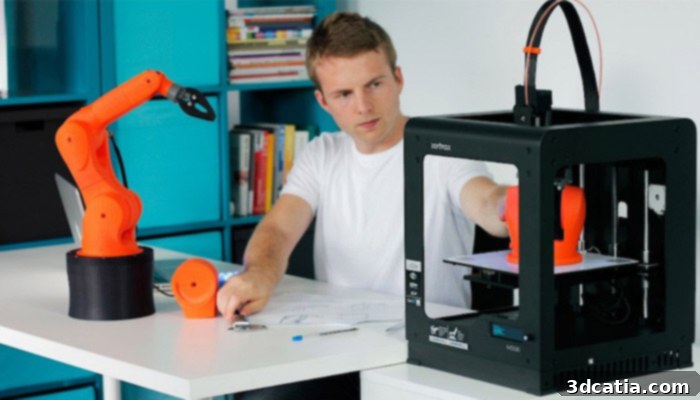
The increasing presence of 3D printers in various settings, from industrial facilities to educational institutions (photo credits: Zortrax)
Materials Driving Innovation: The Rise of Metals in Additive Manufacturing
The materials segment of additive manufacturing is a hotbed of innovation, profoundly influencing the capabilities and applications of the technology. The report strongly indicates that the next five years will be significantly boosted by the expanding use of metals in additive manufacturing processes. While metallic filaments for FDM-like processes are becoming more prevalent and accessible for less demanding applications, the cornerstone of industrial metal 3D printing remains sophisticated techniques such as laser powder bed fusion (LPBF), including Direct Metal Laser Sintering (DMLS). These industrial technologies not only attract substantial investment due to their unparalleled precision, mechanical performance, and repeatability but also offer a wide variety of uses across demanding industries like aerospace, medical, and automotive. The ability to produce parts with superior strength-to-weight ratios, intricate geometries, and reduced weight from materials like titanium alloys, aluminum, and stainless steel is a game-changer. Beyond metals, continuous advancements in high-performance polymers, ceramics, and composite materials further expand the horizon for additive manufacturing, enabling new functionalities, performance characteristics, and broader application scope across countless industries.
Applications: From Rapid Prototyping to Functional End-Use Parts
When analyzing applications, Research and Markets categorizes them into three primary groups: prototyping, tooling, and functional parts. Of these, prototyping continues to hold the most significant share across all processes, materials, and vertical markets. This dominance is largely due to additive manufacturing’s unparalleled ability to rapidly produce physical models for design validation, form and fit testing, and iterative development cycles, drastically reducing time-to-market and R&D costs for product development. Tooling applications, encompassing jigs, fixtures, molds, and patterns, are also highly impactful, improving manufacturing efficiency, offering customized solutions for production lines, and enabling greater flexibility. The most transformative growth, however, lies in functional end-use parts, where 3D printing transitions from a supportive role to direct part production, delivering custom, complex, and high-performance components that offer superior functionality, customization, and supply chain resilience for demanding applications previously unattainable.
Geographical Landscape of Additive Manufacturing Growth
A global perspective reveals distinct regional leadership in the additive manufacturing market. Unsurprisingly, the North American market is projected to maintain its position as the primary driver of market growth. This leadership is attributed to significant and sustained investments in research and development, a well-established ecosystem of technology providers and users, robust venture capital funding, and widespread adoption of 3D technologies across diverse industries, including defense, healthcare, and automotive. The deep integration of additive manufacturing into the industrial mindset and educational curriculum across North America provides a strong foundation for continued innovation and market penetration.
In Asia, China is identified as the leading force in advancing additive manufacturing. Propelled by substantial government support, massive domestic manufacturing capabilities, and a rapidly growing innovation ecosystem, China is aggressively investing in R&D and scaling up production. This includes a strong focus on developing indigenous technologies and expanding applications across various industries within the region and for export markets, positioning China as a global powerhouse in AM. Other Asian economies, particularly South Korea, Japan, and Singapore, are also making significant strides, contributing to the region’s overall dynamic growth.
Within Europe, while the report specifically highlights Italy as a key growth driver over the next five years, the continent as a whole presents a vibrant and evolving landscape for additive manufacturing. Countries like Germany, with its strong engineering, industrial, and automotive sectors, and the UK, with its focus on aerospace and medical applications, are also significant players. European Union initiatives aimed at fostering innovation, digital transformation, and sustainable manufacturing further bolster the market, emphasizing the strategic importance of advanced manufacturing techniques for regional competitiveness and economic resilience.
Overcoming Challenges and Embracing a Bright Future
Despite the overwhelmingly positive outlook, the additive manufacturing market still faces several challenges that need to be addressed for its full potential to be realized. Key hurdles include the persistent lack of comprehensive industry standards and certifications. For 3D printed parts to gain wider acceptance, especially in highly regulated sectors like aerospace, medical, and defense, universally recognized standardized processes, material specifications, and rigorous quality assurance protocols are absolutely essential. Efforts by organizations like ASTM International and ISO are actively underway, but broader industry adoption and regulatory enforcement are still required to instill full confidence.
Another significant barrier is the high initial investment associated with industrial-grade 3D printers, specialized materials, and complex post-processing equipment. While costs are gradually decreasing and financing options are improving, this initial capital outlay can still be prohibitive for many small and medium-sized enterprises (SMEs) looking to integrate additive manufacturing into their operations. Demonstrating a clear and measurable return on investment (ROI) and developing more accessible, modular, and user-friendly systems are crucial steps toward democratizing the technology and expanding its user base beyond large corporations.
Nevertheless, when considering the monumental progress made over the last five years—from groundbreaking material science discoveries to advancements in machine intelligence, software optimization, and automation—it is undeniable that additive manufacturing has a remarkably bright future ahead. Its transformative capabilities for design freedom, supply chain resilience, unprecedented customization, and sustainable manufacturing position it as a cornerstone technology for the 21st century industrial revolution. The market is not just growing; it’s evolving, maturing, and increasingly demonstrating its capacity to deliver real-world economic, environmental, and societal value across a myriad of applications.
For those interested in delving deeper into the granular details and extensive analysis provided by this pivotal study, the full report can be purchased HERE.
What are your thoughts on the projected growth and future of the 3D printing market? We encourage you to share your insights and predictions in the comment section below, or engage with us on our LinkedIn, Facebook, and Twitter pages! Don’t forget to sign up for our free weekly Newsletter here to receive the latest 3D printing news directly in your inbox! You can also explore our extensive video library on our YouTube channel for more engaging content.
*Cover Photo Credits: KUKA