

3D Printing Patent Wars Escalate: Stratasys Sues Bambu Lab Over Core FDM Technologies and Market Dominance
The normally dynamic and innovative 3D printing market has been rattled yet again, not by a technological breakthrough, but by another high-stakes legal battle over intellectual property. It may be August, but the industry is anything but quiet. This new development comes only four short months after Markforged was ordered to pay a substantial $17 million to Continuous Composites, marking the final chapter in a patent infringement lawsuit that had been ongoing since 2021. Now, a fresh and equally significant legal challenge has emerged, drawing the attention of the entire additive manufacturing community. This time, one of the pioneering giants of 3D printer manufacturing, Stratasys, has filed a comprehensive patent infringement lawsuit against the rapidly growing newcomer, Bambu Lab. This adds considerable weight to the ongoing wider discussion within the additive manufacturing sector regarding the critical importance and complex nature of intellectual property rights and their role in shaping industry competition and innovation.
Bambu Lab’s meteoric rise since its explosive market entry in 2022 has been nothing short of remarkable. The company quickly captured a significant share of the consumer and prosumer 3D printing market, largely due to its focus on speed, user-friendliness, and advanced features previously uncommon in affordable desktop machines. Despite facing some notable challenges over the past few years, including security concerns that the company itself proactively addressed, and a recall of its popular A1 3D printer due to potentially severe heating issues stemming from cable damage, Bambu Lab has continued its impressive growth trajectory. Indeed, a market intelligence report from CONTEXT published in April highlighted a clear trend: while sales for industrial, midrange, and professional 3D printers appeared to be slowing, the entry-level segment was experiencing robust growth. This growth, the report emphasized, was overwhelmingly driven by the unprecedented success of Bambu Lab, demonstrating its disruptive impact on the traditional market landscape.
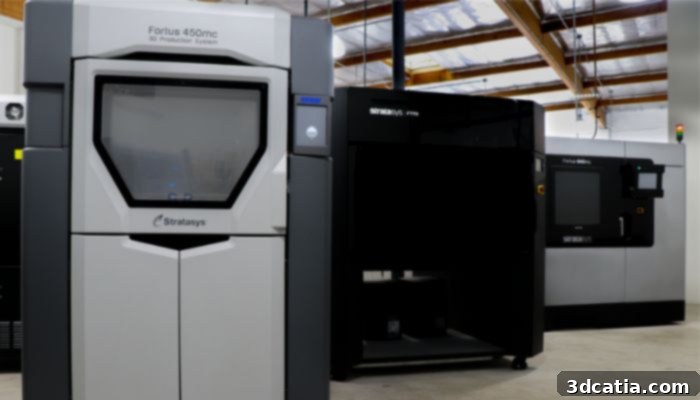
The patent infringement case from Stratasys centers on technologies and printers using FDM 3D printing, a core method pioneered by Stratasys (photo credits: Stratasys)
With this latest patent infringement lawsuit, it has become abundantly clear that established 3D printing solution providers are keenly observing and responding to the shifts in the market. Bambu Lab has undeniably made significant waves with its remarkably faster extrusion speeds, innovative multi-color 3D printing capabilities, and highly integrated systems. However, Stratasys is now asserting that these groundbreaking features are only achievable because Bambu Lab has allegedly infringed upon technologies patented by Stratasys. As a result, Stratasys has filed two distinct lawsuits, Civil Action No. 2:24-cv-644 and Civil Action No. 2:24-cv-00645, both in Texas. These lawsuits claim infringement for a broad array of US patents, including No. 9,421,713; No. 9,592,660; No. 7,555,357; No. 9,168,698; No. 10,556,381; No.10,569,466; No. 11,167,464; No. 8,747,097; No. 11,886,774; and No. 8,562,324. Notably, the first five patents listed hold particular relevance for the consumer 3D printing market, hinting at the core technologies at the heart of Bambu Lab’s popular machines.
A Closer Look at the Patent Infringement Lawsuit by Stratasys Against Bambu Lab
Understanding the true implications of these patent infringement claims requires a deeper dive into what they actually mean for the industry. The patents in question cover a wide range of factors, many of which are arguably considered key features in numerous new desktop 3D printers currently on the market. This broad scope potentially opens the door for more manufacturers to face similar lawsuits if Stratasys is successful in its claims against Bambu Lab. This is particularly true for the first lawsuit (cv-644), which specifically addresses patent infringements related to the 3D printers themselves. These claims encompass fundamental aspects such as the additive manufacturing process employed, the use of purge towers essential for multi-material printing, and even the presence and functionality of a heated build platform. The second case (cv-645), while perhaps less broad in its initial scope, primarily concerns a 3D printer’s sophisticated ability to automatically recognize the type of installed filament, a feature present in many advanced consumer machines for optimal printing settings.
In greater detail, lawsuit cv-644 alleges that Bambu Lab has infringed upon several core Stratasys patents. These relate to critical functionalities and methods including: the use of a patented additive manufacturing method for printing 3D parts that incorporate purge towers (an indispensable component for efficiently switching between different colors or materials in multi-color and multi-material printing setups); advanced heated build platform systems specifically designed for printing with thermoplastics, which include a precise temperature control unit and feature a polymer coating on the print surface rather than traditional tape (a design choice often made for compatibility with more technical and demanding materials); the fundamental use of an extrusion-based layer deposition system, which is essentially the very definition of Fused Deposition Modeling (FDM) 3D printing; and two patents specifically related to 3D printers equipped with contact force detection systems. These contact force patents are particularly focused on the ability to detect contact force against an extruder or other tool head, crucially, during the fabrication process itself, enabling features like automatic bed leveling and collision detection.

Stratasys has named the entire line of Bambu Lab 3D printers in the lawsuit, including popular models like the P1S, highlighting the breadth of their claims (photo credits: 3Dnatives)
The patents cited in these lawsuits are directly related to features that are widely employed by a multitude of 3D printer manufacturers across the industry, particularly those focusing on FDM technology. These include, but are not limited to, the integration of heated build beds, the core FDM 3D printing systems, and the increasingly common use of purge towers for multi-color capabilities. This naturally encompasses Bambu Lab, a company celebrated for its high-speed, effective multi-color printing solutions, often featuring heated chambers across its entire product line. The lawsuit specifically names a comprehensive list of Bambu Lab’s popular printing solutions, including the A1, A1 mini, P1S, X1-Carbon, and P1P. It is important to note that it appears all these patents are currently held by Stratasys, with extended deadlines reaching well past 2030 in most cases, granting them significant longevity. The onus is now on Bambu Lab to either successfully demonstrate that their technologies do not infringe upon these patents or to prove that the patents themselves are not valid or enforceable.
Broader Implications and Precedents in 3D Printing Patent Law
As of now, predicting the exact outcome of this high-profile legal battle is challenging, given the complexities of patent law and the significant stakes involved for both parties and the wider industry. Past lawsuits initiated by Stratasys have seen varied results; for instance, their case against Afinia ultimately failed, serving as a reminder that legal victories are far from guaranteed. However, the industry also vividly remembers the significant case between Formlabs and 3D Systems, where Formlabs was indeed required to pay for proven patent infringement, underscoring the serious financial and operational consequences such lawsuits can carry. Many supporters of Bambu Lab and the broader hobbyist community perceive this lawsuit as a direct assault on the rapidly expanding and increasingly accessible commercial 3D printer market. They view it as an attempt by an established industry titan to curb the rapid ascent of innovative Chinese companies that have begun to dominate the consumer 3D printing space through their competitive pricing and advanced features. However, it is also crucial to remember that, at present, the patent infringement claims are only relevant for printers sold within the USA, with no other geographical regions explicitly named in the current filings. In addition to Bambu Lab, other companies named in these civil action lawsuits include Tiertime, Contour Technology, Beijing Yinhua Laser Rapid Prototyping and Mould Technology, and Tuozhu Technology Limited, suggesting a broader focus on technologies originating from certain regions or adopting similar approaches. Interested parties can access the full details of cv-644 HERE and cv-645 HERE.
Bambu Lab’s Initial Response and the Road Ahead
*Update August 10th, 2024: Following the initial news of the lawsuit, Bambu Lab released an official statement on X (formerly Twitter) regarding the legal proceedings. The company stated: “We have taken note of the relevant information. As of now, we have not received any formal documents from the court, but we are closely monitoring the situation. We will actively respond to this case in accordance with the appropriate legal procedures to protect our legitimate rights and interests. Bambu Lab has always advocated for and upheld the principles of respecting and protecting intellectual property. Through continuous research and technological innovation, we strive to provide our users with the best possible 3D printing experience. We also advocate our industry peers to drive the development of the sector through genuine technological innovation.” This statement indicates Bambu Lab’s intent to vigorously defend itself against the allegations, emphasizing its commitment to intellectual property while also highlighting its focus on internal R&D and innovation. The coming weeks and months will be critical as both parties prepare their legal arguments, potentially setting a significant precedent for how established patent holders and disruptive newcomers coexist and compete within the fast-evolving 3D printing industry. We will continue to monitor the situation closely and provide further updates as they emerge regarding this pivotal case.
What are your thoughts on the Stratasys lawsuit against Bambu Lab? How do you think this high-profile case could impact the hobbyist FDM 3D printing market, as well as the broader additive manufacturing landscape? Share your insights and predictions with us in the comments section below, or join the conversation on our LinkedIn, Facebook, and Twitter pages! Don’t forget to sign up for our free weekly newsletter here to receive the very latest 3D printing news and developments straight to your inbox! You can also find all our engaging videos and in-depth discussions on our YouTube channel.