
Inkbit’s AI-Powered 3D Printer: Revolutionizing Multimaterial Additive Manufacturing with Vision and Intelligence
The landscape of additive manufacturing (AM) is constantly evolving, driven by innovations that push the boundaries of what’s possible. While MIT has long been at the forefront of this evolution, notably through initiatives like the Additive and Digital Advanced Production Technologies (APT) consortium dedicated to accelerating AM implementation, a groundbreaking startup emerging directly from its labs is taking a profoundly different approach. Inkbit, a pioneering company, is set to redefine industrial 3D printing by integrating advanced artificial intelligence and machine vision into its core technology. Their goal is ambitious: to transcend the traditional limitations of 3D printing, enabling unprecedented precision and the use of a wider array of materials for true end-part production.
Inkbit’s journey began with a vision to overcome persistent challenges in additive manufacturing, such as material limitations, inconsistent print quality, and the inability to reliably produce functional, multimaterial parts. The solution they developed is an industrial 3D printer that stands apart from its competitors. This sophisticated machine is not just capable of multimaterial printing, but it also boasts extraordinary accuracy, particularly when working with highly flexible materials. It’s a significant leap forward, designed to bring industrial-grade performance and reliability to processes that were once limited to prototyping or simpler material applications.
The “Eyes and Brain” Behind Intelligent 3D Printing
What truly distinguishes Inkbit’s technology is its innovative integration of machine vision and machine learning – systems that effectively give its machines “eyes” and a “brain.” This intelligent approach addresses fundamental issues that plague traditional 3D printing. The multimaterial inkjet printer is equipped with high-resolution machine-vision cameras that meticulously scan each layer as it is being printed. This real-time inspection system is crucial; it can detect and correct errors instantaneously, preventing cumulative inaccuracies that often lead to failed prints or subpar part quality. By actively monitoring the print process, the machine ensures that each successive layer adheres perfectly to the design specifications, significantly enhancing overall reliability and precision.
Complementing the machine-vision system is a powerful machine-learning algorithm. This “brain” processes the vast amounts of data collected by the vision system, learning the unique properties and behaviors of different materials during the printing process. Crucially, it uses this information to predict how materials will warp, shrink, or deform under various printing conditions. Traditional 3D printers often struggle with material inconsistencies, requiring extensive trial and error to optimize settings. Inkbit’s machine, however, continuously learns and adapts, dynamically adjusting parameters to compensate for material idiosyncrasies. This predictive capability is a game-changer, enabling consistent, high-quality output even with notoriously difficult materials, and dramatically reducing development cycles for new applications.
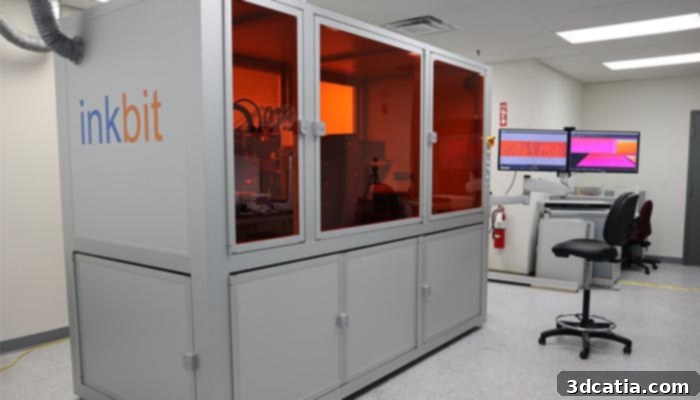
Inkbit’s 3D printer: Integrating machine vision for enhanced precision. | Credits: Inkbit
Unlocking the Potential of Multimaterial and Functional Parts
One of the most compelling aspects of Inkbit’s offering is its advanced multimaterial capabilities. The ability to print with a diverse range of materials, including challenging ones like silicone-based rubber-like polymers and high-temperature epoxies, opens up entirely new avenues for manufacturing. These materials are prevalent in conventional manufacturing processes due to their specific mechanical and thermal properties, yet they have historically been extremely difficult to process using 3D printing. Issues such as nozzle clogging, significant shrinkage, and edge rounding over time have limited their widespread adoption in AM. Inkbit’s co-founders have dedicated years to solving these very problems, understanding that overcoming these material hurdles is key to unlocking the true potential of additive manufacturing for end-use parts.
As Wojciech Matusik, co-founder of Inkbit, eloquently explains, “Before, people could make prototypes with multimaterial printers, but they couldn’t really manufacture final parts. This is something that’s not possible using any other manufacturing methods.” This statement highlights a critical distinction: Inkbit’s technology enables the production of fully functional, complex parts with multiple material properties integrated within a single print. This capability extends beyond simple multimaterial components; the printer can precisely fabricate intricate structures, even printing directly around delicate electronic components or computer chips. Once an object is finalized, the system retains a digital replica, providing an invaluable resource for stringent quality assurance and traceability throughout the product lifecycle. This level of integrated functionality and quality control is a significant step towards full industrial adoption of AM.
Transforming Industries: From Idea to Usable Product
The implications of Inkbit’s advanced 3D printing technology are far-reaching, promising to revolutionize several key industries. Companies in the medical device sector, for instance, could benefit immensely from the ability to produce highly customized, multimaterial implants or patient-specific surgical guides with unprecedented precision. The consumer products market could see an explosion of personalized, functional items, while the automotive industry could leverage the technology for rapid prototyping of complex components, tooling, and even end-use parts requiring specific material combinations for optimal performance and durability. Davide Marini, CEO and co-founder of Inkbit, encapsulates this transformative potential: “Everyone knows the advantages of 3D printing are enormous. But most people are experiencing problems adopting it. The technology just isn’t there yet. Our machine is the first one that can learn the properties of a material and predict its behavior. I believe it will be transformative, because it will enable anyone to go from an idea to a usable product extremely quickly. It opens up business opportunities for everyone.“
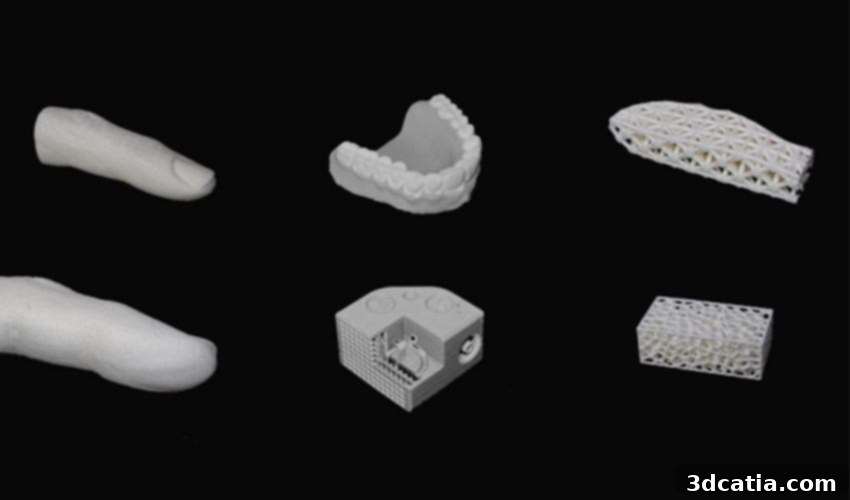
This vision of accelerating product development from conception to tangible reality is at the heart of Inkbit’s mission. The ability to reliably print complex lattice structures, as showcased in their examples, demonstrates the machine’s capacity for creating lightweight, high-performance parts with optimized mechanical properties—a critical advantage in fields requiring advanced engineering. Specific applications where this technology is poised to make a significant impact include the production of custom dental aligners, intricate industrial tooling, and even specialized medical devices like apnea masks, where material flexibility and precise fit are paramount. The seamless integration of diverse materials within a single manufacturing process offers engineers and designers unparalleled freedom, previously unattainable with conventional methods or earlier generations of 3D printers.

Examples of 3D printed complex lattice structures by Inkbit. | Credits: Inkbit
Market Strategy and Future Outlook
Inkbit’s strategic rollout reflects a careful approach to market penetration and technology adoption. Rather than immediately launching its industrial machines, the startup plans to first introduce 3D printed products to the market later this year. This initial phase will allow them to demonstrate the capabilities and quality of their technology through tangible applications, building trust and validating the demand for their unique offerings. This allows potential customers to experience the benefits of Inkbit’s advanced parts firsthand, showcasing the superior quality, material flexibility, and precision that their ‘eyes and brain’ system delivers. This customer-centric approach also provides Inkbit with valuable feedback, enabling them to fine-tune their processes and production capabilities before a broader release. Following this introductory period, the company will commence selling its innovative 3D printing machines to businesses and manufacturers next year, allowing for wider industrial adoption.
The success of Inkbit’s machine will largely depend on the market’s reception of this novel technology and its ability to consistently deliver on its promises of speed, precision, and material versatility. Given the undeniable demand for more sophisticated and reliable additive manufacturing solutions, Inkbit has the potential to carve out a significant niche, playing an important and transformative role in various high-value markets. Their approach tackles fundamental barriers that have hindered the full realization of 3D printing’s potential, moving it firmly from a prototyping tool to a robust, intelligent manufacturing platform capable of producing complex, functional end-use products. This could mark a new era of intelligent, adaptive manufacturing, making advanced production more accessible and efficient for industries across the globe.
Conclusion: The Dawn of Intelligent Additive Manufacturing
Inkbit’s emergence from MIT represents a pivotal moment in the evolution of 3D printing. By uniquely integrating machine vision and machine learning into its multimaterial inkjet technology, the company is not merely improving existing processes but fundamentally reimagining what industrial additive manufacturing can achieve. The ability to correct errors in real-time, predict material behavior, and reliably print with challenging flexible and high-temperature materials moves 3D printing firmly into the realm of true end-part production. This intelligent approach streamlines development cycles, enhances quality assurance, and unlocks vast opportunities for innovation across critical sectors like medical devices, consumer goods, and automotive components. As Inkbit prepares to introduce its advanced products and machines to the market, it heralds a future where complex designs and multimaterial functionality are not just possible, but consistently precise and readily achievable, truly accelerating the transition from concept to usable product with unprecedented speed and intelligence.
You can find more information HERE.
What are your thoughts on Inkbit’s groundbreaking new 3D printer and its intelligent manufacturing capabilities? We invite you to share your insights in a comment below or join the conversation on our Facebook and Twitter pages! Don’t miss out on the latest advancements and news in the world of 3D printing – remember to sign up for our free weekly Newsletter, delivered straight to your inbox with all the essential updates!