
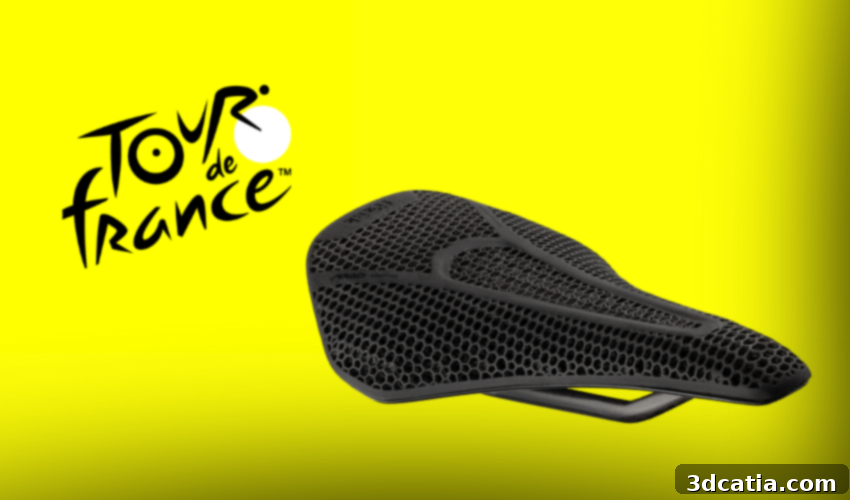
3D Printed Saddles: Tadej Pogačar’s Secret Weapon and the Future of Elite Cycling Performance
While the final stage of the Tour de France is a spectacle of speed, strategy, and pure athletic prowess, sometimes the most profound innovations operate subtly beneath the surface. In a scene dominated by pedaling power and relentless endurance, one of the unsung heroes of Slovenian cyclist and Tour de France victor Tadej Pogačar’s triumph wasn’t his legs, but an advanced piece of equipment that didn’t even move. A sleek, state-of-the-art $400 3D printed saddle played a crucial, silent role in shaping his remarkable victory. This isn’t just any saddle; it’s a testament to the transformative power of additive manufacturing, specifically utilizing technology from Carbon Adaptive, which provided Pogačar with a distinct advantage during the arduous final stage in Paris and throughout the entire gruelling race.
The innovative device, known as the Vento Argo 00 Adaptive, is the brainchild of the renowned Italian cycling brand Fizik. Its emergence on the professional circuit signals a significant and accelerating trend where the demanding world of elite sports increasingly intersects with cutting-edge additive manufacturing technologies. What makes these saddles revolutionary is their bespoke nature. Each Vento Argo 00 Adaptive saddle is meticulously tailored and customized to the individual rider, leveraging Carbon Adaptive’s exclusive One-to-One Program. This highly specialized program employs Digital Light Synthesis (DLS) technology to precisely 3D print a complex lattice structure. This structure is not generic; it’s intricately designed and entirely unique, engineered specifically to the athlete’s distinct anatomy, biomechanical data, and individual riding style. For a champion like Pogačar and his UAE Team Emirates, this meant equipping him with an ultra-lightweight, high-performance saddle capable of enduring the immense stresses and demands of one of the most physically challenging global cycling events.
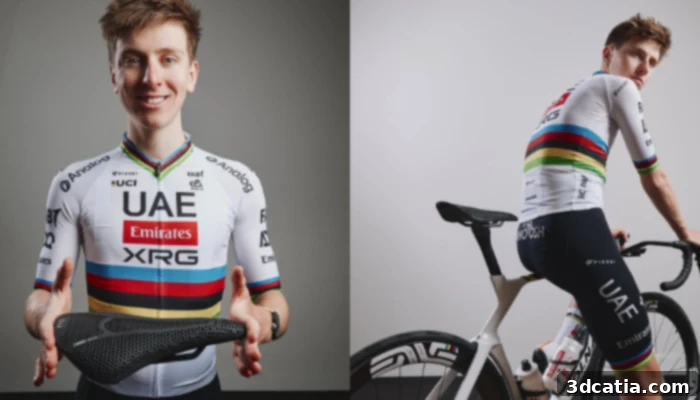
The adaptive 3D printed lattice and full carbon frame deliver both comfort and speed, showcasing the precision of additive manufacturing. (Credit: Fizik, Carbon Adaptive)
Unprecedented Customization and Performance: The Advantages of Adaptive 3D Printing
Traditional bike saddles, often constructed from foam padding over a rigid shell, typically provide a uniform feel and limited adaptability across their entire surface. While adequate for many, this conventional approach falls short of optimizing performance and comfort for elite athletes where every marginal gain counts. The Vento Argo 00 Adaptive radically departs from this standard. Its DLS-printed lattice enables the creation of micro-tuned zones of stiffness, compliance, and support precisely where the rider needs them most. This innovative zoning capability allows for significantly better pressure distribution across the saddle, which is crucial for reducing discomfort, minimizing numbness on long distances and steep inclines, and ultimately enhancing blood flow and sustained power output for the rider.
The inherent nature of 3D printing allows for a level of geometric complexity and customization that was previously unattainable through conventional mass production methods. This means Fizik can create saddles that are not just comfortable, but biomechanically optimized for individual athletes. The move to additive manufacturing represents a strategic shift for Fizik, focusing on creating products that are specifically tailored to meet the exacting demands of professional and aspiring cyclists alike. While a standard version of the Vento Argo 00 Adaptive is indeed available for discerning consumers, the specific saddle utilized by Tadej Pogačar at the Tour de France was an intensely customized and fine-tuned iteration. Every aspect of its design was precisely calibrated to ensure maximum efficiency, comfort, and aerodynamic advantage, providing every conceivable marginal gain necessary to excel in the world’s most prestigious cycling race.
The Growing Impact of 3D Printing in Elite Sports and Beyond
The prominent presence of sophisticated 3D printed saddles in an event as high-profile as the Tour de France is clear evidence of a profound technological shift occurring across the landscape of elite sports. This isn’t an isolated incident; additive manufacturing is rapidly becoming an integral component in the design, development, and production of equipment used in training and racing at the absolute highest echelons of athletic competition. From specialized football cleats offering enhanced grip and personalized fit, to lightweight and structurally optimized bike components, and even custom-molded protective gear and seating solutions, the advantages of 3D printing are undeniable. This technology allows engineers and designers to move beyond the limitations of traditional manufacturing, enabling the creation of complex geometries and material properties previously thought impossible.
As the capabilities of customization continue to advance, driven by improved material science and more sophisticated printing processes like DLS, athletes are consistently able to push the boundaries of both their physical performance and their endurance thresholds. The ability to fine-tune equipment to an athlete’s unique physiological data provides a significant competitive edge. This extends beyond just cycling saddles; it encompasses everything from bespoke insoles that correct gait imbalances, to custom prosthetic limbs for para-athletes, and even advanced aerodynamic components for various sporting vehicles. The integration of data analytics, biomechanical scanning, and rapid prototyping via 3D printing is fundamentally changing how sports equipment is conceived, designed, and manufactured, fostering an environment where innovation leads directly to improved athletic outcomes and greater competitive fairness.
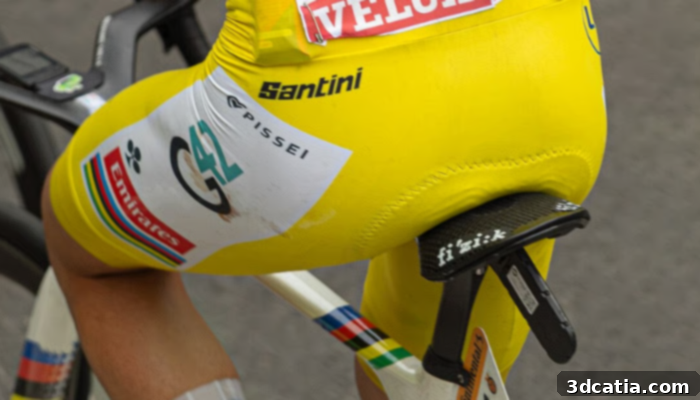
Tadej Pogačar’s custom 3D printed saddle, a key element in his performance during Stage 21 of the Tour de France. (Credit: Fizik)
The Future is Now: Personalization and Innovation in Sports Equipment
The story of Tadej Pogačar’s 3D printed saddle is more than just an anecdote from a single race; it’s a powerful indicator of the future trajectory for sports equipment design and athlete performance optimization. This technology heralds an era where “off-the-shelf” solutions become increasingly insufficient for those striving for peak performance. Instead, a paradigm of personalized, data-driven design will become the norm. Imagine equipment that evolves with an athlete’s training, adapting to subtle changes in their body and performance metrics over time. This level of responsiveness and precision, enabled by additive manufacturing, offers unprecedented opportunities for athletes to maximize their potential, minimize injury risks, and extend their careers.
Furthermore, the advancements in 3D printing are not limited to elite athletes. As production costs decrease and accessibility increases, we can expect to see highly customized equipment become more available to amateur enthusiasts, providing them with enhanced comfort, performance, and injury prevention benefits. The ability to print on demand also carries significant sustainability advantages, reducing waste and minimizing the environmental footprint associated with traditional mass production. The integration of artificial intelligence and machine learning with 3D printing processes will unlock even greater potential, allowing for predictive design modifications and optimized material utilization. The narrative of the 3D printed saddle at the Tour de France is just the beginning of how additive manufacturing will redefine what’s possible in sports, pushing the boundaries of human performance and technological innovation hand-in-hand.
What are your thoughts on the impact of 3D printed saddles and other custom sports equipment at events like the Tour de France? Do you believe this level of personalization fundamentally changes the competitive landscape, or is it simply the natural evolution of sports technology? If you’re intrigued by the Vento Argo 00 Adaptive and wish to explore its features further, you can find more information HERE. We invite you to share your perspectives and engage in the conversation. Let us know your opinions in a comment below or join the discussion on our LinkedIn and Facebook pages! Don’t forget to sign up for our free weekly Newsletter here to receive the latest 3D printing news directly to your inbox. You can also explore all our insightful videos on our YouTube channel for more additive manufacturing content.
*All Photo Credits: Fizik, Carbon Adaptive, & UAE Team Emirates