
Empowering Innovation: Celebrating Women’s Impact and Driving Diversity in 3D Printing
International Women’s Day, observed globally every year on March 8th, stands as a powerful testament to the remarkable achievements of women worldwide and the significant strides made towards gender equality. It is a day of celebration, acknowledging the invaluable contributions women have made across all sectors of society. However, beyond celebration, it also serves as a crucial day for reflection, urging us to consider the persistent challenges and the further advancements required to achieve genuine gender parity across the globe. In the spirit of this vital day, we embarked on a journey to engage with six highly influential women in the realm of 3D printing. Our aim was not only to shed light on the current landscape for women in this cutting-edge industry but also to deeply consider the ongoing efforts, learning, and growth necessary to cultivate an even more inclusive and welcoming environment for women in additive manufacturing (AM) in the years to come.
The profound gender disparities within Science, Technology, Engineering, and Mathematics (STEM) fields have long been a recognized and extensively discussed issue. While young girls and boys often participate in science and math classes at similar rates throughout primary and secondary education, a concerning trend emerges as they advance to higher education. Women are significantly less likely than their male counterparts to pursue STEM degrees at university levels, and this disparity becomes even more pronounced when examining workforce participation in STEM careers. Engineering, in particular, exhibits one of the most significant gender gaps, a challenge that regrettably permeates the additive manufacturing sector as well. To gain deeper insights into the status of women in this rapidly evolving field, we had the privilege of speaking with six prominent figures in the world of 3D printing. These visionary leaders shared their perspectives on the evolution of women’s presence, the persistent barriers to participation, and their recommendations for fostering greater female involvement in the industry. Our esteemed interviewees included: Michelle Bockman, CEO of 3D Control Systems; Marie Langer, CEO of EOS; Mariel Diaz, CEO and founder of Triditive; Cindy Deekitwong, Global Head of Marketing at Henkel; Anne Debauge, Digital Director for Pack&Dev at L’Oréal; and Elena López, Head of AM at Fraunhofer IWS. Their collective wisdom offers a comprehensive view of the challenges and opportunities for women in 3D printing.
-

- Michelle Bockman, the CEO of 3D Control Systems

-
- Anne Debauge, the Digital Director of Pack&Dev at L’Oréal

-
- Cindy Deekitwong, Global Head of Marketing at Henkel

-
- Mariel Diaz, CEO of Triditive

-
- Marie Langer, the CEO of EOS

-
- Elena López, the Head of AM at Fraunhofer IWS

Addressing the Persistent Barriers to Women’s Participation in Additive Manufacturing
Despite the industry’s rapid growth and innovative spirit, it is undeniable that significant barriers still hinder the full participation of women in the additive manufacturing field. Mariel Diaz, CEO of Triditive, incisively points out three primary areas that impede greater female involvement: funding, prejudice, and inclusiveness. “The barriers mainly fall into three areas: funding, prejudice and inclusiveness,” Diaz explains. She elaborates on the critical need to challenge and dismantle existing prejudices against women in the technical sectors. Furthermore, she highlights the “irrefutable lack of funding for women’s entrepreneurial ideas in the industry,” a systemic issue that starves promising female-led ventures of the capital they need to thrive. Finally, Diaz underscores the responsibility of men in technology, urging them to actively inquire about their contributions to increasing female representation, rather than solely placing the burden on women. She also observed the practical difficulty in reaching a female audience during recruitment, as significantly fewer women apply for these specialized roles compared to men. To overcome this, Diaz advocates for actively highlighting and celebrating female role models already excelling in the industry. By showcasing these successful women, the industry can inspire more girls and women to envision a place for themselves in 3D printing. She further stresses the importance of supporting women’s initiatives in 3D printing and broader STEAM (Science, Technology, Engineering, Arts, and Math) fields. Without a concerted, multi-faceted approach to address these interconnected issues, any effort to boost women’s presence in additive manufacturing will struggle to achieve truly meaningful and lasting impact.
It is crucial to recognize that the challenges faced by women in additive manufacturing are not isolated; they mirror broader systemic issues affecting women across numerous industries. Marie Langer, CEO of EOS, eloquently articulates that barriers for women in AM are deeply rooted in a societal tendency to prioritize men across nearly all sectors. She powerfully illustrates this point: “Think about smartphones, navigation systems, crash test dummies or diagnostic tests for heart attacks. These are just some examples of products where women weren’t included in the development process. The result? Some smartphone sizes are not made for female hands. The first version of the navigation system didn’t recognize female voices. And, it’s less likely that women survive a car accident or heart attack due to missing gender parameters.” This lack of female input during critical design and development phases leads to products and services that are inherently biased and often suboptimal, or even dangerous, for half the population. Therefore, addressing gender disparity necessitates the intentional inclusion of women at every stage of decision-making, not merely in token positions. All six influential women interviewed universally emphasized that fostering greater diversity, particularly by including women, on teams leads to more innovative, effective, and ultimately beneficial outcomes for the industry as a whole. When the perspectives of 50% of the population are overlooked, it is inevitable that critical insights will be missed, resulting in far-reaching consequences—ranging from products that fail to meet diverse user needs to systemic inequities that hinder progress and innovation.
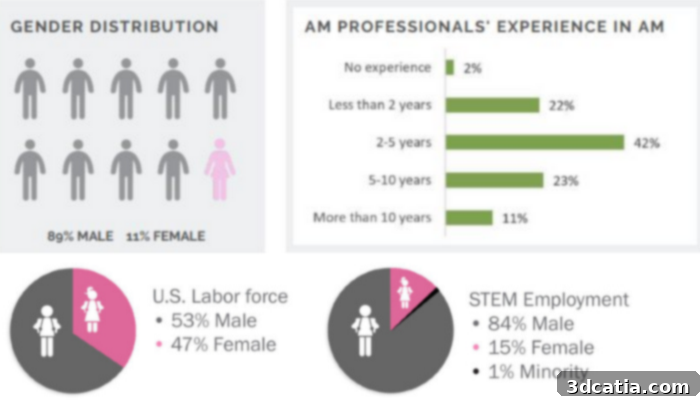
There are still far fewer women than men in the industry, with data from 2018 showing a 2% decrease in women’s participation in the field from the previous year. This is reflective of a wider issue in STEM where there are less women (photo credits top: Alexander Daniels Global, Additive Manufacturing Salary Survey, 2018; photo credits bottom: 3D Printing Academy for Girls)
Despite these significant hurdles, Michelle Bockmann, CEO of 3D Control Systems, expresses optimism, believing that tangible pathways exist to overcome these entrenched barriers. She observes a positive shift in the industry: “I am seeing more and more women (and allies) supporting the hiring of females which is a great indicator to the barrier being broken down. I truly believe that having a diverse team helps create the best products…after all, women purchase over half of the products being built.” Her insight highlights a crucial dynamic: as more women ascend to positions of influence and leadership within additive manufacturing, the likelihood of more women being hired, mentored, and promoted within the field naturally increases. This creates a virtuous cycle of inclusion. This strategy is not merely about achieving quotas; it underscores a fundamental principle espoused by many women leaders in 3D printing: true diversity begins with cultivating diversity within teams themselves. By intentionally building diverse teams, companies not only broaden their pool of applicants but also enhance their ability to recognize and value a wider range of talents and perspectives, ultimately leading to superior innovation and market relevance.
The Promising Evolution of Women in the 3D Printing Industry
Despite the persistent challenges, there is a palpable sense of hope and evidence of gradual but meaningful progress within the 3D printing industry. A recurring theme highlighted by the women we interviewed is the indispensable role played by organizations such as Women in 3D Printing. This influential body is consistently praised for its critical efforts in drawing attention to gender disparities, advocating for greater visibility for women, and fostering a supportive community within the sector. This work is especially vital in an industry that has historically been, and largely remains, male-dominated. Marie Langer acknowledges the slow pace of change, stating, “To be honest, I would say we are only slowly progressing here and there is still a way to go. 3D printing still is a very male dominated industry.” However, she quickly adds a note of optimism: “On the other hand, organizations such as Women in 3D printing have been doing a great job over the last few years in constantly changing perception, giving women in this industry a voice and opening up new opportunities for women in the industry.” Their efforts are not just about advocacy; they are about creating tangible pathways and communities that empower women and drive systemic change.
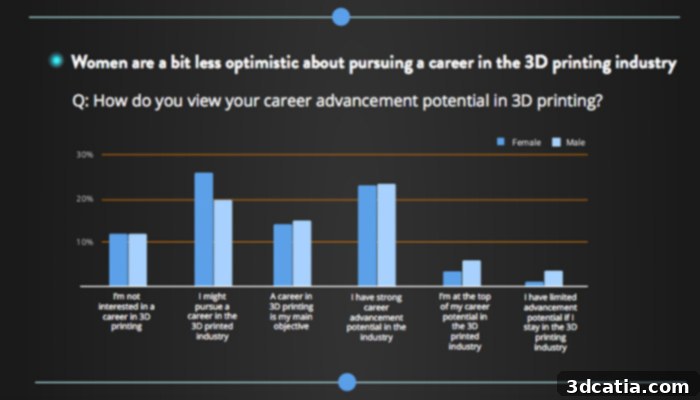
A joint Sculpteo and Women in 3D printing report showed that women are slightly less optimistic than their male peers about pursuing a career in the 3D printing industry. However, that could easily change as more women come into the industry (photo credits: Sculpteo/Women in 3D Printing)
While the pace of change may sometimes feel incremental, it is clear that significant advancements have indeed been made. Elena López, with 16 years of experience in the field, reflects on this evolution: “I have been working for 16 years and my feeling is that we are becoming more and more diverse. At the beginning of my career, I saw almost only gray-haired men over 60 years old around me in positions of responsibility. With the TIPE conference a few weeks ago, we saw a women-only 3D-printing conference with thousands of participants: unthinkable not too long ago! Sure it still seems like a slow evolution, but we are facing many thousands of years of history until a clear emancipation of women.” Her perspective highlights the profound shift from a largely homogenous leadership landscape to one that is visibly embracing diversity. The success of initiatives like the TIPE conference, which brings together thousands of women in 3D printing, serves as a powerful indicator of this transformation and the burgeoning community of female professionals. Cindy Deekitwong expresses particular enthusiasm regarding the progress already achieved, declaring, “It’s the perfect time to be a female working in the additive manufacturing industry. From the C-Suite on down, more women are entering the business and making an impact…Numbers have shifted dramatically with women now holding 32% of positions that have ‘business responsibility.’” This statistic is particularly encouraging, signifying that women are not just entering the field but are also ascending to influential roles where they can shape strategy, drive innovation, and mentor future generations. These combined observations paint a picture of an industry undergoing a positive, albeit ongoing, transformation towards greater gender inclusion and equality.
Actionable Recommendations to Accelerate Women’s Presence in 3D Printing
If the goal is to significantly narrow the gender gap in additive manufacturing, a substantial and concerted effort is still required. However, this is far from an insurmountable challenge. There are numerous proactive strategies and approaches that can be implemented to enhance the presence of women, not only within the AM industry but across STEM fields in general. The most insightful and effective recommendations often come directly from the women who are already navigating these industries, as they possess a unique understanding of the specific challenges that need to be addressed. Our six influential women in 3D printing generously shared their final thoughts and actionable advice on how to effectively increase female representation in additive manufacturing.
“I think that national education has a role to play on this. As soon as I have the opportunity, I share education initiatives to young people in fablabs to be able to deploy them more widely.” – Anne Debauge
Anne Debauge’s insight emphasizes the foundational importance of early exposure and education. National education systems are pivotal in shaping career aspirations from a young age. By integrating 3D printing and broader STEM concepts into curricula and supporting initiatives like fablabs, which provide hands-on learning experiences, we can spark interest in these fields among girls much earlier. Widespread deployment of such educational programs can demystify additive manufacturing and make it more accessible, illustrating its creative and practical applications, thus inspiring the next generation of female innovators.
“If you are a hiring manager or a leader in your company, you need to have diversity on your team, and if you don’t, you are probably not building the best product you could.” – Michelle Bockman
Michelle Bockman’s statement is a direct call to action for leadership. It moves beyond diversity as a moral imperative, framing it as a strategic business advantage. Diverse teams bring varied perspectives, experiences, and problem-solving approaches, leading to more robust innovation, better product design, and a deeper understanding of diverse customer bases. For hiring managers, this means actively seeking out female candidates, challenging unconscious biases in the recruitment process, and creating an inclusive culture where all voices are valued. A lack of diversity is a missed opportunity for optimal product development and market success.
“It is important to show more female role models and generate more interest in STEAM work, making more women and girls see that they can also be part of the 3D printing industry, supporting more women’s initiatives in 3D printing and STEAM in general.” -Mariel Diaz
Mariel Diaz reiterates the profound impact of visible role models. When young girls and women see successful female engineers, designers, and entrepreneurs in 3D printing, it dismantles stereotypes and provides tangible proof that these careers are attainable. This goes hand-in-hand with cultivating interest in STEAM through targeted programs and initiatives. Supporting and amplifying women-led projects and organizations within 3D printing and STEAM creates a positive feedback loop, encouraging more participation and fostering a sense of community and belonging.
“Much has been achieved in recent years! The important thing now is to keep going strong for those who come after us: giving talks, acting as mentors, encouraging in private meetings that it can be achieved and awakening interest in science and technology from our positions of influence, are key.” – Elena López
Elena López underscores the responsibility of current female leaders to pave the way for future generations. Her recommendation transcends formal programs, highlighting the power of personal engagement. By sharing their journeys through public talks, offering mentorship, and providing private encouragement, experienced women can directly inspire and guide aspiring professionals. Leveraging their positions of influence to champion science and technology, they can ignite passion and create opportunities, ensuring that the progress made continues to accelerate for those who follow.
“I think the first step is for leaders and managers in the industry to understand the systemic disadvantages that women and also other demographics face in our industry and how to counter these in a strategic way. We need to understand that good will for things to change is not enough. This will not change unless we make real commitments to change our processes and approach to recruitment and internal promotion.” – Marie Langer
Marie Langer provides a crucial, systemic perspective. She argues that surface-level efforts or mere “good will” are insufficient. True change requires a deep understanding of the systemic disadvantages that actively hinder women and other underrepresented groups. Leaders must move beyond awareness to strategic action, implementing concrete changes in recruitment processes, talent development, and internal promotion structures. This involves setting measurable diversity goals, scrutinizing hiring panels for bias, and ensuring equitable access to career advancement opportunities. Only through such committed, process-driven change can genuine equality be achieved.
“We cannot be responsive to the challenges at hand, if we are not willing to be uncomfortable, if we are not willing to extend ourselves. So, I say to you – be comfortable with the feeling of being uncomfortable. Be willing to stretch the rubber band. Growth in every sense – personal growth, business growth, industry growth, diversity growth – happens only when we are willing to take the next step, to go a little further today than where we were yesterday.” – Cindy Deekitwong
Cindy Deekitwong’s powerful advice centers on the necessity of stepping outside comfort zones. Addressing deep-seated gender disparities inherently involves challenging the status quo, which can be uncomfortable. She encourages individuals and organizations alike to embrace this discomfort as a catalyst for growth. Whether it’s advocating for a more inclusive policy, speaking up against bias, or mentoring someone from a different background, these acts require courage and a willingness to “stretch.” This philosophy applies to personal development, business strategy, and the collective effort to foster diversity, emphasizing that progress is a continuous journey of proactive engagement and pushing boundaries.
The future of additive manufacturing is undoubtedly intertwined with its ability to embrace and leverage diverse talent. The insights shared by these six trailblazing women illuminate both the persistent obstacles and the promising pathways toward a more equitable and innovative industry. Their collective wisdom underscores that enhancing the presence of women in 3D printing is not just a matter of fairness, but a strategic imperative for technological advancement and economic success. By actively promoting education, celebrating role models, fostering inclusive environments, and implementing systemic changes, we can collectively build an additive manufacturing sector that truly reflects the full spectrum of human potential.
What are your thoughts on the status of women in 3D printing? We invite you to share your perspectives and engage in this vital discussion by leaving a comment below or by connecting with us on our Facebook, Twitter, and LinkedIn pages! Don’t miss out on the latest advancements and news in the 3D printing world—sign up for our free weekly Newsletter here and get exclusive updates delivered straight to your inbox!
Thumbnail Photo Credits: Royal DSM