
Beyond “Biodegradable”: Matt Harkness and the Controversial Human Body Recycling of PLA 3D Printing Waste
The world of 3D printing continues to expand, offering innovative solutions across countless industries and empowering creators at every level. Among the most popular materials for this groundbreaking technology is Polylactic Acid, or PLA filament. Often lauded for its origins, PLA is largely derived from renewable resources such as corn starch, sugarcane, or cassava roots. This plant-based foundation leads manufacturers and marketers to frequently advertise PLA as an “environmentally friendly” option, capable of being labeled “biodegradable.” However, this seemingly positive eco-stamp can be highly misleading for consumers. Many are led to believe that “biodegradable” equates directly to “compostable” in a domestic setting, suggesting that discarded PLA prints will simply break down in a backyard compost pile like vegetable scraps.
The reality, as highlighted by Australian artist Matt Harkness, is far more complex and considerably less convenient. Through his provocative and deeply thoughtful projects, Harkness aims to peel back the layers of misconception surrounding PLA and raise crucial awareness about the true environmental impact of 3D printing. His unique approach doesn’t just critique the status quo; it offers a jarring, albeit hypothetical, solution to 3D printer waste that challenges our very understanding of recycling and human interaction with plastics. Prepare yourself for an idea that will undoubtedly get under your skin – literally. Harkness has conceived of an innovative, albeit eccentric, method to recycle PLA waste: through tattoos on the human body. We delve into the depths of the artist’s audacious concept and the critical questions it raises about sustainability in the age of additive manufacturing.
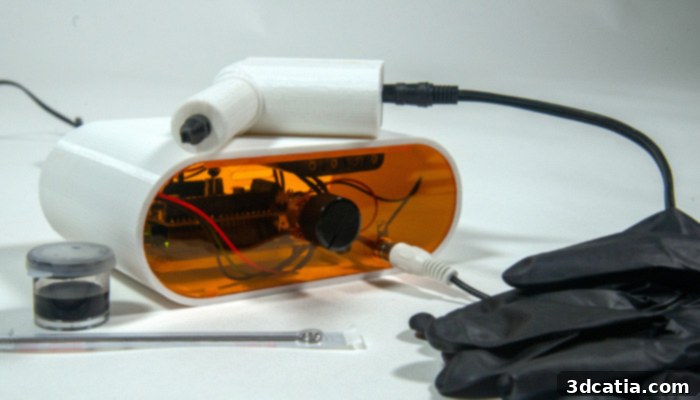
The biorecycling machine concept by artist Matt Harkness (photo credits: Matt Harkness)
The Green Illusion: Deconstructing PLA’s “Biodegradability”
To truly appreciate Matt Harkness’s artistic intervention, it’s essential to understand the scientific and practical nuances of PLA’s environmental claims. While PLA is indeed derived from renewable resources, its “biodegradable” label is often misunderstood. Biodegradability simply means that a material can be broken down by microorganisms into natural components like water, carbon dioxide, and biomass. However, the conditions under which this breakdown occurs are critical and often overlooked by consumers.
Unlike naturally occurring organic matter such as food scraps, PLA does not readily decompose in a typical home compost bin or landfill environment. The term “compostable,” when applied to bioplastics, typically refers to industrial composting, which requires very specific, controlled conditions: consistently high temperatures (often between 55-70ºC or 131-158ºF), precise moisture levels, and the active presence of specialized microorganisms. These parameters are rarely, if ever, met in a domestic compost pile, let alone in the anaerobic conditions of a landfill, where PLA can persist for hundreds of years, much like traditional petroleum-based plastics. This significant discrepancy between marketing claims and real-world decomposition capabilities forms the cornerstone of Harkness’s critique, highlighting a critical gap in consumer understanding and industry transparency regarding PLA’s sustainability.
Matt Harkness: An Artist’s Provocation Against 3D Printing Waste
Matt Harkness is not just an artist; he is a PhD student in Art, Design, and Media at the University of New South Wales, bringing an academic rigor to his creative provocations. His work intentionally challenges perceptions and sparks uncomfortable conversations about our consumption habits and environmental responsibilities. Harkness’s core mission is to shed light on the less visible aspects of our technological advancements, particularly the unforeseen ecological footprints they leave behind. He sees the rapid proliferation of desktop 3D printers in homes and small businesses as a potential environmental liability, especially given the widespread misconceptions surrounding PLA waste.
In his artistic practice, Harkness often uses shock value and unconventional methods to draw attention to critical issues. His “biorecycling machine” project is a prime example of this approach. It’s not merely a conceptual art piece; it’s a profound statement designed to force individuals to confront the tangible consequences of their waste. By proposing such an intimate and personal form of waste disposal, Harkness pushes the boundaries of what we consider acceptable for recycling, urging us to question the entire lifecycle of the materials we use and discard.
The Biorecycling Machine: Man as the Ultimate PLA Composter
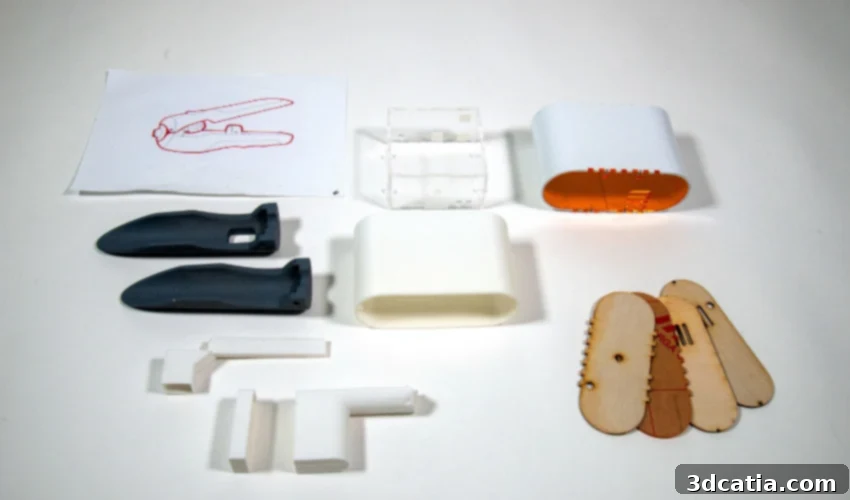
At the heart of Matt Harkness’s audacious vision is the “biorecycling machine” – a conceptual apparatus that takes 3D printing waste granules and converts them into a unique PLA polymer ink. This specialized ink, in Harkness’s hypothetical scenario, can then be meticulously placed under the skin using a custom-designed device, much like a traditional tattoo. The idea is undeniably startling, prompting immediate questions about safety, ethics, and practicality. Yet, it is precisely this unsettling nature that allows the project to effectively highlight the complexities of plastic waste.
Once the PLA microplastic particles enter the dermal layer of the human body, Harkness postulates that a natural hydrolysis process would begin. Polylactic acid, under the body’s internal conditions, would slowly convert into its constituent components: lactic acid, carbon dioxide, and water. According to his research and conceptual framework, this biodegradation process within the human body would be remarkably efficient. After approximately thirty weeks, the body would have completely “recycled” the PLA particles, with the resulting components being naturally excreted through normal physiological processes such as urination and respiration. This concept flips our traditional understanding of recycling on its head, suggesting the human body itself could act as a sophisticated, albeit highly unconventional, biological composting facility for plastics.
A Critique of Bioplastic Marketing and Maker Community Awareness
Beyond its shocking premise, the “biorecycling machine” serves as a powerful metaphor for Harkness’s broader critique of bioplastic marketing and the growing environmental impact of the maker community. The artist explicitly states that his machine is a “hypothetical way to naturally compost PLA waste generated by 3D printing,” emphasizing its role as a thought experiment rather than a practical, immediate solution. His core message targets the often-irresponsible marketing tactics employed by manufacturers of bioplastics. By labeling products like PLA as simply “biodegradable” without clearly stipulating the stringent conditions required for their actual breakdown, companies contribute to what many consider “greenwashing.” This practice misleads consumers into believing they are making environmentally sound choices when, in reality, the disposal options are far more limited and problematic.
Harkness also aims to galvanize the rapidly expanding maker community. The increasing accessibility and affordability of desktop 3D printers have led to a surge in private users. While this democratization of manufacturing is exciting, Harkness identifies a significant danger: a corresponding surge in plastic waste. Because manufacturers often promote their filaments as environmentally benign, many private users remain unaware that their PLA waste cannot simply be tossed into a household compost bin or even traditional recycling streams. This lack of awareness, combined with the sheer volume of printed objects and failed prints (often called “printer spaghetti”), contributes substantially to the global plastic waste problem. Harkness’s work brutally reminds us that microplastic particles are already pervasive, found in an estimated 50% of all humans, and his “biorecycling machine” asks us to consider a future where our bodies might actively participate in processing this ubiquitous material.
The Harsh Realities of PLA Composting Infrastructure
The discussion around PLA’s sustainability inevitably leads to a critical examination of waste management infrastructure. As we’ve established, while PLA waste is indeed biodegradable, its decomposition is conditional. It demands the specific environment of an industrial composting plant, characterized by meticulously controlled temperatures (55-70ºC/131-158ºF), precise moisture levels, and the necessary presence of active microorganisms. These exacting parameters are simply not met by a typical domestic composting bin, which operates at ambient temperatures and lacks the specialized microbial communities. Consequently, disposing of PLA alongside organic kitchen waste like eggshells or banana peels is futile; the PLA will persist, failing to decompose and potentially contaminating the compost.
Harkness’s critique extends beyond misleading marketing to address the glaring inadequacy of infrastructure. He points out the severe lack of industrial composting facilities capable of processing PLA waste. Even where such facilities exist, consumer access is often limited or non-existent. Furthermore, manufacturers frequently fail to adequately communicate the specific disposal requirements for their bioplastic products, leaving consumers confused and frustrated. This dual problem – insufficient infrastructure combined with poor public awareness – means that a vast amount of PLA waste, despite its “eco-friendly” label, ends up in landfills, contributing to plastic pollution rather than mitigating it. Harkness, therefore, calls for a significant overhaul, demanding not only greater public education but also the development of accessible and widespread recycling collection points specifically designed for bioplastics.
Beyond Biorecycling: Practical Solutions from Matt Harkness
While the “biorecycling machine” captures attention with its radical concept, Matt Harkness’s work is not solely focused on hypothetical, body-based recycling. He actively demonstrates more immediate and tangible approaches to addressing 3D printing waste. Recognizing the current limitations of PLA disposal, Harkness also dedicates himself to transforming discarded 3D printing waste into practical household items and functional furniture. These projects serve as a powerful contrast to his more abstract ideas, offering concrete examples of how material reuse can combat waste.
Among his creations are items like a functional dustpan and a matching hand brush, meticulously crafted from melted and repurposed PLA 3D printer waste. These objects are not merely decorative; they are usable, durable items that highlight the potential for circularity within additive manufacturing. By taking waste material and giving it a new life as a useful product, Harkness visually communicates that the lack of conventional recycling options for plastic waste cannot simply be ignored or “swept under the rug.” These practical projects reinforce his overarching message: innovation in 3D printing must be accompanied by equally innovative and responsible waste management strategies. You can explore more about Matt Harkness’s biorecycling machine concept and his various other impactful projects, both conceptual and practical, by visiting his website HERE.
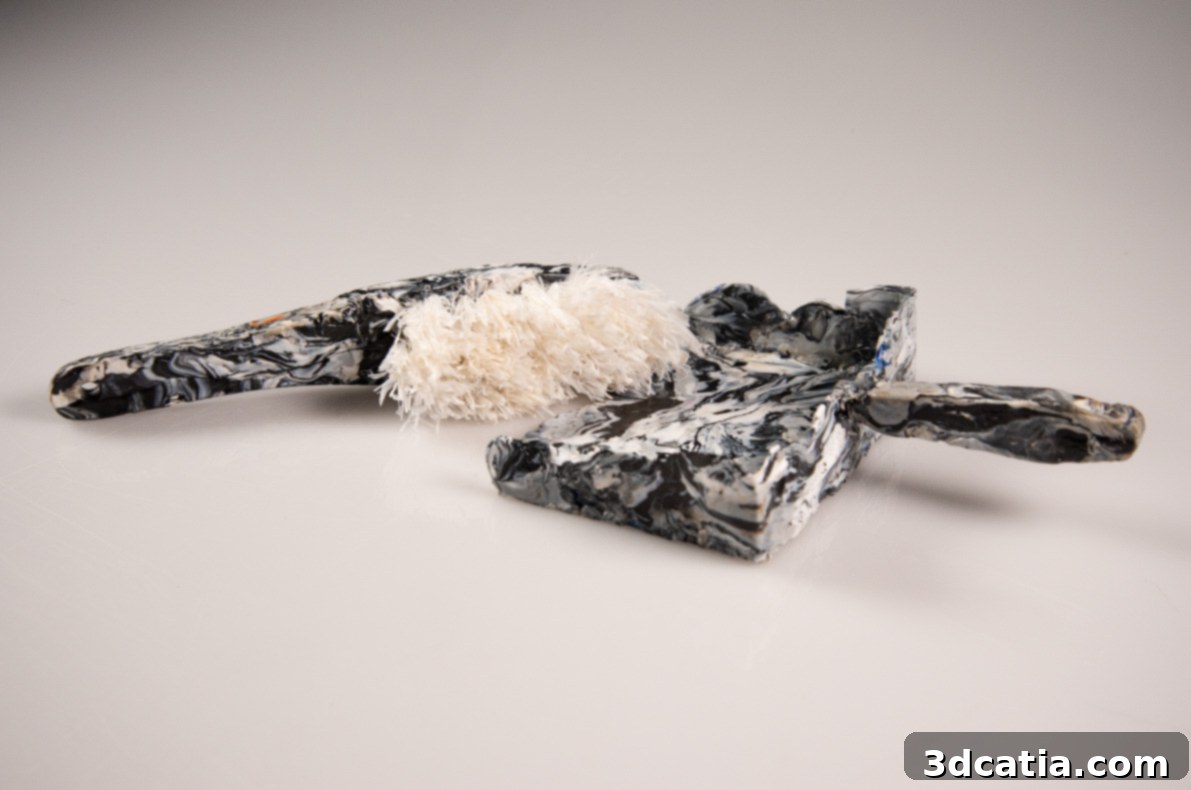
Photo Credits: Matt Harkness
Rethinking Our Relationship with 3D Printing and Sustainability
Matt Harkness’s provocative “biorecycling machine” challenges us to confront the uncomfortable truths about PLA filament and the broader environmental responsibilities associated with 3D printing. The notion that a material derived from renewable resources is “environmentally friendly” is a simplification that ignores the complex realities of decomposition and waste infrastructure. His work brilliantly exposes the gap between marketing claims and practical disposal, urging consumers and manufacturers alike to look beyond surface-level green labels and delve into the actual lifecycle of materials.
The artist compels us to ask difficult questions: What truly constitutes sustainable manufacturing in the age of rapid prototyping? How much responsibility do individuals bear for their waste, and how much falls on producers and policymakers? While his concept of human-body recycling is hypothetical, its power lies in its ability to spark intense debate and force a re-evaluation of our approach to plastic waste. Whether through radical artistic concepts or practical re-purposing, Harkness unequivocally demonstrates that the issue of 3D printing waste, particularly PLA, demands urgent attention and innovative solutions that move beyond misleading eco-stamps.
What are your thoughts on Matt Harkness’s biorecycling machine? Would you be willing to conceive of disposing of PLA waste using your own body, even conceptually? We invite you to share your perspectives in a comment below or join the conversation on ourFacebook,Twitter andLinkedIn pages! Don’t miss out on the latest advancements and discussions in additive manufacturing; sign up for our free weeklyNewsletter here, and get the most recent 3D printing news delivered straight to your inbox!
Thumbnail Photo Credits: Matt Harkness