
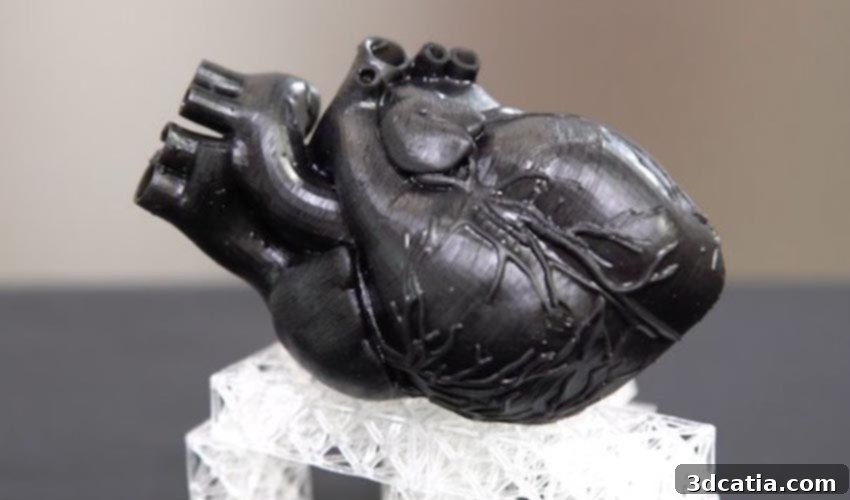
Revolutionizing Additive Manufacturing: DSM and Adaptive3D Unveil Soft ToughRubber Photopolymer
In a groundbreaking collaboration set to redefine the landscape of additive manufacturing, Royal DSM, a global leader in Nutrition, Health, and Sustainable Living, has partnered with Adaptive3D to commercialize a truly innovative material: Soft ToughRubber. This pioneering photopolymer is lauded as the world’s softest tough 3D printable material, marking a significant advancement in the capabilities of three-dimensional printing technologies. DSM’s extensive global reach, robust supply chain, and deep-seated relationships across key markets will be instrumental in the production, distribution, and sales of this revolutionary new additive manufacturing material, bringing it to a diverse array of industries and applications worldwide.
Soft ToughRubber represents a paradigm shift in 3D printable photopolymers developed by Adaptive3D. As a material that meticulously alters its properties when exposed to light, it offers an unprecedented combination of pliability and resilience. Its applications are vast and transformative, ranging from highly realistic medical models essential for training and pre-surgical planning to high-performance consumer products like custom audio earbuds and advanced footwear. What truly distinguishes Soft ToughRubber is its ability to deliver the tactile feel and superior mechanical properties typically associated with silicone, while simultaneously achieving the exceptional resolution and fine surface finish inherent to DLP (Digital Light Processing) technology. This unique combination addresses long-standing challenges in the additive manufacturing of soft, durable goods. Noud Steffens, Market Development Director for Additive Manufacturing at DSM, emphasized the strategic importance of this alliance, stating, “This partnership allows us to combine DSM’s global supply chain and strong relationships in key markets with Adaptive3D’s proprietary material innovations, creating an unparalleled synergy that will accelerate the adoption of advanced 3D printing solutions.“

Adaptive3D CEO Walter Voit onstage at RAPID+TCT with Noud Steffens of DSM Additive Manufacturing to announce their partnership | Credits: Adaptive3D
Adaptive3D has carved out a niche as a leading supplier of premium additive manufacturing polymer resins, consistently partnering with global industry leaders to provide innovative solutions for functional end-use products and high-fidelity prototypes. The company’s expertise extends to offering a diverse portfolio of specialty polymers across various sectors worldwide. They are particularly renowned for their pioneering work in damping materials, advanced rubber-like 3D printable materials, and low-cure stress photopolymers, which minimize warping and improve part accuracy. This specialized knowledge is at the core of Soft ToughRubber’s development. Walter Voit, founder and CEO of Adaptive3D Technologies, highlighted not only the expansive new applications but also the significant sustainability advantages of their latest material. “Aside from new applications in consumer products and medical models, Soft ToughRubber adds to the available materials for manufacturers looking for sustainable options,” Voit explained. He further elaborated on the eco-friendly aspects of additive manufacturing, noting, “Thanks to additive manufacturing, we are able to drastically reduce material waste in parts production through optimized designs and on-demand manufacturing. Moreover, DLP printing utilizes light instead of heat to cure materials, leading to dramatically lower energy consumption and a significantly reduced carbon footprint compared to traditional manufacturing methods.” This commitment to sustainability aligns perfectly with DSM’s overarching mission for a healthier and more sustainable planet.
The superior properties of Soft ToughRubber are intrinsically linked to the advanced capabilities of DLP (Digital Light Processing) 3D printing technology. Unlike traditional layer-by-layer extrusion methods, DLP 3D printers employ a digital projector screen to flash a single, complete image of each layer across the entire build platform simultaneously. This process drastically increases print speed and, crucially, allows for a significantly higher print quality and resolution compared to technologies like FDM (Fused Deposition Modeling). In DLP, material is not extruded but rather each layer is meticulously formed through the precise polymerization of the resin when exposed to light, resulting in much thinner and more accurate layer sizes. This precision is paramount for intricate designs and smooth surface finishes. Soft ToughRubber has been painstakingly developed and perfected to leverage the full potential of this advanced additive manufacturing process. The result is a material that, despite being remarkably soft and pliable to the touch, maintains an incredible degree of strength, elasticity, and durability, making it ideal for high-performance applications where both comfort and robustness are critical. This balance of properties is what truly sets it apart, allowing for the creation of components that can withstand significant stress and repeated use without degradation, offering an unprecedented combination of attributes in the 3D printing world.
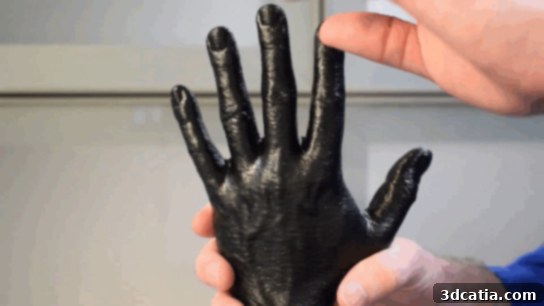
This soft AM photopolymer is also tough and elastomeric | Credits: Adaptive3D
The collaborative efforts of DSM and Adaptive3D are meticulously orchestrated to ensure the widespread commercial availability of Soft ToughRubber. This strategic partnership is not merely about launching a new product; it’s about fostering an ecosystem where innovation thrives and cutting-edge materials become accessible to a broad spectrum of manufacturers. Noud Steffens reiterated this vision, commenting, “This is yet another prime example of how DSM’s unwavering commitment to building a robust global additive manufacturing ecosystem offers Original Equipment Manufacturers (OEMs) across the globe unprecedented access to cutting-edge materials and technologies, enabling them to push the boundaries of design and functionality.” Looking ahead, both companies are committed to a long-term collaboration, intending to work closely to continuously explore novel applications and develop even more advanced materials. Their shared focus will be on engineering materials that provide next-generation soft, flexible, and highly elastic solutions, addressing emerging demands in fields such as advanced robotics, specialized medical devices, custom wearable technology, and high-performance automotive components. This ongoing research and development will solidify their position at the forefront of elastomeric additive manufacturing, promising a future where customized, high-performance soft goods are not only possible but readily available.
The introduction of Soft ToughRubber offers immense potential for various industries. In the medical field, it enables the creation of highly accurate anatomical models with lifelike haptic feedback, vastly improving surgical training and patient-specific device development. For consumer electronics, particularly audio devices, Soft ToughRubber can lead to bespoke earbuds that offer superior comfort, enhanced acoustic sealing, and greater durability. In footwear, it opens doors for truly customized insoles and midsoles that provide optimal cushioning, support, and energy return, tailored to individual biomechanics. Beyond these initial applications, the material’s unique combination of softness, toughness, and printability via DLP suggests its utility in industrial gaskets, seals, flexible robotics components, and custom protective gear. The ability to precisely tune the material’s properties through the DLP process allows for unprecedented control over the final product’s characteristics, paving the way for truly innovative product designs and functionalities that were previously unattainable with conventional manufacturing techniques or less advanced 3D printing materials. This forward-looking approach underscores the transformative impact Soft ToughRubber is poised to have across a multitude of sectors, driven by the synergy of DSM’s market leadership and Adaptive3D’s material science expertise.
You can find more information about Adaptive3D and their innovative materials HERE.
What are your thoughts on this exciting new AM material, heralded as the softest tough photopolymer on the market? We invite you to share your insights and predictions in a comment below or join the conversation on our Facebook and Twitter pages! For all the latest news and developments in the rapidly evolving world of 3D printing, don’t forget to sign up for our free weekly Newsletter, delivered straight to your inbox!