
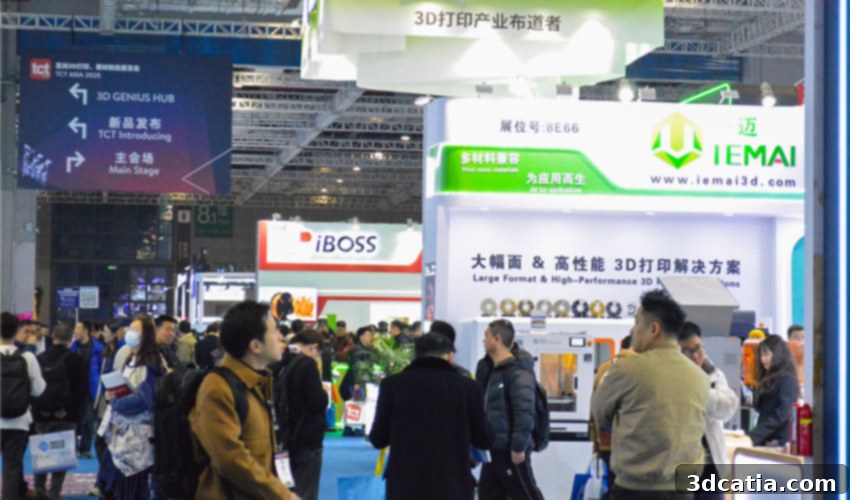
TCT Asia 2025 Review: Charting China’s Ascendancy in Additive Manufacturing and Global 3D Printing Trends
The eleventh edition of TCT Asia 2025 concluded its successful run on March 19th at the prestigious National Exhibition and Convention Center in Shanghai. Spanning three dynamic days across halls 7.1 and 8.1, the event brought together over 450 exhibitors, firmly cementing its reputation as one of the most pivotal trade shows for additive manufacturing in Asia. This year’s exhibition not only highlighted the rapid advancements within the 3D printing sector but also underscored the significant growth and increasingly influential role of Chinese companies on the global stage. Through its diverse array of exhibitors, specialized thematic zones, and an insightful conference program, TCT Asia 2025 served as a crucial platform for showcasing key industry trends and China’s accelerating journey towards leadership in the additive manufacturing landscape.
Hundreds of prominent 3D printing companies, ranging from innovative solution manufacturers to comprehensive manufacturing service providers, converged at this latest installment of TCT Asia. Many of the most recognized global brands seized the opportunity to unveil their cutting-edge developments and latest products to thousands of eager attendees. Interestingly, one notable observation was the conspicuous absence of dedicated exhibition stands from some of China’s most popular consumer-focused 3D printing brands, such as Bambu Lab and Anycubic. While their presence was maintained through various distributors and partners, they did not operate their own independent booths. This absence was particularly striking given the highly anticipated release of Bambu Lab’s H2D printer, scheduled for just a few days after the exhibition on March 25th. This unique dynamic sparked discussions among industry observers regarding evolving market strategies, distribution models, and the focus areas for different segments within the rapidly expanding Chinese 3D printing market.
Innovations and Insights: A Deep Dive into TCT Asia 2025’s Exhibition Floor
Exploring the Diverse Thematic Zones
To enhance the visitor experience and effectively spotlight the myriad applications of 3D printing, the TCT Asia trade show was meticulously organized into several well-defined thematic zones. Each area was curated to address specific facets of additive manufacturing, guiding attendees through the complex ecosystem of materials, processes, and applications.
A substantial section of the exhibition was dedicated entirely to **Metals**, featuring a wide array of companies specializing in this crucial material family. Exhibitors showcased advanced metal powders and innovative additive manufacturing technologies compatible with various processes, including Selective Laser Melting (SLM), Electron Beam Melting (EBM), and binder jetting. These solutions demonstrated remarkable advancements in printing precision, material strength, and the ability to produce complex geometries for high-performance applications in aerospace, medical, and industrial sectors.
Adjacent to the metal zone was the area dedicated to **Non-metals**, encompassing a vast spectrum of polymers, resins, and advanced composites. This zone was a hotbed of innovation, presenting new material formulations designed for increased resistance, enhanced sustainability, and optimized performance in high-speed printing environments. Visitors witnessed breakthroughs in engineering-grade thermoplastics for fused deposition modeling (FDM), high-resolution resins for stereolithography (SLA) and digital light processing (DLP), and reinforced composites offering superior strength-to-weight ratios for demanding applications across consumer goods, automotive, and healthcare industries.
The **Enabling Process Area** stood out as a critical hub, focusing on the ancillary processes that are indispensable for fully integrated additive manufacturing workflows. This included a comprehensive display of solutions for post-processing, quality inspection, and optimization software. This emphasis clearly signaled the growing importance of automation and efficiency in the entire 3D printed production lifecycle. Attendees explored advanced automated support removal systems, sophisticated surface finishing technologies, state-of-the-art in-situ monitoring and non-destructive testing equipment, and powerful software tools for topology optimization, generative design, and simulation. These innovations highlight the industry’s shift towards repeatable, reliable, and scalable production.
Furthermore, a dedicated area for **Service Providers** showcased the comprehensive capabilities offered by companies specializing in additive manufacturing services. From rapid prototyping and customized tooling to full-scale mass production, these service bureaus demonstrated how 3D printing is increasingly becoming a viable, and often superior, alternative to traditional manufacturing methods. They play a vital role in making additive manufacturing accessible to businesses of all sizes, enabling faster product development cycles and innovative production strategies.
Finally, the **3D Genius Hub** served as a vibrant corner tailored for makers, startups, and experimental projects. This dynamic space fostered creativity and showcased innovative, often unconventional, 3D printing applications across various sectors. It highlighted the grassroots innovation within the community and provided a glimpse into future applications and disruptive technologies emerging from independent creators and small businesses.
TCT Asia 2025 Highlights the Boom in Metal 3D Printing
One of the most profound and undeniable trends observed at TCT Asia 2025 was the overwhelming presence and undeniable boom in metal additive manufacturing. Leading industry players such as BLT, LIM Laser, Farsoon, HBD, Eplus3D, and UnionTech, among others, commanded some of the largest and most visually impressive booths. Their exhibits were replete with cutting-edge metal 3D printing solutions, ranging from large-format machines to highly specialized systems designed for precision components. This surge in metal 3D printing is far from coincidental; it directly reflects the Chinese market’s aggressive strategic investment in the industrialization of additive manufacturing, continuously pushing for more advanced, efficient, and increasingly accessible technologies.
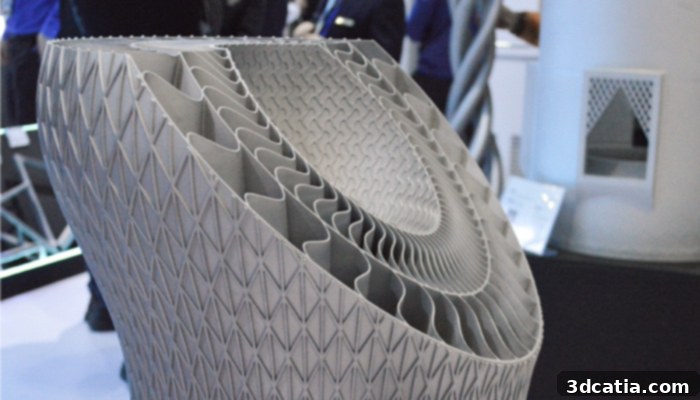
A complex heat exchanger component on display at LIM Laser’s booth (photo credits: 3Dnatives)
The strong presence of these Asian players, characterized by their expansive stands and compelling demonstrations of high production capacity, validates a trend that has been steadily building over previous industry events. Companies like Farsoon, which has significantly expanded its portfolio of Laser Powder Bed Fusion (L-PBF) machines, and BLT, renowned for its large-format metal printers capable of producing sizable components, are not merely participating; they are actively shaping and dominating key segments of the sector. This rapid expansion and technological advancement from Chinese manufacturers represent a direct and significant challenge for established European and North American manufacturers. These Western counterparts will undoubtedly need to re-evaluate their strategies, foster new innovations, and explore new market approaches to effectively compete in a global market where China is demonstrably gaining ground by leaps and bounds.
Promoting Adoption and Navigating Towards a Promising Future in Additive Manufacturing
Beyond the extensive exhibition floor, TCT Asia 2025 offered a robust and highly informative conference program. Divided across three distinct stages – the Main Stage, Tech Stage, and TCT Introducing – the presentations delved into a wide spectrum of topics. These discussions ranged from strategies for the broad adoption of additive manufacturing across various industries to its specific applications in critical sectors such as automotive, consumer goods, and healthcare. The overarching sentiment conveyed through these expert talks was that the global industry, with a particular focus on Asia, is currently in a phase of strategic consolidation. This phase is marked by a noticeable shift towards a more pragmatic, application-driven, and mass-production oriented approach to 3D printing.
The narrative articulated at the conferences underscored that 3D printing has evolved well beyond its traditional role as merely a prototyping tool. It is now recognized as a mature, industrial-grade technology actively seeking full integration into complex global supply chains. This evolution necessitates not only advancements in hardware and materials but also a deeper understanding of economic viability, regulatory compliance, and post-processing efficiencies.
China, by all accounts, is taking a decisive lead in the broader field of 3D printing, with a particularly strong emphasis on metal processes. Its sustained investment and innovative drive are pushing the boundaries of technology, presenting formidable challenges to Western manufacturers. However, beyond the impressive growth trajectory of the Chinese market, a profound question lingers over the industry: are we currently entering a phase of stabilization, where existing technologies are optimized and refined, or are we on the cusp of another truly disruptive leap that will fundamentally redefine additive manufacturing? The answer to this crucial question will unfold as additive manufacturing continues its relentless evolution, persistently redefining production processes, material science, and design paradigms.
What is unequivocally clear is that TCT Asia has firmly established itself as an indispensable event in the global 3D printing calendar. Its future editions will be pivotal in charting the course and witnessing the trajectory of this dynamic sector, offering invaluable insights into both regional and worldwide trends. The event serves as a critical barometer for innovation, market shifts, and strategic developments in additive manufacturing.
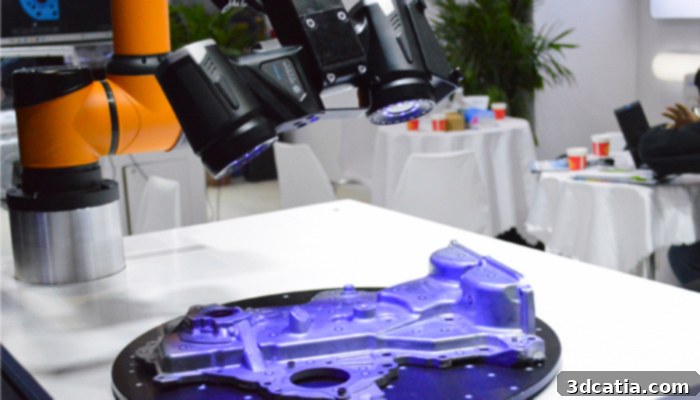
An illustrative example of 3D scanning technology on display at the Insvision booth (photo credits: 3Dnatives)
What were your thoughts on TCT Asia 2025? Were you fortunate enough to attend this year’s event? We invite you to share your experiences and insights in a comment below, or connect with us on our social media channels: LinkedIn, Facebook, and Twitter! Don’t miss out on the latest developments in the 3D printing world – sign up for our free weekly Newsletter here to receive all the breaking news directly in your inbox. For more visual content, you can also explore all our videos on our dedicated YouTube channel.
*Cover Photo Credits: 3Dnatives