
Revolutionizing Math Education: University of Illinois Students 3D Print Historic Mathematical Models for Preservation and Global Outreach
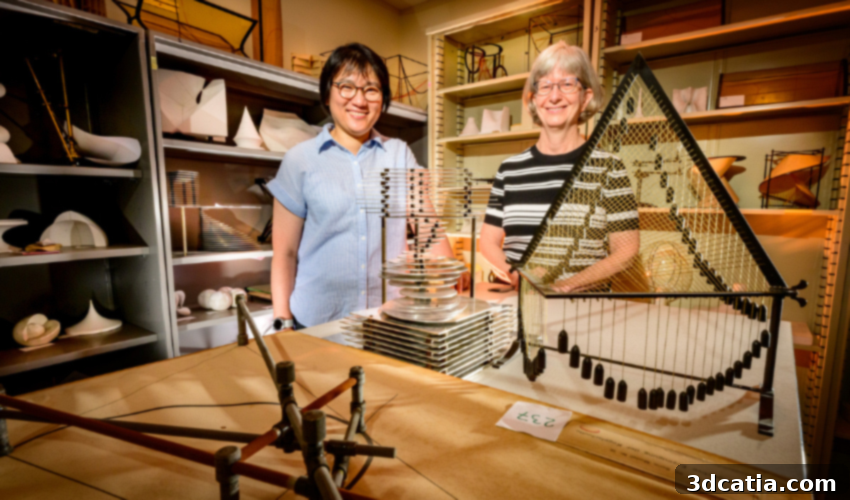
In a remarkable fusion of historical preservation and cutting-edge technology, students at the University of Illinois Urbana-Champaign have embarked on an innovative project to recreate intricate 3D models of mathematical surfaces and theorems. This initiative, a collaborative effort spearheaded by the Illinois Mathematics Lab and the Champaign-Urbana Community Fab Lab, has empowered undergraduate students to reproduce a select number of the university’s invaluable historic mathematical models, some of which date back as far as the 1800s. Leveraging the versatility and accessibility of Fused Deposition Modeling (FDM) 3D printing technology, this project breathes new life into a treasured collection. These newly printed models are modern counterparts to a significant 400-piece collection meticulously maintained by the university’s esteemed mathematics department, offering a tangible link between mathematical heritage and contemporary educational practices.
The original collection itself is an extraordinary repository of mathematical visualization, comprising complex theorems beautifully constructed from a diverse array of materials, including plaster, wood, cardboard, and various metals. Many of these intricate pieces were initially designed and fabricated by an Illinois facility, serving as fundamental tools for classroom instruction and demonstration for generations of students. The most historically significant pieces within this collection were originally imported from Germany, contributing to what is widely recognized as one of the world’s largest and most comprehensive collections of mathematical models. Sarah Park, the university’s dedicated Mathematics Librarian, eloquently underscores the profound value of these artifacts, stating, “These are a department treasure. They offer unmatched educational value to students and researchers alike.” This project not only aims to preserve these physical artifacts but also to extend their educational reach through modern replication.
![Student created version of Dandelin spheres [left] with original wooden model [right].](https://3dcatia.com/wp-content/uploads/2025/10/img_65251_1.jpg)
Student-created version of Dandelin spheres [left] with original wooden model [right].
A Unique Opportunity: Renovation, Digitization, and Student Engagement
The genesis of this ambitious 3D printing project can be traced back to recent comprehensive renovations undertaken at Altgeld Hall, the historic home of the university’s mathematical department. As part of these renovations, the original mathematical models were carefully removed from their long-term storage, bringing them into the light and offering an unprecedented opportunity. This relocation provided students with a rare and unique chance to not only document and study these historic artifacts up close but also to embark on the crucial task of digitizing them for future generations. The hands-on engagement allowed students to meticulously select models of particular interest, then utilize powerful software tools such as Mathematica for geometric rendering and specialized slicing programs to prepare the digital files for 3D printing. This intricate process transformed complex mathematical concepts into digital blueprints, ready for physical manifestation.
Once the digital models were meticulously prepared, the next phase of the project commenced at the CU Community Fab Lab. Here, using advanced FDM 3D printers, the new models were brought to life from durable plastic filament. The students carefully optimized printing settings to ensure high fidelity and structural integrity, resulting in robust and accurate replicas. Among the fascinating mathematical concepts re-created in this manner were a conic section-proof Dandelin sphere, which elegantly illustrates fundamental geometric principles, a complex Kummer surface, renowned for its intricate self-intersections, and various ruled surfaces expertly constructed using taut threads to define their geometry. A particularly enriching aspect of the project involved students being tasked with developing comprehensive descriptions to accompany each newly printed model. This required them to delve deeply into the original mathematical equations, often sourced from historical texts written in German, thereby deepening their understanding of both the mathematics and its historical context.
Transforming Education and Community Outreach with Durable 3D Printed Models
The implications of these new mathematical 3D printed models extend far beyond the university’s campus. They are poised to play a pivotal role in educational outreach initiatives, particularly benefiting the local Urbana-Champaign community. This includes planned engagements with students in various middle and high schools, where these tangible models will serve as powerful teaching aids. A significant advantage of these modern replicas lies in their enhanced durability compared to their often fragile, centuries-old predecessors. This robustness allows for frequent, hands-on interaction without the risk of damage, making them ideal for active learning environments. For students studying mathematics, these models offer an unparalleled hands-on learning experience, allowing them to physically manipulate and explore complex geometric shapes and abstract theorems in a way that static diagrams or purely digital simulations often cannot replicate. The tactile engagement fosters a deeper, more intuitive understanding of mathematical concepts, bridging the gap between abstract theory and concrete reality.
While the new 3D printed models embark on their journey of community engagement and educational transformation, the priceless original models remain carefully safeguarded within the university archives. Their continued preservation is meticulously overseen by the University Library’s dedicated Preservation Services, ensuring that these historical artifacts endure for future generations. Complementing the physical preservation efforts, a comprehensive digital archive is actively under development. This ambitious online resource will feature high-resolution photographs of both the original and 3D printed models, detailed explanations of the mathematical principles they represent, and, most importantly, downloadable 3D model files (STL files). This means educators, researchers, and enthusiasts worldwide will be able to access and utilize these resources free of charge, fostering a global community of mathematical exploration and learning. Through this multifaceted project, University of Illinois students have not only preserved a significant piece of mathematics history but have also actively contributed to ensuring these invaluable models remain accessible and inspiring to all, leveraging technology to democratize educational resources.
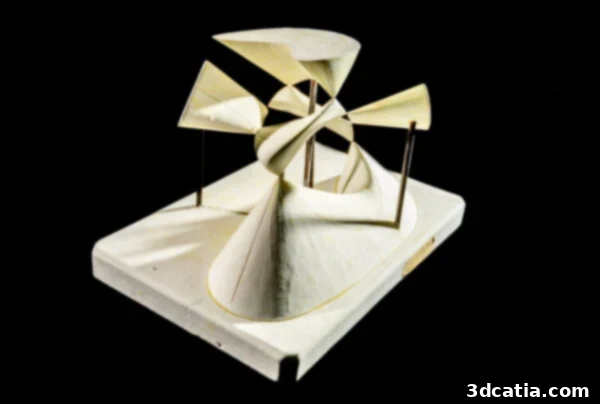
Student created 3D print of a Kummer surface.
Sustaining Heritage: The Power of Digital Archives and Global Access
The foresight to create a robust digital archive alongside the physical reproductions is a testament to the comprehensive vision behind this project. By providing downloadable 3D model files, the University of Illinois Urbana-Champaign is effectively establishing a global repository for these unique mathematical visualizations. Imagine a high school student in a remote village, an undergraduate researcher in a developing nation, or a seasoned mathematician seeking to illustrate a complex concept – all gaining free access to these meticulously digitized models. This initiative removes geographical and financial barriers, fostering a more inclusive and interconnected global learning environment. The digital archive will serve as an invaluable resource not only for academic instruction but also for public engagement, igniting curiosity and understanding of mathematics across diverse audiences. It exemplifies how technology can democratize knowledge, making specialized academic resources universally available.
Conclusion: A Model for Future Preservation and STEM Education
The University of Illinois Urbana-Champaign’s project to 3D print historic mathematical models stands as a shining example of how innovative technologies can be harnessed for both historical preservation and educational advancement. By merging the rich legacy of mathematical models with the transformative power of 3D printing, students have gained invaluable experience, while the broader community has received an unparalleled resource for hands-on learning. This initiative ensures that these “department treasures” continue to inspire and educate, bridging centuries of mathematical thought with contemporary pedagogical approaches. It underscores the critical role of STEM education in fostering interdisciplinary skills and preparing students to tackle complex challenges with creative solutions. The project not only preserves a significant piece of academic heritage but also lays a foundation for future collaborations that bring history, technology, and education together.
To delve deeper into this fascinating endeavor and access the digitized collection of these remarkable math models, please click HERE. We invite you to share your thoughts: How do you envision 3D printing continuing to reshape education, enhance preservation efforts, and perhaps even influence the very nature of mathematics itself? Let us know your insights in a comment below or connect with us on our LinkedIn or Facebook pages! Additionally, ensure you don’t miss out on the latest advancements in additive manufacturing by signing up for our free weekly Newsletter, delivered directly to your inbox. All our engaging videos are also available on our YouTube channel for your viewing pleasure.
*All Photo Credits: University of Illinois, Fred Zwicky