

Revolutionizing Space: Fleet Space’s Fully 3D Printed Alpha Satellites and the Future of Additive Manufacturing in Orbit
Additive manufacturing, commonly known as 3D printing, has rapidly emerged as a transformative force across various industries, and none more so than the aerospace sector. From ambitious building projects on the moon to the creation of intricate 3D printed rocket parts, the intersection of advanced manufacturing and space exploration is opening up a universe of new possibilities. This groundbreaking technology is empowering space companies to overcome traditional design and manufacturing constraints, offering unparalleled advantages in terms of weight reduction, complexity, cost-efficiency, and speed.
Major players like NASA and the European Space Agency (ESA) are at the forefront of integrating 3D printing into their strategic initiatives. For instance, ESA has partnered with Incus, an Austrian firm specializing in photopolymerization-based 3D printing solutions, to test additive manufacturing in microgravity environments – a critical step towards on-orbit fabrication. Similarly, Lockheed Martin and Makerbot have been collaborating on a Lunar Rover Project for NASA, leveraging 3D printing to create lightweight and robust components for future lunar missions. These projects underscore a growing trend: 3D printing is not just a tool, but a fundamental enabler for the next generation of space technology. Amidst this innovation wave, Fleet Space, an Australian satellite developer, recently made a significant announcement regarding the future launch of their entirely 3D printed Alpha satellites, marking a pivotal moment in the industry.
The Alpha constellation, as it’s named, is designed to complement Fleet Space’s existing Centauri constellation. These satellites are slated for launch within approximately 12 months and represent a monumental leap forward, being the first commercial satellites to be fully manufactured using 3D printing technology, according to the company. This isn’t merely about printing a few components; it signifies a paradigm shift where the entire satellite structure and many of its intricate subsystems are brought to life through additive manufacturing processes. Flavia Tata Nardini, CEO and founder of Fleet Space, emphasized the profound impact of this innovation: “Alpha represents a major step forward and the first time a satellite has been created entirely through 3D-printing. By bringing together the creation, deployment and service of space technology this is a clear statement of our intent to become a global leader in space technology, and to support Australia’s ambition to lead this critical field.” Her statement highlights not just a technological achievement, but a strategic vision for global leadership in space technology, propelled by advanced manufacturing capabilities.
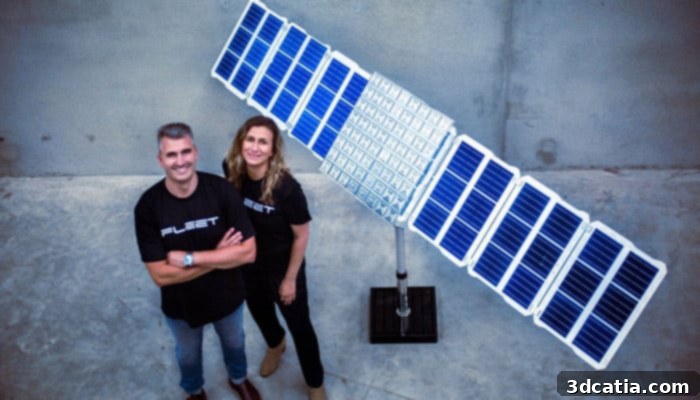
Photo Credits: Fleet Space
The Composition and Advanced Capabilities of Fleet Space’s Alpha Satellites
One of the most remarkable features of the 3D printed Alpha satellites is their advanced antenna array. Each Alpha satellite will be equipped with up to 64 all-metal antennas, a significant upgrade from the Centauri line, which features only 4 antennas per satellite. This dramatic increase in antenna count is not merely about quantity; it enables the integration of advanced digital beamforming technology. Digital beamforming allows the satellite to dynamically direct and shape its radio signals, offering unprecedented precision and flexibility in communication. This technology translates directly into a substantial increase in customer IoT (Internet of Things) data throughput, meaning the Alpha satellites can handle a much larger volume of data from a greater number of connected terminals across various industries, from logistics and agriculture to environmental monitoring.
The choice of “all-metal” antennas further underscores the advantages of additive manufacturing. Metal 3D printing allows for the creation of complex geometries that are impossible or highly challenging with traditional manufacturing methods. This enables engineers to design antennas that are not only high-performing but also lightweight and durable enough to withstand the harsh conditions of space. While Fleet Space has remained tight-lipped about the specific 3D printing processes utilized for the Alpha line, it is likely they are leveraging sophisticated metal additive manufacturing techniques such as Selective Laser Melting (SLM) or Direct Metal Laser Sintering (DMLS). These processes are known for producing parts with high material density, excellent mechanical properties, and the ability to integrate intricate internal structures, which are crucial for optimizing antenna performance and overall satellite efficiency.
In essence, additive manufacturing has empowered Fleet Space to design and produce satellites with significantly enhanced connectivity capabilities. The ability to rapidly prototype, iterate designs, and consolidate parts into single, complex 3D printed components has drastically reduced lead times and manufacturing costs, while simultaneously improving performance. This level of innovation could profoundly reshape the aerospace industry, particularly within the burgeoning sector of small satellite constellations and global IoT networks. The Alpha satellites are expected to offer new opportunities for a wide range of applications that rely on ubiquitous and high-bandwidth satellite communication.
The Broader Impact of 3D Printing on Space Exploration
The advancements made by Fleet Space with its Alpha satellites are indicative of a larger trend where 3D printing is becoming indispensable for space exploration and commercial ventures. The benefits extend far beyond satellite construction:
- Weight Reduction: Every kilogram saved during launch translates to millions of dollars in cost savings. 3D printing enables the creation of complex lattice structures and topology-optimized designs that are incredibly lightweight yet robust, ideal for spacecraft components.
- Part Consolidation: Instead of assembling dozens of individual parts, additive manufacturing can combine them into a single, intricate component. This reduces assembly time, lowers the number of potential failure points, and simplifies supply chains.
- Design Freedom and Customization: 3D printing liberates engineers from traditional manufacturing constraints, allowing for the creation of highly complex geometries, internal channels (e.g., for regenerative cooling in rocket engines), and custom components tailored precisely to mission requirements.
- Rapid Prototyping and Iteration: The speed at which new designs can be printed and tested significantly accelerates development cycles, allowing for quicker innovation and shorter time-to-market for new space technologies.
- On-Orbit Manufacturing and Repair: The long-term vision for space exploration includes the ability to 3D print tools, spare parts, or even entire habitats directly in space or on extraterrestrial surfaces like the Moon or Mars. This reduces reliance on Earth-based supply chains and is crucial for sustainable deep-space missions.
- Material Efficiency: Additive manufacturing typically generates less material waste compared to subtractive methods, contributing to more sustainable production processes.
According to Fleet Space, the Alpha satellites will bring about a “fundamental change” in the sector, not just for their internal operations but for the entire global satellite communication landscape. With such groundbreaking innovation, Fleet Space strategically positions itself to thrive in this highly competitive environment and aspires to become a global leader in space technology in the coming years. Their ability to deliver enhanced IoT data throughput and expand connectivity is critical for industries increasingly reliant on remote data collection and communication. This move signifies a clear intent to dominate a crucial niche in the rapidly expanding space economy.
To delve deeper into this fascinating project and understand the full scope of its implications, you can watch the official video below or visit the Fleet Space website HERE for more detailed information.
What are your thoughts on the Alpha Satellite project from Fleet Space and the increasing role of 3D printing in the aerospace industry? Let us know in a comment below or join the conversation on our Linkedin, Facebook, and Twitter pages! And don’t forget to sign up for our free weekly Newsletter here to receive the latest 3D printing news straight to your inbox! You can also find all our videos, interviews, and technology spotlights on our YouTube channel.