

Revolutionizing Spinal Surgery: Nexus Spine Unveils Groundbreaking 3D Printed Compliant Mechanism Implants for Enhanced Patient Care
In a significant leap forward for modern medicine, Nexus Spine has officially announced the broad availability of its novel implants for spinal surgery. This innovative suite of products includes the compliant-mechanism based system, PressON, and a flexible titanium device for interbody fusion, Tranquil. As a specialist in the development of cutting-edge medical instruments and implants for spinal surgery, Nexus Spine is at the forefront of integrating advanced engineering with biological functionality. The company leverages sophisticated modern mathematical modeling, meticulous 3D finite element analysis, and state-of-the-art 3D printing technologies to pioneer the application of microscopic compliant mechanisms to the delicate structures of the spine. Tranquil and PressON are not merely incremental improvements; they set an entirely new precedent in the therapeutic application of compliant mechanism technology within the orthopedic field. These ingenious implants empower well-established biocompatible materials to mimic the intricate behavior of organic human tissue at a microscopic level, promising a more natural integration and superior patient outcomes. Following extensive rigorous testing in hundreds of patients over the past six years, Nexus Spine has reported compelling results, demonstrating that these implants consistently lead to faster healing processes and significantly reduced post-operative pain, marking a new era in spinal care.
Tranquil: The Next Generation of Interbody Fusion Devices
Unlocking Natural Bone Growth with Flexible Titanium
Tranquil represents a paradigm shift in interbody spinal devices. It is a meticulously 3D printed, flexible, and truly bone-replicating implant specifically designed to vigorously encourage rapid spinal bone growth and fusion. Fabricated from bio-friendly titanium, this device offers multiple advantages over conventional alternatives. Beyond being a more cost-effective solution, Tranquil boasts a remarkable reduction in stiffness, being ten times less rigid than traditionally used spinal implants. This crucial characteristic allows it to behave more like natural bone, minimizing stress shielding and promoting a healthier biomechanical environment for fusion. Gary L. Crocker, president of Crocker Ventures, eloquently expanded on the profound benefits of this material and design philosophy: “Titanium has been utilized in orthopedic surgery for many decades, establishing an absolutely stellar history of safety and efficacy. The true key to achieving superior patient outcomes, however, is to push the boundaries further and engineer titanium to act functionally and physiologically like spinal bone itself. Any spinal implant company can readily 3D print what is essentially a basic block of titanium, perhaps adorned with a fancy external shape and a smattering of tiny holes, and indeed, this approach is becoming widespread in the market today,” Crocker emphasized. He then concluded with a critical distinction, “However, only Tranquil successfully achieves the precise and optimal combination of implant stiffness, interconnected pore size, extensive surface area, specific texture, and overall material architecture. Other products simply cannot replicate this intricate synergy that is vital for genuine bone mimicry and accelerated integration.”
The unique micro-architecture of Tranquil, achieved through advanced 3D printing and compliant mechanism principles, is engineered to foster an ideal environment for osteointegration and vascularization. Its optimized pore structure not only allows for bone ingrowth but also facilitates nutrient exchange, which is critical for the vitality of new bone tissue. The flexibility of Tranquil minimizes subsidence into the vertebral endplates, a common complication with overly rigid implants, thus preserving the structural integrity of the spinal segment. This thoughtful design leads to a more robust and biologically sound fusion, reducing the likelihood of complications and improving long-term stability for patients. The ability of Tranquil to replicate the natural properties of healthy spinal bone represents a monumental achievement, offering patients a path to recovery that is both quicker and more comfortable, ultimately enhancing their quality of life post-surgery.
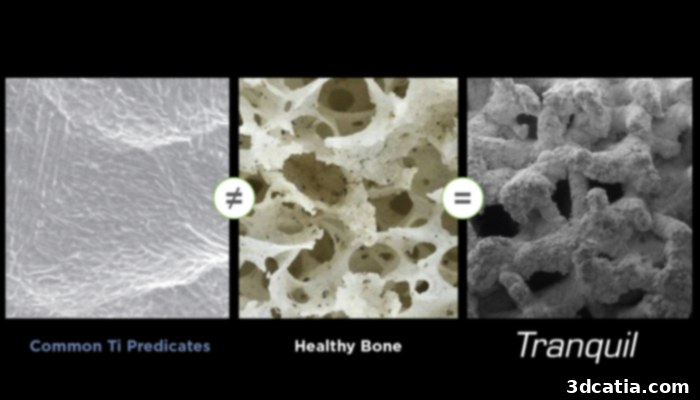
Tranquil is able to replicate healthy bone found in the human spine, enhancing natural fusion. (Photo Credit: Nexus Spine)
PressON: Tailored Spinal Fixation for Unprecedented Comfort and Recovery
Eliminating Pain Through Compliant Mechanism Technology
Nexus Spine’s PressON introduces a revolutionary spinal fixation system that directly addresses and eliminates the chronic pain often associated with conventional spinal stabilization techniques. By meticulously employing compliant-mechanism technology, PressON is uniquely engineered to cater the device’s biomechanical response specifically to each individual patient’s anatomy and needs. This innovative approach eradicates the need for painful and imprecise spinal rod-bending, along with other contemporary spinal surgery “persuasion techniques” that frequently contribute to significant post-operative discomfort. David Hawkes, president at Nexus Spine, highlighted the ingenuity behind this design: “Compliant mechanisms have fundamentally transformed what is possible, enabling our skilled engineers to achieve more for patients with significantly less metal. Traditional rigid rod systems typically necessitate larger surgical wounds, more extensive tissue retraction, and a greater array of surgical instruments. This not only inherently lengthens the duration of the surgery but also critically increases the likelihood of post-operative infections and intensifies patient pain and recovery time.”
The PressON system meticulously redefines efficiency and ease of application in spinal fixation. It is not only significantly faster to implant but also boasts a smaller profile, and is an astonishing sixteen times easier to apply compared to its conventional counterparts. These design advantages translate directly into substantial patient benefits. The surgical incision required for the PressON system is approximately half the length of those demanded by traditional alternatives. This dramatic reduction in incision size directly correlates with a profoundly less invasive procedure, leading to substantially less intraoperative trauma and, consequently, even less post-surgical pain for the patient. Moreover, this minimized invasiveness accelerates the recovery process, allowing patients to regain mobility and resume their normal activities much faster than previously possible. The compliant nature of PressON allows for a more forgiving and adaptive fixation, distributing stress more evenly and reducing the incidence of implant-related pain or failure. This patient-centric design marks a monumental advancement, focusing on both immediate surgical success and the long-term well-being and comfort of individuals undergoing spinal stabilization procedures.
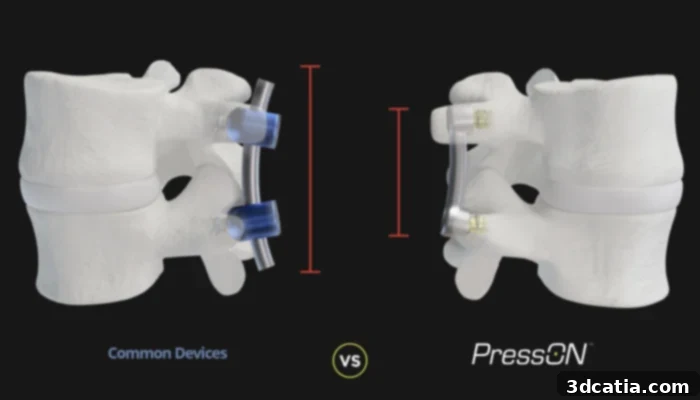
PressON is a third of the size of its common counterparts, facilitating minimally invasive surgery. (Photo Credit: Nexus Spine)
A New Era for Spinal Surgery: Improved Outcomes, Reduced Costs
The introduction of Tranquil and PressON by Nexus Spine undeniably signals a transformative period for spinal surgery. These two groundbreaking devices are poised to drastically improve not only the cost-effectiveness and operational efficiency of spinal procedures but, more importantly, to significantly enhance the lives of countless patients who will benefit from their advanced designs. The integration of cutting-edge 3D printing and innovative compliant mechanism engineering allows these implants to transcend the limitations of traditional spinal devices, offering solutions that are more biologically congruent and patient-friendly. The extensive clinical validation over six years, involving hundreds of patients, underscores the robust performance and positive impact of these technologies.
David Hawkes summarized the monumental impact of these innovations with clarity and conviction: “Nexus Spine has unequivocally demonstrated superior clinical outcomes, substantially decreased healthcare costs, and remarkably simplified surgical use by expertly leveraging our novel compliant mechanism engineering expertise and proprietary intellectual property. Our advanced technology products have been proven to consistently decrease patient pain, accelerate the healing process, and significantly reduce the overall cost of spinal care, marking a pivotal moment for both patients and healthcare providers.” This commitment to innovation, coupled with a deep understanding of biomechanics and patient needs, positions Nexus Spine as a true leader in the medical device industry. Their work promises a future where spinal surgery is less invasive, recovery is faster, and patient satisfaction is higher than ever before.
For those interested in delving deeper into Nexus Spine’s pioneering work and their complete range of advanced spinal solutions, further information is available HERE. We invite you to explore how these innovations are setting new benchmarks in patient care and surgical efficacy.
What are your thoughts on Nexus Spine’s revolutionary implants and the potential impact of compliant mechanisms in medical technology? Share your insights and comments below, or connect with us on our social media platforms: Linkedin, Facebook, and Twitter pages! Don’t miss out on the latest advancements in 3D printing and medical innovation. Sign up for our free weekly Newsletter here to get the freshest news delivered straight to your inbox!