
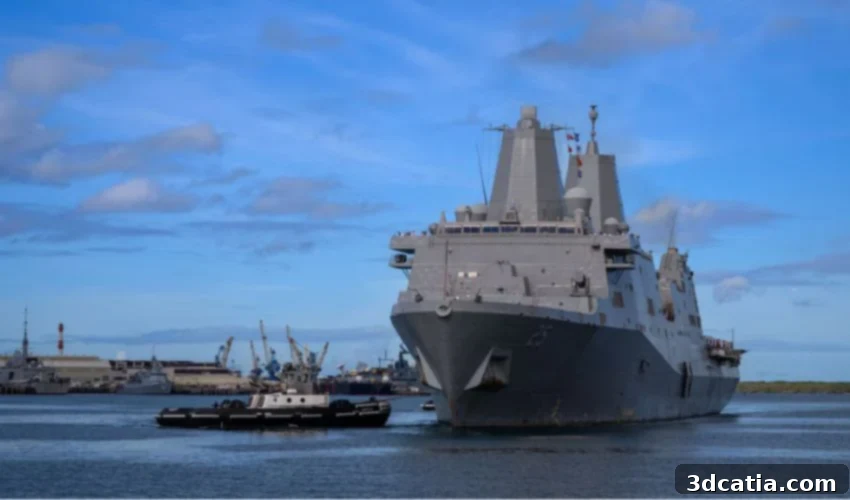
Revolutionizing Naval Operations: How the U.S. Navy Enhances Fleet Readiness with Additive Manufacturing at RIMPAC 2024
The United States Navy is aggressively exploring and implementing additive manufacturing (AM), commonly known as 3D printing, across its global operations, both at sea and ashore. This strategic initiative aims to fundamentally transform naval logistics, maintenance, and operational readiness. A prime example of this commitment was showcased at The Rim of the Pacific Exercise (RIMPAC) 2024, where students from the Naval Postgraduate School (NPS) demonstrated the profound potential of 3D printing to significantly enhance fleet capabilities. Their efforts particularly highlighted how additive manufacturing can be leveraged for critical ship repair, minimizing downtime and maximizing operational uptime for naval assets.
RIMPAC stands as the world’s largest international maritime exercise, a monumental event held biannually in even-numbered years. The 2024 iteration, the 29th time this exercise has taken place, unfolded between June 26th and August 2nd in and around the picturesque Hawaiian Islands. Centered on the crucial theme of “integrated and prepared,” the exercise brought together an unparalleled coalition of 29 nations, deploying 40 surface ships, 3 submarines, 14 national land forces, over 150 aircraft, and more than 25,000 personnel. This vast scale and complexity made RIMPAC 2024 an ideal, real-world testing ground for evaluating the practical applications of cutting-edge technologies like additive manufacturing, especially for the intricate and demanding task of repairing vital parts on ships operating in a dynamic maritime environment.

Retired Marine Corps Col. Patrick Tucker, Marine Corps Lt. Col. Michael Radigan, Navy Lt. Cmdr. Zachary Vrtis, Lt. Ashley Adams and Lt. Andrew Staley showcasing parts made with the XSPEE3D expeditionary cold spray printer (photo credits: NPS)
The Strategic Imperative: Why Additive Manufacturing for Naval Operations?
The traditional naval supply chain, while robust, faces inherent challenges. These include long lead times for obtaining specialized parts, the increasing obsolescence of components for aging vessels, the logistical complexities of transporting parts across vast distances, and the sheer cost of maintaining extensive physical inventories at various global locations. For a navy that operates globally and must respond rapidly to evolving threats, these challenges can significantly impact operational readiness and mission success.
Addressing these critical issues, Navy Lt. Cmdr. Zachary Vrtis, an engineering duty officer pursuing a doctorate in mechanical engineering with a focus on metal additive manufacturing, articulated the Navy’s strategic vision. “Ship and submarine repair is one of our crucial focus areas,” he explained. “We are working to implement advanced metal manufacturing to better supplement traditional fabrication methods, repair fleet assets quicker, and assist in revitalizing the submarine industrial base to meet production goals.” This statement underscores the multifaceted benefits of AM: not only does it offer immediate solutions for repairs, but it also plays a vital role in modernizing and strengthening the broader defense industrial base.
The ability to manufacture parts on-demand, directly at the point of need—whether on a ship at sea or at a forward operating base—transforms the logistics paradigm from a “just-in-case” inventory model to a “just-in-time” manufacturing capability. This shift significantly reduces reliance on distant logistics chains, lowers inventory costs, and critically, enhances the self-sufficiency of naval units operating far from traditional repair facilities. For the U.S. Navy, this means a more agile, resilient, and responsive fleet, better prepared to meet the demands of 21st-century maritime challenges.
On-Deck and On-Shore: Deploying Advanced 3D Printing Technologies for Fleet Readiness
During RIMPAC 2024, a dedicated team of ten NPS students, drawn from the U.S. Navy, U.S. Marine Corps, and U.S. Army, collaborated with representatives from the school’s Consortium for Advanced Manufacturing and Research (CAMRE) and FLEETWERX. Their mission was to actively deploy metal additive manufacturing capabilities both aboard ships and at land-based installations to produce crucial repair parts. This collaborative effort saw the CAMRE team embedded aboard the San Antonio-class amphibious transport dock ship USS Somerset (LPD 25), while a Joint Advanced Manufacturing Cell was established ashore at Marine Corps Base Hawaii. These strategic deployments provided invaluable opportunities to rigorously test and demonstrate the ability of 3D printing to directly improve fleet readiness in challenging operational environments.
The exercise specifically utilized two key additive manufacturing systems renowned for their ruggedness and deployability. The first was the XSPEE3D cold spray 3D printer from SPEE3D. This innovative printer is engineered for rapid deployment and operation even in remote locations and harsh conditions, making it perfectly suited for military applications. It employs a high-velocity impact of metal particles to build parts, bypassing the need for melting and significantly speeding up the manufacturing process. The XSPEE3D can produce parts up to approximately 0.9 meters in diameter and 0.7 meters in height, weighing up to 40 kg, using a variety of materials including aluminum, aluminum bronze, stainless steel, and copper. Its ability to create functional metal parts quickly and without extensive post-processing is a major advantage for battlefield or shipboard repairs.
The second system was a hybrid wire directed energy deposition (DED) machine from Snowbird Technologies. This robust solution is housed within a 10-foot, containerized platform, designed for ultimate portability and deployability. Powered by a Meltio print system, integrated with FANUC controls, and featuring Creaform 3D scanning capabilities, this DED system is versatile. It excels at repairing existing components by adding material layer by layer, as well as fabricating new parts. The hybrid nature, combining additive and subtractive capabilities, allows for the creation of complex geometries and high-precision repairs. Both the XSPEE3D and Snowbird Technologies DED solution highlight a crucial requirement for the U.S. Navy: 3D printing is most impactful for fleet readiness when it comes in a mobile, deployable platform that can be rapidly transported and set up wherever needed, a necessity given the unpredictable nature of naval operations and global conflicts.
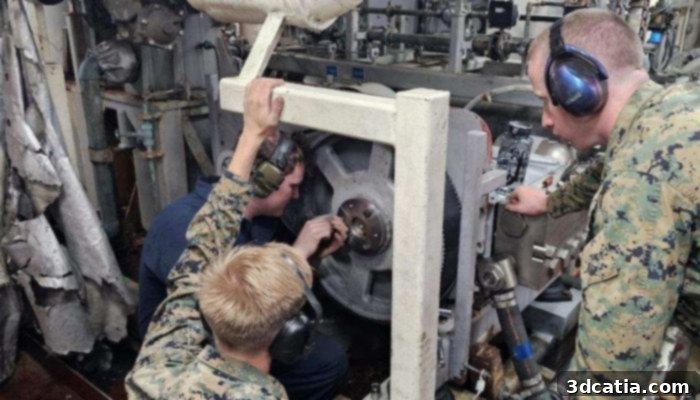
Installing 3D-printed stainless steel reverse osmosis pump sprocket bushing aboard USS Somerset (photo credits: NPS)
A Tangible Impact: Preventing Downtime and Enhancing Self-Sufficiency on the USS Somerset
The RIMPAC 2024 exercise proved to be an unequivocal success for the demonstration of additive manufacturing’s capabilities. A standout achievement involved the use of AM to repair a critical component of a reverse osmosis pump aboard the USS Somerset. Reverse osmosis pumps are vital for naval vessels, providing essential fresh water for the crew, various ship systems, and even some propulsion components. A failure in such a system can severely impact a ship’s endurance and operational capacity.
In this instance, the ability to rapidly 3D print a replacement part directly on board prevented the USS Somerset from having to prematurely withdraw from RIMPAC 2024. This single accomplishment vividly demonstrated the immediate, real-world operational value of having on-demand manufacturing capabilities. It highlighted how access to these advanced AM solutions ensures rapid repairs, drastically reducing the traditional reliance on lengthy, distant logistical pipelines and the associated delays. By embracing 3D printing, the U.S. Navy is moving towards a future where fleet readiness is significantly increased, as vessels will no longer be held hostage by legacy components with unacceptably long acquisition lead times or by the vulnerabilities of extended supply chains. This shift directly translates into more time at sea, greater mission accomplishment, and enhanced strategic flexibility.
Beyond RIMPAC: The Future of Additive Manufacturing in the U.S. Navy
The successes at RIMPAC 2024 are not merely isolated incidents but represent a significant step forward in the U.S. Navy’s broader strategy to integrate advanced manufacturing across its entire fleet. Navy Capt. Jeremy Gray, who serves as surface warfare chair at NPS, succinctly captured this transformative potential: “This innovative technology [3D printing] is becoming an increasingly game-changing capability that is improving operational readiness and afloat self-sufficiency.” He further emphasized the collaborative spirit driving this innovation, stating, “The partnership between Commander Naval Surface Forces and NPS is accelerating fleet experimentation and Sailor experience with advanced manufacturing techniques and processes.”
Looking ahead, the U.S. Navy envisions a future where additive manufacturing is a standard tool in every sailor’s kit, enabling on-demand production of not just repair parts, but also custom tools, prototypes, and potentially even components for new systems. This paradigm shift involves moving from a physical inventory model, where warehouses are stocked with countless spare parts, to a digital inventory. In this future, digital blueprints of parts can be stored securely and printed on demand, anywhere in the world, reducing storage space, obsolescence issues, and the logistical burden of transporting physical items. This concept of a “digital warehouse” significantly enhances the Navy’s agility and responsiveness.
Furthermore, the integration of 3D printing fosters greater self-reliance and innovation within the naval ranks. Training sailors in additive manufacturing empowers them to be problem-solvers, capable of fabricating solutions in austere environments when traditional supply chains are unavailable or compromised. This not only boosts morale but also cultivates a culture of technological ingenuity essential for maintaining a decisive edge. The continued partnership between academic institutions like NPS and operational commands ensures that these advancements are rigorously tested, refined, and rapidly transitioned into practical fleet applications, accelerating the pace of technological adoption. As the U.S. Navy continues to invest in and expand its additive manufacturing capabilities, it is not merely acquiring new tools; it is fundamentally reshaping its operational doctrine, logistics, and maintenance strategies to build a more resilient, efficient, and formidable fighting force for decades to come. You can find out more from the U.S. Navy’s press release HERE.
What are your thoughts on the U.S. Navy’s strategic adoption of 3D printing for enhancing fleet readiness and operational efficiency? Do you believe additive manufacturing will become a cornerstone of military logistics worldwide? Share your insights in a comment below or join the conversation on our LinkedIn, Facebook, and Twitter pages! Don’t forget to sign up for our free weekly newsletter here for the latest 3D printing news straight to your inbox! You can also find all our videos on our YouTube channel.
*Cover Image: The U.S.S Somerset arrives at Pearl Harbor in Hawaii for RIMPAC 2024 (photo credits: NPS)