
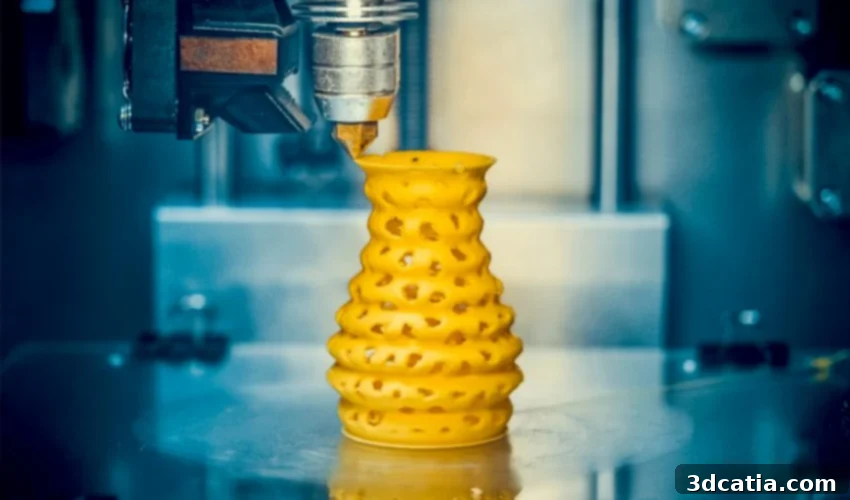
PLA for 3D Printing: The Ultimate Guide to Polylactic Acid Filament
Polylactic Acid, commonly known as PLA, stands out as one of the most extensively utilized plastics within the additive manufacturing sector. Its journey began in 1930, thanks to the pioneering work of chemist Wallace Carothers, renowned for his contributions to materials science, including the development of nylon and neoprene. PLA’s versatility allows it to be processed into filament or pellet form, catering to a broad spectrum of 3D printing technologies, from accessible desktop 3D printers to sophisticated industrial solutions. A key differentiator for PLA, and a primary reason for its widespread adoption, is its reputation as a more sustainable thermoplastic. Unlike many conventional plastics derived from finite fossil fuels like petroleum, PLA is sourced from natural and renewable resources. This eco-friendlier origin has fueled its popularity since its inception in the realm of 3D printing, leading to its application across a vast array of industries and innovative uses. This comprehensive guide will delve deep into everything you need to know about PLA, exploring its fundamental characteristics, ease of use in 3D printing, diverse applications, and identifying the leading manufacturers in the market today.
Understanding PLA: Production and Core Characteristics
As highlighted, PLA’s sustainable appeal stems directly from its organic and renewable origins. The primary raw materials typically include corn starch, tapioca roots, or sugarcane. The production of this versatile polymer is achieved through a meticulous process of fermentation, utilizing one of these carbohydrate-rich sources. More specifically, the natural product, such as corn, is first ground to meticulously separate its starch component. This isolated starch is then mixed with either acid or lactic monomers. This mixture facilitates the breakdown of the starch into dextrose (D-glucose), often referred to as corn sugar. The final and crucial step involves the fermentation of this glucose, which ultimately yields L-lactic acid – the foundational building block of PLA. This intricate process results in a material that is not only environmentally conscious and renewable but also possesses the potential for biodegradability, depending on specific environmental conditions like temperature and humidity.
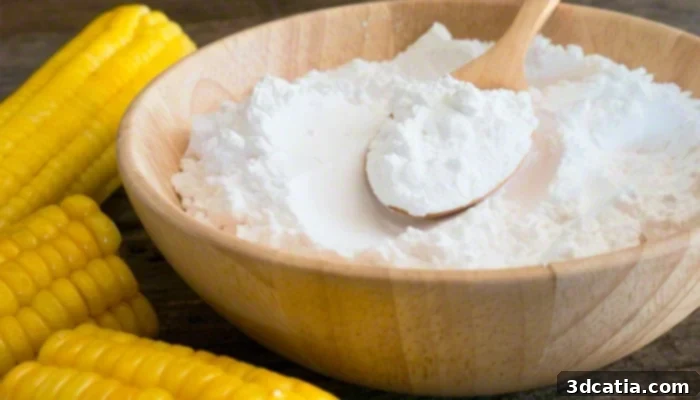
PLA is manufactured from renewable materials such as corn starch, making it an eco-friendlier option for 3D printing.
The Biodegradability Debate: A Nuanced Perspective
Despite its renewable origins, whether PLA can truly be classified as biodegradable has been a subject of considerable debate in recent years, prompting scrutiny into the material’s overall sustainability and environmental footprint. The reality is that the question of PLA’s biodegradability is far more complex than it initially appears. While the plastic is indeed derived from renewable resources, its capacity to be decomposed by living organisms is critically dependent on specific aerobic conditions, primarily those found in industrial composting facilities. Under these controlled environments, where optimal temperature, humidity, and microbial activity are maintained, PLA can degrade relatively quickly, often within a few months. However, when discarded in an open environment, such as a landfill or natural setting, without these ideal conditions, PLA can take an alarmingly long time—up to 80 years or more—to decompose, effectively becoming another persistent plastic pollutant. This distinction is crucial for understanding its true environmental impact and for promoting responsible disposal and recycling practices.
Material Properties: Pseudoplasticity and Viscosity
An additional and fascinating property of PLA is its classification as a non-Newtonian pseudoplastic fluid. This technical designation implies that its viscosity—a measure of its resistance to flow—is not constant but rather changes dynamically depending on the shear stress applied to it. In practical terms for 3D printing, this means PLA does not exhibit a fixed and unchanging viscosity value; instead, it varies in response to the manufacturing or extrusion conditions. More specifically, PLA is a shear-thinning material, which means its viscosity decreases as the applied stress (such as the pressure exerted by an extruder screw) increases. This characteristic is highly advantageous in Fused Filament Fabrication (FFF) 3D printing, as it allows the material to flow more easily through the nozzle under pressure, then solidify quickly once the pressure is released, helping to maintain dimensional accuracy and intricate details. Understanding this behavior is key to optimizing printing parameters for ideal results.
PLA in 3D Printing: Ease of Use and Performance
PLA’s reputation as one of the most user-friendly materials has made it an undisputed favorite in Fused Filament Fabrication (FFF) 3D printing, particularly among newcomers to the additive manufacturing world. Its straightforward printing characteristics significantly lower the barrier to entry for hobbyists and professionals alike. While most commonly encountered in filament form, PLA is also available as pellets or granules, especially for more industrial-scale extrusion systems. It’s important to note that regardless of the format—whether fed via an extruder for filaments or a hopper for pellets—the intrinsic characteristics of the material and the final printed parts remain consistent. However, for the scope of this guide, we will primarily focus on PLA in its filament form, as this is by far the most prevalent way this thermoplastic is utilized in desktop 3D printing.
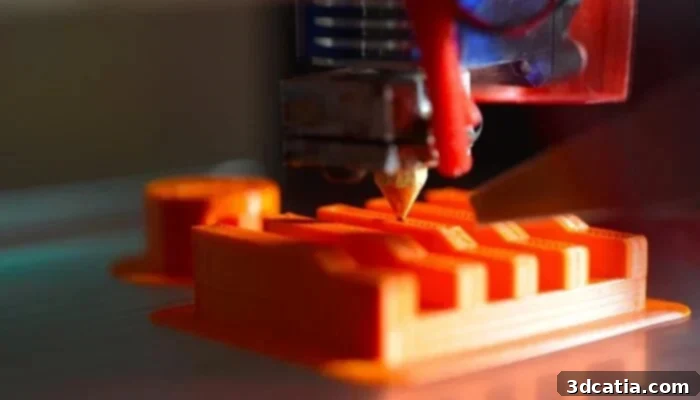
PLA is one of the most widely used thermoplastics in 3D printing (photo credits: BMI Lab)
Optimal Printing Parameters and Performance
PLA is categorized as a semi-crystalline polymer, boasting a relatively low melting temperature, typically ranging between 170-180°C. This is a distinct advantage compared to other common filaments like ABS, which generally requires extrusion temperatures between 200-260°C. This lower melting point often negates the need for a heated print bed or an enclosed printing chamber, simplifying the printing process and making it accessible even on entry-level machines. Furthermore, PLA filament offers commendable printing performance, enabling high printing speeds while still producing parts with fairly sharp edges and fine details, provided that adequate cooling is applied during the extrusion process. The resulting printed parts also exhibit a very low tendency to deform, minimizing issues like warping which can plague other materials. However, it’s worth noting that PLA inherently possesses a higher viscosity than some other standard thermoplastics in its molten state. If printing temperatures are too low or retraction settings are not optimized, this can sometimes lead to nozzle clogging. Properly stored, PLA filaments typically have a shelf life of at least one year when maintained at temperatures between 15°C and 25°C, away from moisture and direct sunlight.
PLA vs. ABS: A Comparative Analysis
When we compare PLA with ABS, another ubiquitous thermoplastic in FDM 3D printing, several key differences emerge. Generally, PLA does not match the superior strength, flexibility, or impact resistance of ABS. For applications requiring high mechanical stress or durability, ABS often proves to be the better choice. However, PLA significantly outperforms ABS in terms of ease of printing, particularly concerning its reduced susceptibility to warping, a common frustration for ABS users. PLA’s lower shrinkage rate during cooling means less stress on the printed part and the print bed, leading to more consistent results. While it might not be the go-to material for highly complex mechanical parts requiring extreme resilience, PLA remains the recommended choice for projects where simplicity of printing, aesthetic quality, and moderate structural integrity are prioritized.
Post-Processing PLA Parts
In terms of post-processing, PLA generally requires minimal effort, making it even more beginner-friendly. One common challenge during part removal can be excessive adhesion of the first print layer to the build plate. To mitigate this, it is often recommended to use specialized adhesives, such as glue sticks, blue painter’s tape, or specific build plate surfaces (e.g., PEI sheets), to facilitate easier removal of the finished parts once cooled. For improving the surface finish and aesthetics of printed objects, users can effectively sand PLA parts using various grits of sandpaper, starting with coarser grits and progressing to finer ones for a smoother result. Unlike ABS, PLA does not dissolve well in acetone, so chemical smoothing techniques using acetone are not applicable. However, other methods like vapor smoothing with chloroform (though hazardous) or specific industrial smoothing solutions exist. If support structures are employed, they can typically be removed with ease using standard tools like tweezers or pliers. For more intricate designs, soluble support materials can be printed alongside PLA, allowing the supports to be dissolved away in water or a specialized solution, leaving behind a clean final part.
Diverse Applications of PLA in 3D Printing
As previously outlined, PLA’s inherent accessibility and ease of use in 3D printing have cemented its status as a foundational plastic, especially within the vibrant community of makers and hobbyists. However, it’s crucial to acknowledge its limitations: PLA typically yields printed parts that are somewhat brittle, possess moderate strength, and are sensitive to prolonged exposure to direct sunlight and high temperatures. These characteristics make it less suitable for applications demanding high mechanical performance or extreme environmental resistance. Consequently, it remains a preferred material for beginners and for creating items where aesthetic appeal and ease of fabrication are paramount, such as decorative elements, various gadgets, educational models, and children’s toys.
Yet, PLA’s utility extends far beyond the realm of hobbyists. Numerous industries strategically leverage this thermoplastic, most notably for rapid prototyping. This application offers significant cost and time savings for companies, allowing them to iterate designs quickly without the expensive and time-consuming process of creating traditional molds. For instance, while not always the primary choice for load-bearing components, sectors like the automotive industry can still benefit from PLA filament. It proves invaluable for producing conceptual models, interior trim prototypes, accessories for vehicles, or even certain elements of the dashboard where high mechanical stress is not a concern, facilitating design validation and fitment checks.
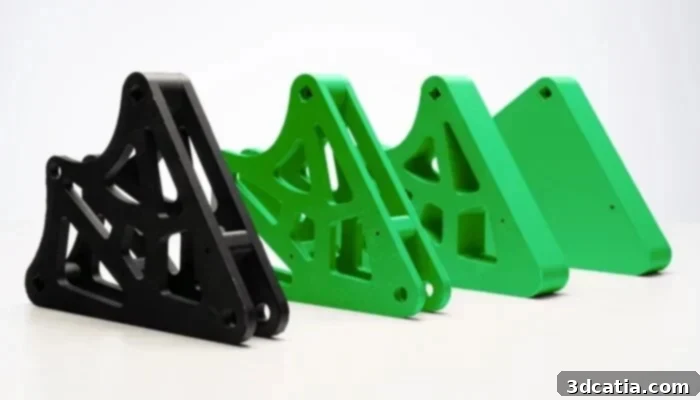
PLA is popular with makers as well as for rapid prototyping (photo credits: Markforged)
Limitations and Food Safety Considerations
A significant limitation of PLA is its relatively low glass transition temperature (Tg), typically around 60-65°C. This characteristic means that PLA parts can begin to soften and deform at temperatures that are easily reached in environments like a hot car on a sunny day or when exposed to hot liquids. Consequently, it is generally unsuitable for applications requiring high heat resistance. For example, industries dealing with hot food or beverages should avoid using PLA to create cups or containers intended for hot liquids, as the material could deform and potentially leach compounds. However, it is important to distinguish between heat resistance and food contact safety. Many virgin PLA formulations are considered food-contact safe, meaning they are non-toxic and do not transfer harmful substances to food under normal, non-heating conditions. This property makes PLA widely used in food packaging, disposable cutlery, and containers for cold foods. Always check the specific manufacturer’s safety data sheets and certifications for food contact suitability to ensure compliance and safety for any particular application.
Key PLA Manufacturers and Pricing Insights
Given its status as one of the most popular and accessible thermoplastics for FDM/FFF 3D printing, virtually all material manufacturers in the additive manufacturing space offer PLA filaments or pellets within their extensive product ranges. Prominent names in this segment include industry leaders such as Polymaker, known for its diverse range of PLA variants including specialty types; Recreus, recognized for innovative and functional filaments; Smart Materials, offering a wide array of standard and enhanced PLA options; and BASF, through its Forward AM brand, providing high-quality engineering-grade thermoplastics, including PLA. Additionally, a multitude of FDM 3D printer manufacturers often supply their own branded filaments, optimized for their machines. This list includes well-known brands like UltiMaker, Stratasys, Prusa Research, and Zortrax, among many others, ensuring compatibility and consistent print quality for their users.
Types of PLA and Pricing Factors
The versatility of PLA extends to numerous specialized blends and variations, each offering unique properties and influencing pricing. Beyond standard PLA, you can find “Tough PLA” designed for increased impact resistance, “Flexible PLA” for more elastic properties, “Silk PLA” which provides a glossy, smooth finish, and composites like “Wood PLA” (infused with wood fibers for a natural look and feel), “Carbon Fiber Reinforced PLA” (for improved stiffness and strength), or even aesthetic variants such as “Glow-in-the-Dark PLA” and “Temperature-Sensitive Color Change PLA.” These hybrid and specialty filaments often come at a higher price point due to the added materials, manufacturing complexity, and enhanced characteristics. Nevertheless, the price of a standard 1kg spool of PLA filament typically ranges between 20 and 70 euros, depending on the brand, quality, color, and any specific additives. Furthermore, as mentioned, for those with industrial-grade 3D printers capable of direct pellet extrusion, PLA pellets represent an even more affordable material option, particularly because they bypass the processing costs associated with converting raw polymer into filament form, offering significant savings for large-scale production.
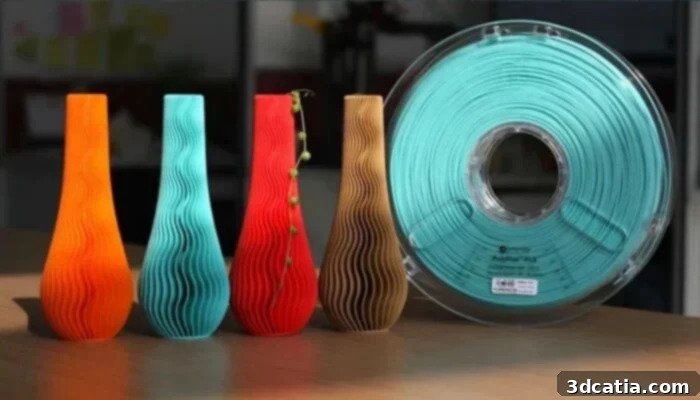
Photo Credits: Polymaker
We hope this comprehensive guide has enriched your understanding of PLA for 3D printing. Did you discover something new or have further insights to share? Let us know in a comment below or connect with us on our LinkedIn, Facebook, and Twitter pages! Don’t forget to sign up for our free weekly Newsletter here to get the latest 3D printing news delivered straight to your inbox! You can also find all our engaging videos and tutorials on our YouTube channel.