
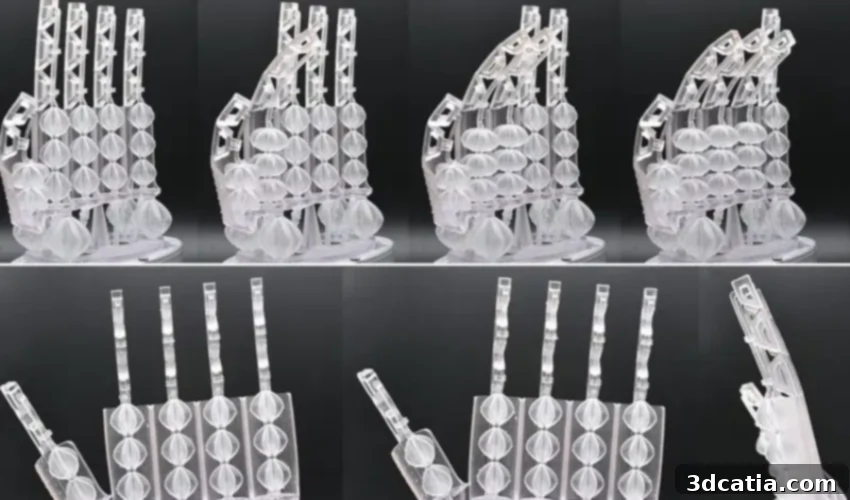
GRACE: The Additive Manufactured Robotic Hand Redefining Strength and Dexterity
The natural world often inspires groundbreaking engineering, and the incredible strength of ants – capable of lifting up to 100 times their own body weight – has long fascinated scientists. Now, however, researchers at the Italian Institute of Technology (IIT) have pushed these biological boundaries with an astonishing achievement in robotics. They have successfully developed a robotic hand, dubbed GRACE, that can carry an astounding 1000 times its own weight, all thanks to advanced additive manufacturing techniques. This remarkable innovation is no longer a concept but a reality: a robotic hand weighing only 8 grams can effortlessly lift 8 kilograms, demonstrating not only immense strength but also the capability to perform sophisticated, human-like movements using artificial muscles. GRACE operates by meticulously exerting pressure on various actuator membranes, enabling a wide range of precise and powerful movements.
At its core, GRACE functions as a highly sophisticated actuator. In robotics and engineering, an actuator is a mechanism responsible for transforming energy and control signals into mechanical motion, thereby executing commands such as gripping, lifting, or manipulating objects. The GRACE robotic hand, leveraging its innovative design as artificial muscles, represents a significant leap forward in robotic capabilities. This project holds immense promise for the future, potentially leading to more versatile and powerful robotic assistance across numerous sectors of society, from healthcare and manufacturing to exploration and domestic aid. De Pascali, a key research member of the IIT team, elucidated the foundational philosophy behind this revolutionary design, stating: “We started from the traditional artificial muscle and developed a new class of artificial muscles made of a single monolithic component.” This approach emphasizes simplicity in design while maximizing functional efficiency.
The Power of Additive Manufacturing and Advanced Materials
While the concept of designing robots with artificial muscles is not entirely new, what truly distinguishes the GRACE actuators is the ingenious inclusion of specific folds within their membrane structure. These strategically designed folds are the primary drivers behind the extraordinary strength and unparalleled flexibility that these artificial muscles exhibit, allowing them to mimic the intricate and agile movements of human muscles with remarkable precision. The membrane itself is a marvel of modern engineering, meticulously fabricated using advanced additive manufacturing (often referred to as 3D printing) techniques. This process utilizes a specially formulated flexible resin, a material critical to GRACE’s functionality. Much like its biological counterpart, the human muscle, this innovative membrane possesses the inherent ability to stretch considerably under tension and then efficiently contract back to its original state, facilitating fluid and dynamic motion. The research team highlighted a significant improvement over previous attempts, where stiff resins were commonly employed. These earlier materials offered a severely limited range of motion, proving inadequate for the complex and nuanced movements desired in advanced robotics, underscoring the vital role of the new flexible resin in GRACE’s success.
Unlocking Design Freedom with 3D Printing
The selection of additive manufacturing for producing the GRACE robotic hand’s actuators was a strategic decision, driven by several key advantages that this technology offers over traditional manufacturing methods. Firstly, 3D printing excels at creating complex geometries and intricate internal structures, which are essential for integrating the specialized folds within the actuator membranes. These folds are not merely aesthetic; they are meticulously engineered features that enable the muscle-like expansion and contraction, distributing stress evenly and enhancing overall durability. Secondly, additive manufacturing allows for rapid prototyping and iteration. Researchers can quickly design, print, and test multiple variations of the actuator, refining the mathematical models and material properties until optimal performance is achieved. This iterative process is crucial in cutting-edge research and development. Lastly, 3D printing offers exceptional material efficiency, minimizing waste by only depositing material where it is needed. This is particularly beneficial when working with specialized and potentially costly flexible resins.
From Mathematical Models to Human-like Motion
The journey to creating the GRACE actuators began with sophisticated mathematical modeling. This foundational step allowed the researchers to precisely predict and optimize the behavior of the membrane, accounting for factors such as material elasticity, fold geometry, and hydraulic pressure dynamics. The starting point for the membrane’s design is indeed a rigorous mathematical model, which serves as a blueprint for its exceptional performance. Depending on the exact model and the specific manufacturing process employed for each actuator, the material used for its construction and its precise width can vary significantly. These variations, in turn, have direct implications for the gripping force and overall capabilities of the robots incorporating these actuators. This modularity allows for a high degree of customization and adaptability, enabling the creation of specialized robotic components for diverse tasks.
During the intensive research phase in Italy, the dedicated team successfully developed and integrated a total of 18 individual actuators, each differing in size, into a fully functional robotic hand complete with a wrist. This complex assembly demonstrates the versatility and scalability of the GRACE technology. The genius lies in the ability to influence both the muscle strength and the capacity for imitation of various body parts simply by strategically combining different types and quantities of these actuators. For example, a configuration requiring fine motor skills might use smaller, more numerous actuators, while a task demanding sheer force would incorporate larger, more powerful units. This level of customizable biomechanics makes GRACE an incredibly exciting project, one that has already garnered significant recognition and approval from the wider scientific community, including experts in Great Britain. Jonathan Aitken from the esteemed University of Sheffield commendably observed, “The design of the GRACE is interesting and novel, providing easy antagonistic operation by design.” This ‘antagonistic operation’ refers to the ability of the actuators to work in opposing pairs, much like human muscles (e.g., biceps and triceps), allowing for precise and controlled movement in two directions without the need for complex external mechanisms.
Future Implications and Applications of GRACE Technology
The development of the GRACE robotic hand opens a vast array of possibilities for future robotic applications. Its unique combination of strength, dexterity, and lightweight design makes it ideal for roles where robots previously struggled due to limitations in force-to-weight ratio or delicate manipulation. In the medical field, GRACE-like technology could revolutionize prosthetics, offering amputees more natural and functional robotic limbs that can perform intricate tasks with greater ease and sensitivity. Surgical robots could also benefit, allowing for more precise and less invasive procedures. Beyond healthcare, the industrial sector stands to gain immensely. Imagine robotic arms capable of handling extremely heavy components with the finesse required for delicate assembly, or performing dangerous tasks in hazardous environments with unprecedented reliability and control. In assistive robotics, GRACE could lead to the development of incredibly helpful domestic robots, capable of lifting objects, aiding the elderly, or assisting individuals with disabilities, all while operating safely and gently in human environments.
Furthermore, the principle of using a ‘single monolithic component’ for artificial muscles, as highlighted by De Pascali, signifies a paradigm shift towards simpler, more robust robotic designs. Fewer moving parts mean less potential for wear and tear, reduced maintenance, and increased overall lifespan for robotic systems. This advancement not only makes robots more efficient but also more accessible for wider deployment. The ability to customize muscle strength and movement imitation by combining different actuators suggests a future where robotic systems are highly adaptable, tailored precisely to the demands of their intended function, from exploration in challenging terrains to everyday human interaction. This is truly a testament to how biomimicry, combined with cutting-edge materials and manufacturing processes like 3D printing, can yield innovations that surpass even nature’s own benchmarks, propelling us into a new era of human-robot collaboration and capability.
What are your thoughts on this groundbreaking robotic hand that enables such powerful, human-like movements? We invite you to share your insights in a comment below or join the conversation on our LinkedIn, Facebook, and Twitter pages! Don’t forget to sign up for our free weekly Newsletter here to receive the very latest 3D printing news straight to your inbox! You can also find all our videos, offering deeper dives into these fascinating innovations, on our YouTube channel.
*Cover Photo Credits: IIT