
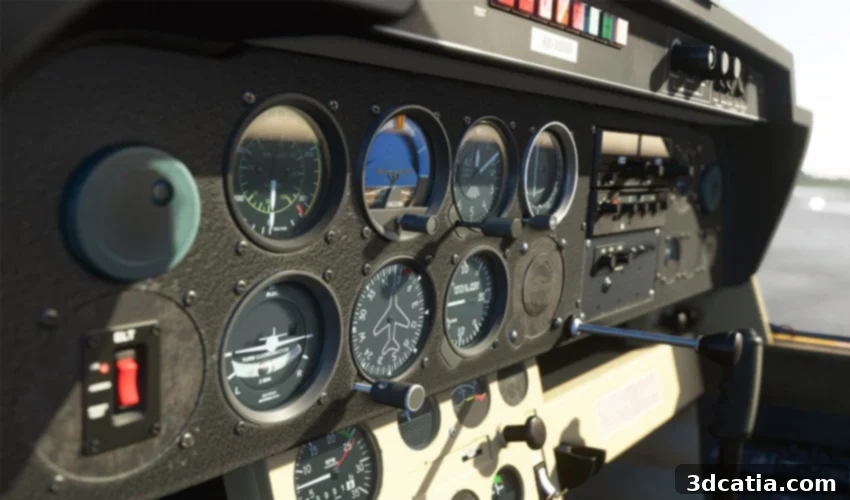
Unlocking Unprecedented Realism: How 3D Scanning Revolutionized Microsoft Flight Simulator
Microsoft Flight Simulator stands as a colossal achievement in the world of flight simulation, captivating millions of players with its unparalleled ambition to replicate the global aviation experience. With a player base exceeding a million and an astounding 26 million completed virtual flights, its latest iteration has set new benchmarks for realism. To achieve this breathtaking level of immersion, Asobo Studio, the brilliant creators behind the game, turned to cutting-edge technology: Artec 3D scanning solutions. By utilizing the advanced capabilities of the Artec Leo 3D scanner, Asobo Studio meticulously reproduced aircraft cockpits with astonishing fidelity, transporting players directly into the pilot’s seat. The result is nothing short of impressive; players are fully immersed, navigating their chosen aircraft through diverse conditions and embarking on unforgettable virtual journeys, all from the comfort of their computer.
The Quest for Authenticity: Why 3D Scanning is Crucial for Simulation
In the realm of digital content creation, especially for high-fidelity simulations, the pursuit of realism is paramount. While numerous 3D modeling techniques are available, ranging from procedural generation to manual sculpting, directly scanning an existing physical object often emerges as the most efficient and accurate method. This process captures real-world data, forming a precise 3D model that can then be refined, edited, and even prepared for 3D printing in other applications. Effectively, 3D scanners provide an incredibly powerful tool for digitally replicating physical objects with exceptional detail and speed. This method has seen widespread adoption across various industries; for instance, many museums leverage 3D scanning to create digital archives of priceless artifacts, sculptures, and historical items. For Asobo Studio and Microsoft Flight Simulator, this methodology was not just a convenience but a strategic imperative. The core objective of a flight simulator is to offer an experience as close to real-life flying as possible, and 3D scanning proved to be the cornerstone of achieving this ambitious goal, especially when it came to the intricate and critical details of aircraft cockpits.
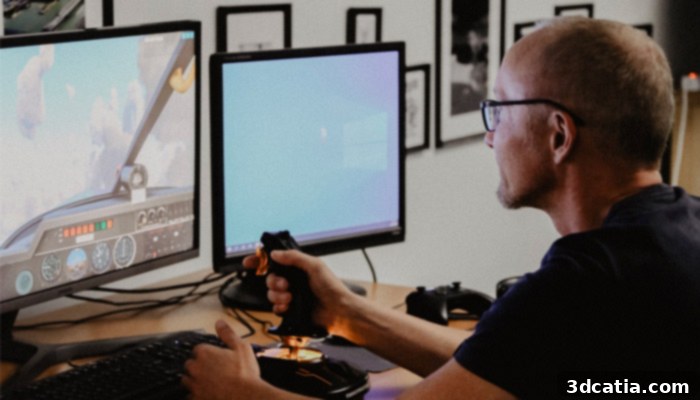
Microsoft Flight Simulator is currently one of the most famous simulators on the market
Expediting Development and Elevating Realism Through Advanced 3D Scanning
The discerning audience of Microsoft Flight Simulator largely comprises experienced aviation enthusiasts and actual pilots for whom the intricacies of flying hold no mystery. This demographic demands absolute virtual perfection in terms of graphical fidelity, aerodynamic accuracy, and, crucially, environmental detail. To meet these exceptionally high expectations, Asobo Studio deployed their teams to various tarmacs around the globe, armed with the portable and user-friendly Artec Leo 3D scanner. Over several weeks, they undertook a monumental task: scanning a diverse fleet of aircraft, ranging from compact two-seater aerobatics planes to colossal wide-bodied commercial jets. No detail was deemed too small to capture. They meticulously scanned various components, including the curvature of fuselages, the complex mechanisms of landing gear, and, most critically, every single element within the cockpits. This was not an easy feat, as attested by Nicolas Favre, Vehicle Artist at Asobo Studio. He elaborated on the challenges: “During the scanning operations, the primary difficulty was achieving the optimal distance to successfully scan the entirety of a dashboard within the confined, cramped space of a cockpit. Without the precision and speed of 3D scanning, it would have been extraordinarily difficult and consumed significantly more time to reproduce such a high level of detail, especially considering the multitude of buttons, switches, and instruments present in a typical cockpit.” This highlights how 3D scanning not only ensured accuracy but also streamlined a process that would otherwise be fraught with painstaking manual labor and potential inaccuracies.
A Streamlined Workflow: From Physical Scan to Digital Masterpiece
The time required for the scanning process varied depending on the size and complexity of the aircraft. For smaller planes, Asobo’s teams could often complete the scan in half a day, while larger models sometimes necessitated a full day of on-site work. Remarkably, the intricate task of scanning an entire cockpit typically took barely an hour, a testament to the efficiency of the Artec Leo system. Once the physical digitization step was complete, the raw scan data was then transferred to the powerful Artec Studio software for comprehensive processing. This crucial post-processing phase involves several steps: reducing the density of raw scan details to create an optimized mesh, aligning multiple scans into a cohesive model, removing noise, and texturing the surface to reflect the original material properties. These optimized aircraft models are then ready for further refinement and integration into the game engine, allowing developers to produce, edit, and process the 3D data with greater ease. The Asobo Studio teams reported that each scanned aircraft required approximately one full day of dedicated computer processing. This relatively short turnaround time for complex assets significantly shortens overall lead times compared to more traditional, manual modeling methods. More importantly, it dramatically increases the realism and authenticity of the final in-game rendering, delivering an unparalleled visual experience to players.
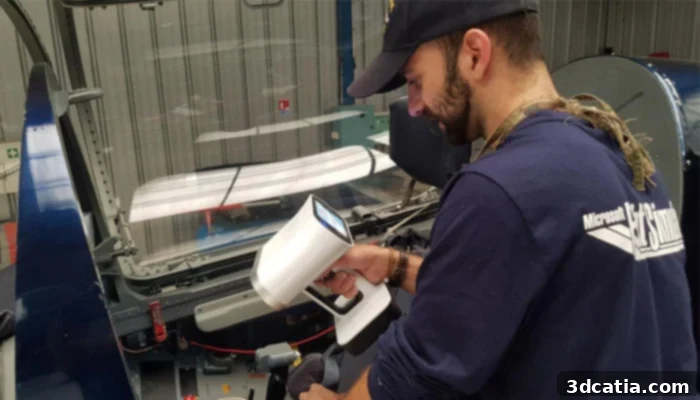
The team is using Artec Leo 3D scanner
Beyond Visuals: Enhanced Credibility and Development Efficiency
The benefits of integrating 3D scanning into the Microsoft Flight Simulator development pipeline extended far beyond mere visual fidelity. Gabriel Turot, another Vehicle Artist at Asobo Studio, summarized the broader impact: “The implementation of 3D scanning generated a significant saving of time and allowed us to bypass certain lengthy stages of verification typically required by the various aircraft manufacturers, who would otherwise need to meticulously review and validate our digital models. By directly capturing the real-world geometry and textures, 3D scanning technologies enabled us to proceed straight to the modeling stage, while simultaneously boosting our credibility and fostering greater confidence with manufacturers. They could immediately see and appreciate the extraordinary fidelity of the planes and cockpits incorporated into our video game, recognizing their brand representations with exceptional accuracy.” This demonstrates a crucial advantage: not only did 3D scanning accelerate the internal development cycle by providing accurate data from the outset, but it also fostered stronger partnerships with aircraft manufacturers. By ensuring a near-perfect digital twin of their aircraft, Asobo Studio gained trust and streamlined the licensing and approval processes, which are often complex and time-consuming in the aviation industry. The ability to present verifiable, highly accurate digital models based on real-world scans minimized subjective feedback and lengthy revision cycles, allowing for a more efficient and collaborative development environment.
The Future of Immersive Simulation: The Enduring Legacy of 3D Scanning
The success of Microsoft Flight Simulator, underpinned by Asobo Studio’s strategic adoption of Artec 3D scanning technology, marks a significant milestone in game development. It underscores how advanced data capture techniques are not just enhancements but fundamental drivers of next-generation immersive experiences. The detailed recreation of cockpits, down to the subtle wear on switches and the precise arrangement of gauges, translates directly into a more believable and engaging flight experience for players. This approach not only caters to the high standards of aviation enthusiasts but also broadens the appeal of the simulator to a wider audience, demonstrating the power of technological innovation in achieving true-to-life digital representations. From the subtle reflections on glass to the tactile feel implied by perfectly replicated buttons, every element contributes to an unparalleled sense of presence within the virtual aircraft. The commitment to such minute detail through 3D scanning ensures that every flight is an authentic journey, whether a player is performing a challenging instrument approach or simply enjoying the scenic beauty of the virtual world. One thing is abundantly clear: the impact of this technology on Microsoft Flight Simulator is profound, and we eagerly anticipate the future evolutions it will inspire in the world of simulation. The ability to bring the physical world into the digital realm with such precision promises an exciting future for gaming and interactive experiences.
What are your thoughts on how 3D scanning has elevated the realism in Microsoft Flight Simulator? We’d love to hear your perspective! Share your comments below or engage with us on our Facebook and Twitter pages. Don’t forget to sign up for our free weekly Newsletter to receive all the latest news and innovations in 3D printing straight to your inbox!