
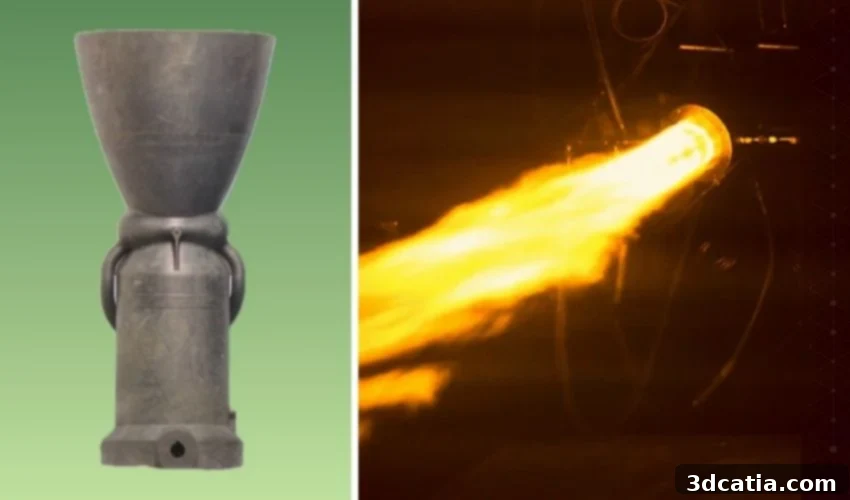
AgniKul Cosmos Achieves Groundbreaking Feat with World’s Largest Single-Piece 3D Printed Inconel Rocket Engine
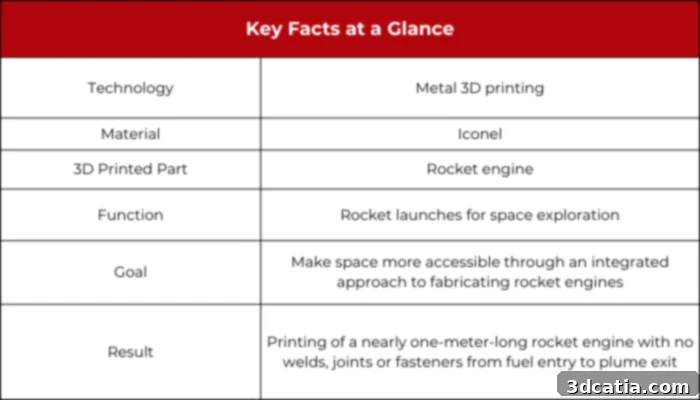
The aerospace industry is rapidly embracing innovation, with additive manufacturing, commonly known as 3D printing, at the forefront of this transformation. In recent years, we’ve witnessed an impressive surge in the development and testing of 3D printed rocket engines. Companies like New Frontier Aerospace, who successfully tested their Mjolnir engine, and POLARIS Spaceplanes, with their trial of a 3D printed aerospike engine, are prime examples. Major players such as Relativity Space, Launcher, and Orbex are also heavily invested in leveraging the unique capabilities of additive manufacturing to create designs that traditional fabrication methods simply cannot achieve. This widespread adoption underscores the technology’s potential to unlock unprecedented levels of complexity, efficiency, and performance in rocket propulsion. Amidst this dynamic landscape, Chennai-based AgniKul Cosmos has distinguished itself by unveiling what they claim to be the world’s largest single-piece 3D printed Inconel rocket engine. Measuring approximately one meter in length, this remarkable engine stands out because it is printed as a single, fully integrated component, entirely free of welds, joints, or fasteners, from the fuel entry point all the way to the plume exit. This represents not just an incremental improvement, but a significant leap in the application of additive manufacturing for high-performance aerospace components, setting a new benchmark for integration and reliability.
The Unparalleled Advantages of Single-Piece Additive Manufacturing
The decision to fabricate the engine as a single piece is not merely an engineering preference; it delivers a multitude of critical benefits that fundamentally enhance rocket engine design and performance. Firstly, it drastically reduces manufacturing complexity. Conventional rocket engines are intricate assemblies of hundreds, sometimes thousands, of individual parts, each requiring precise machining, welding, and assembly. This multi-step process is time-intensive, labor-intensive, and prone to error. By consolidating these components into a single printed structure, AgniKul eliminates countless hours of welding, joining, or fastening, streamlining the entire production pipeline. This simplification directly translates into a more efficient and faster manufacturing cycle, significantly accelerating the pace of rocket development and deployment.
Beyond manufacturing ease, the single-piece design offers profound advantages in terms of reliability and structural integrity. Every weld, joint, or fastener in a traditional engine introduces a potential weak point where stress concentrations can occur, increasing the risk of failure under the extreme operational conditions of launch and flight. A monolithic structure, however, inherently possesses superior structural continuity, minimizing these vulnerabilities. AgniKul reports that this integrated approach has not only reduced production time by more than 60% but has also led to a noticeable reduction in the engine’s overall weight. A lighter engine means higher payload capacity or greater fuel efficiency, both crucial factors for cost-effective space access. Furthermore, the absence of multiple interfaces improves fluid flow dynamics within the engine, ensuring more consistent and efficient combustion. This leap in design and fabrication represents a substantial advancement over the company’s previous generations of engines, demonstrating a clear trajectory towards more robust, lighter, and high-performing propulsion systems.
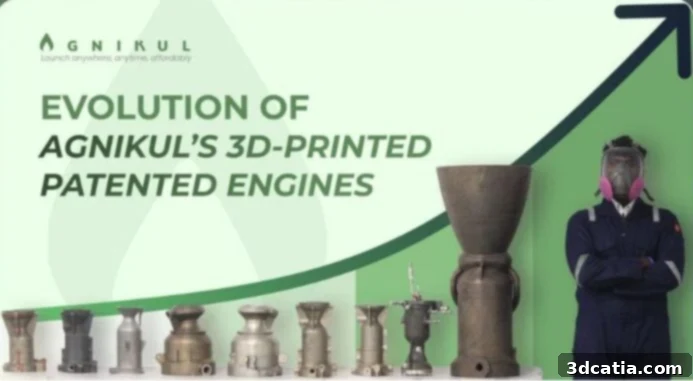
The evolution of AgniKul Cosmos’ 3D printed engines, highlighting how large their latest one is by comparison.
Inconel: The Material of Choice for Extreme Aerospace Applications
The material selection for such a critical component is as vital as its design. AgniKul’s engine is crafted from Inconel, a nickel-chromium-based superalloy. Inconel is revered in high-performance industries, particularly aerospace, for its exceptional properties. Its primary appeal lies in its incredible strength and its unparalleled ability to withstand extreme temperatures and pressures, conditions that are commonplace within a rocket engine during operation. The combustion chambers and nozzles of rocket engines are subjected to immense thermal and mechanical stresses – temperatures can soar to thousands of degrees Celsius, and pressures can reach hundreds of atmospheres. Inconel maintains its structural integrity and mechanical properties even under these brutal conditions, resisting creep, fatigue, and corrosion. This makes it an ideal, if challenging, material for rocket propulsion components that must perform reliably in hostile environments. While 3D printing Inconel presents its own set of challenges, requiring specialized additive manufacturing techniques such as selective laser melting (SLM) or electron beam melting (EBM) and precise process control to manage thermal stresses and microstructure, AgniKul’s success demonstrates their mastery over these advanced manufacturing processes.
AgniKul’s Journey: Bringing Space Within Everyone’s Reach Through Innovation
AgniKul Cosmos was founded in 2017 with an ambitious and clear mission: to make space more accessible and affordable for everyone. From its inception, the company strategically embraced 3D printing as a core technological pillar to achieve this goal. This commitment to additive manufacturing has allowed them to rapidly prototype, iterate, and produce complex rocket components with unprecedented speed and efficiency, significantly driving down costs and development cycles traditionally associated with space hardware. Their journey of innovation has been marked by a series of impressive milestones, steadily building a robust portfolio of additively manufactured rocket components that push the boundaries of propulsion technology.
The company’s pioneering efforts began in 2019 with its first fully 3D printed, single-piece upper-stage engine. This initial achievement demonstrated the viability of their approach and laid the groundwork for future advancements. Two years later, in 2021, AgniKul introduced Agnilet, another revolutionary single-piece engine design. Agnilet subsequently underwent rigorous testing at the prestigious Vikram Sarabhai Space Centre in 2022, proving its performance and reliability under challenging conditions. This was a critical step in validating their additive manufacturing processes for flight-critical components. Most recently, in May 2025, AgniKul once again captured global headlines by successfully firing India’s first electric motor–driven semi-cryogenic rocket engine. This advanced engine showcased AgniKul’s ability to integrate diverse cutting-edge technologies, featuring sophisticated 3D printed pump subsystems that are crucial for handling cryogenic propellants with enhanced efficiency and reduced complexity. Each of these milestones not only affirms AgniKul’s technical prowess but also underscores their unwavering commitment to leveraging additive manufacturing to redefine the future of space propulsion and democratize access to space.
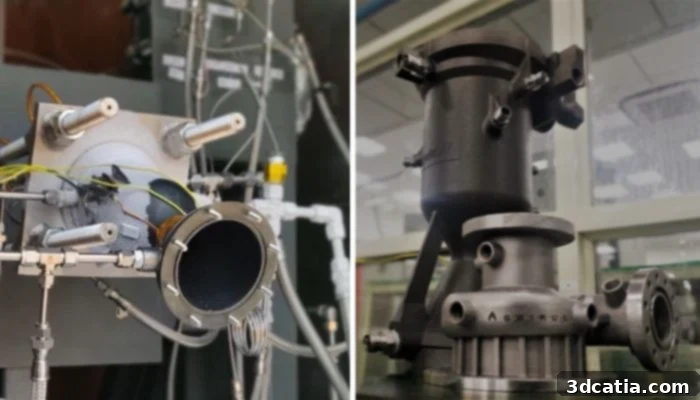
Agnilet, a single piece, 3D printed, semi-cryogenic engine (left) and an example of a 3D printed rocket component (right).
Reflecting on the monumental achievement of the Inconel engine, AgniKul’s CEO and Co-founder, Srinath Ravichandran, shared his enthusiasm and emphasized its profound importance in a LinkedIn post. He stated: “This milestone marks a breakthrough in additive manufacturing at this scale & comes as a major extension of our earlier accomplishment of making & flying the world’s first single-piece engine. Compared to our earlier upper stage engines, these are longer, more complex and massive.” Ravichandran’s words highlight the sheer engineering challenge and success involved in scaling up their proven single-piece printing technology to create an engine of this size and complexity. This signifies not just a technical victory but a strategic move towards developing larger, more powerful, and reliable engines capable of meeting the demands of future space missions, from satellite deployment to interplanetary travel. The increased length, complexity, and mass indicate AgniKul’s capability to tackle more ambitious propulsion systems, paving the way for more significant payloads and advanced mission profiles.
The Strategic Significance of a United States Patent for Global Recognition
Adding to its impressive list of technical and operational achievements, AgniKul has also been granted a prestigious United States patent for the innovative design and manufacturing process of its single-piece rocket engine. This is a monumental recognition of the company’s ingenuity and a strategic asset. Securing a US patent provides AgniKul with exclusive rights in one of the world’s most competitive and technologically advanced space markets. This intellectual property protection is not just a legal safeguard; it serves as a powerful validation of their technical originality and global potential, signaling to the international aerospace community that AgniKul’s innovations are groundbreaking and defensible.
As noted by The Times of India, this is a rare honor for an India-origin design, underscoring the nation’s rapidly growing influence and capability in the global aerospace sector. It demonstrates that India is not merely a consumer of space technology but a formidable innovator, contributing original designs and processes to the global space economy. Srinath Ravichandran eloquently highlighted the pride and significance of this moment, writing: “[It] means something to have a completely Indian origin design patented in the US – a nation that has built some of the most complex engines in this industry.” This patent not only protects AgniKul’s unique technology but also elevates India’s standing on the international stage of advanced manufacturing and space exploration, inspiring future generations of engineers and scientists within the country and beyond.
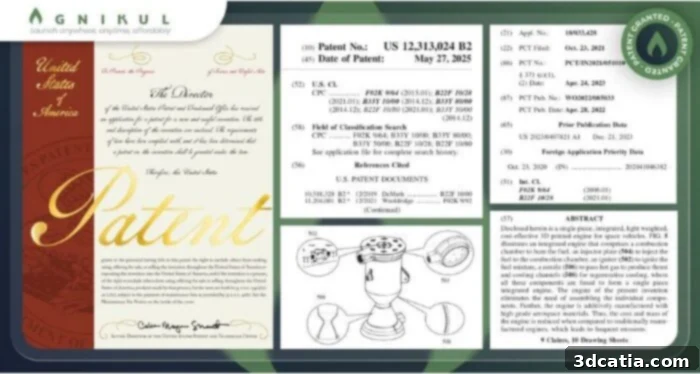
The engine patent and design.
Forging Strong Partnerships for the Future of Space Exploration
AgniKul’s remarkable progress is significantly bolstered by its strong network of strategic partnerships and collaborations. The company actively works with esteemed institutions such as the Indian Space Research Organisation (ISRO), India’s premier space agency, and INSPACe, the Indian National Space Promotion and Authorisation Centre. These collaborations provide invaluable technical guidance, access to cutting-edge testing facilities, and crucial regulatory support. Additionally, AgniKul receives vital backing from governmental bodies like the Department of Science and Technology and the Technology Development Board. These partnerships are instrumental, offering financial support, research grants, and a conducive environment for technological innovation and commercialization.
Together, these synergistic collaborations are not just accelerating AgniKul’s development cycle; they are actively paving the way for a new generation of rocket production. This future envisions a landscape where 3D printing doesn’t merely simplify manufacturing processes or reduce costs, but fundamentally redefines what is possible in space exploration. By enabling the creation of complex, high-performance engines with unprecedented speed, efficiency, and reliability, AgniKul’s technology has the potential to dramatically lower the barriers to entry for space access. This could lead to more frequent and cost-effective satellite launches, foster the growth of commercial space ventures, and even enable more ambitious missions to the Moon, Mars, and beyond. AgniKul Cosmos is not just building rocket engines; they are shaping the future of space, making it more accessible, more sustainable, and more exciting for humanity.
To delve deeper into the pioneering work of AgniKul Cosmos and explore their innovative projects, you can visit their official website HERE. We invite you to share your thoughts on the AgniKul rocket engine and its implications for the future of space technology. Let us know in a comment below or join the discussion on our LinkedIn or Facebook pages! Don’t miss out on the latest advancements in additive manufacturing by signing up for our free weekly Newsletter, delivered straight to your inbox. For a visual overview of various 3D printing applications, you can also find all our videos on our YouTube channel. For more specialized news and insights specifically within the aerospace and defense sectors of 3D printing, be sure to explore our dedicated page HERE.
*Cover Photo: The single-piece AgniKul rocket engine (left) and a hot fire test conducted by AgniKul (right). All Photo Credits: AgniKul Cosmos.