

Revolutionizing Healthy Eating: How 3D Printing Unleashes the Potential of Micro-Algae Snacks
The culinary landscape is undergoing a profound transformation, driven significantly by the advent of 3D printing technologies in the food industry. These innovative methods are not merely changing how we produce food, but fundamentally reshaping our interaction with what we eat. From creating plant-based meat analogues that mimic the texture and taste of conventional meat, to pioneering solutions for recycling food waste into edible products, 3D food printing offers unprecedented control. It also enables the customization of the shape, texture, and nutritional properties of dishes, opening up a world of personalized culinary experiences. As global populations become increasingly conscious of the profound impact their dietary choices have on personal health, environmental sustainability, and societal well-being, the demand for innovative technological advancements that address these complex issues has never been greater. 3D food printing emerges as a promising answer, offering avenues for healthier eating, reduced ecological footprint, and greater food security.
Delving deeper into one of the most exciting applications of 3D printing within the food sector, we find a compelling example from a collaborative research effort. Scientists from the esteemed Dutch University of Wageningen and the Spanish University of Valencia recently captivated the industry by successfully 3D printing a range of innovative micro-algae-based snacks. This particular study was motivated by a desire to develop novel food products that offered significant potential health benefits, integrating an ingredient rarely found in everyday snacks: micro-algae. The primary advantage of leveraging additive manufacturing technologies in this context lies in their unparalleled ability to easily customize food products. Unlike traditional food manufacturing methods, 3D printing provides immense flexibility and personalization throughout the production process, allowing for precise control over ingredients, structure, and nutrient profiles. This flexibility is critical for incorporating unconventional ingredients like micro-algae in a palatable and effective manner.
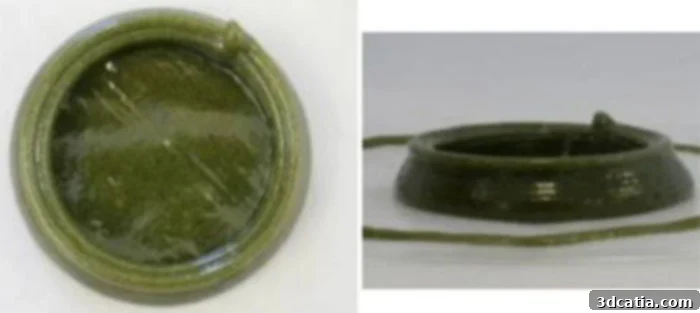
Image of the extruded micro-algae snack during 3D printing. | Image via Food and Bioprocess Technology journal.
One of the main hurdles faced by food scientists when incorporating micro-algae into food products is the ingredient’s inherently strong green color. This vibrant pigmentation, while a natural characteristic of micro-algae biomass, often limits its acceptance and integration into a wide array of consumer products. Understanding this challenge, the researchers embarked on a mission to explore subtle and innovative ways to incorporate these nutrient-dense algae into foods, and 3D printing methods proved to be an invaluable tool. Micro-algae, often celebrated as a superfood, offers a remarkable spectrum of benefits for human health. The two specific species utilized in this groundbreaking study, *Chlorella vulgaris* and *Arthrospira platensis* (commonly known as Spirulina), are freshwater micro-algae powerhouses. They are known for their rich nutritional composition, providing a comprehensive array of essential nutrients including high-quality proteins, vital minerals, a wide range of vitamins, beneficial pigments, essential fatty acids, sterols, and potent antioxidants. These components collectively serve as an excellent complement to a well-balanced diet, offering a sustainable and highly nutritious food source for the future.
The scientific investigation began with a meticulous evaluation of how micro-algae fortification influenced both the rheological properties and the printability of the food batters. Rheology, a critical field in material science, studies the way in which materials deform and flow in response to applied forces or stress. In the context of 3D food printing, optimal rheological properties are paramount for successful extrusion and structural integrity. Following the initial assessment of the batter, the research team then focused on the resulting properties of the 3D-printed snacks, specifically examining their shape, texture, and color. Intriguingly, their observations revealed a significant positive impact: micro-algae fortification substantially improved the printability of batters when using extrusion-based 3D printing techniques. Specifically, the extrusion force required was notably increased in comparison to batters prepared without micro-algae. This indicated that the presence of micro-algae provided a more robust and stable batter, which is advantageous for maintaining intricate shapes and structures during the printing process. This finding was a crucial step towards understanding how to effectively integrate these valuable ingredients into printable food formulations.
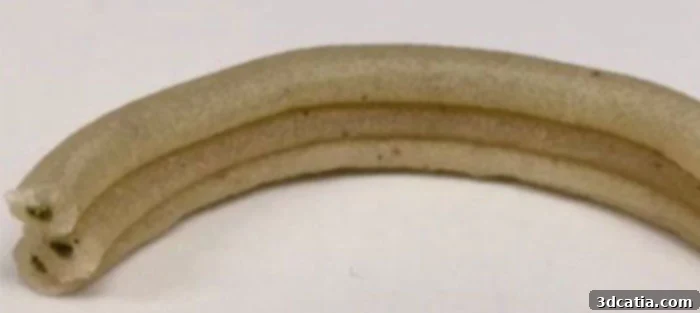
Using an innovative coaxial 3D printer, researchers successfully “hid” micro-algae within the snack batter during extrusion, improving consumer appeal.
Through a series of carefully conducted trials, the researchers made a pivotal discovery: snacks enriched with a specific concentration of 3% and 4% *Chlorella* micro-algae consistently yielded the most accurate and structurally sound printed forms. These concentrations offered the ideal balance for achieving desired printability and maintaining complex geometries. However, despite this technological success in achieving precise structures, the team quickly recognized a critical challenge related to consumer acceptance. Even with perfected dosage, these levels of micro-algae resulted in cereal snacks that, after baking, exhibited a strong green and dark color. This intense coloration, while natural, was deemed likely to be unappealing to the average consumer, potentially hindering widespread adoption of these nutritious snacks. This insight led to the next ingenious step proposed by the team: to employ coaxial food printing. This advanced 3D printing technique allows for the extrusion of two different materials simultaneously, with one forming an outer layer and the other an inner core. By utilizing this method, the researchers aimed to effectively “hide” the micro-algae within the interior of the snack, encapsulating it with a more conventionally colored outer layer. After further experimentation, this coaxial printing method was judged to possess immense potential for the future of healthy food innovation. It could be the key to encouraging consumers to enjoy the nutritional benefits of micro-algae-fortified cereal biscuits without any visual deterrent or preconceived notions about the algae. This innovative approach addresses both the nutritional goals and the crucial aspect of consumer palatability, making healthy eating more accessible and appealing. Further detailed information on this groundbreaking study can be accessed by clicking HERE.
The Broader Impact: Personalized Nutrition and Sustainable Food Systems
The implications of this research extend far beyond the creation of an appealing micro-algae snack. It highlights the profound potential of 3D food printing to revolutionize personalized nutrition. Imagine a future where snacks and meals are custom-printed to meet individual dietary needs, preferences, or even medical requirements, taking into account allergies, nutrient deficiencies, or specific health goals. This level of customization, powered by additive manufacturing, could be a game-changer for public health and dietary management. Furthermore, the integration of micro-algae, a highly sustainable ingredient, underscores 3D printing’s role in fostering more environmentally friendly food systems. Micro-algae cultivation requires significantly less land and fresh water compared to traditional agriculture, and it can even sequester carbon dioxide, making it an eco-conscious choice for future food sources. This research serves as a beacon, illustrating how food innovation can simultaneously address global health challenges and environmental concerns.
Challenges and the Future Outlook for 3D Printed Foods
While the promise of 3D food printing, particularly with novel ingredients like micro-algae, is immense, it’s also important to acknowledge the challenges that lie ahead. Scaling up production from laboratory experiments to industrial levels, reducing production costs, and navigating regulatory frameworks for new food products are all significant hurdles. Consumer education will also play a vital role in overcoming potential psychological barriers associated with unconventional ingredients or manufacturing methods. However, the continuous advancements in 3D printing technology, coupled with a growing global demand for sustainable and healthy food alternatives, paint an optimistic picture. The ability to precisely control ingredients, textures, and even sensory experiences through 3D printing means we are only beginning to unlock its full potential. From creating nutrient-dense foods for astronauts to developing appealing options for elderly individuals with specific chewing or swallowing difficulties, the applications are boundless. This particular study on micro-algae snacks is a testament to how creative scientific inquiry, when paired with cutting-edge technology, can lead to truly transformative solutions in the way we eat and think about food.
What are your thoughts on this exciting food application and the future of 3D printed healthy snacks? We’d love to hear your perspective! Share your comments below or engage with us on our Facebook and Twitter pages. Stay ahead of the curve and get all the latest news in 3D printing delivered straight to your inbox by signing up for our free weekly Newsletter!