
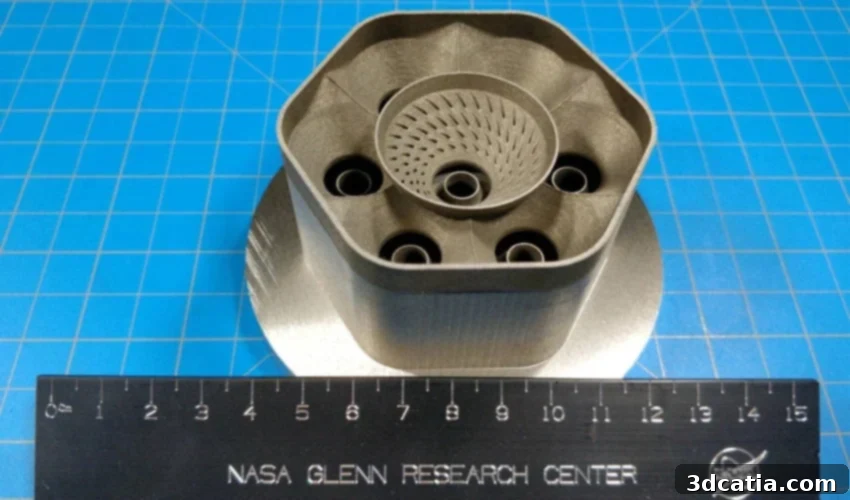
NASA’s GRX-810: A 3D Printed Superalloy Redefining Aerospace Materials and Extreme Performance
In a monumental leap forward for materials science, a dedicated team of researchers at NASA has unveiled a groundbreaking metal alloy named GRX-810. This revolutionary material boasts an astonishing strength that is reportedly up to 1,000 times greater than any previously developed alloy. What makes this achievement even more remarkable is the innovative development process: the team relied entirely on advanced additive manufacturing techniques, commonly known as 3D printing. Specifically, additive manufacturing was instrumental in uniformly dispersing nanoscale oxides throughout the alloy’s matrix. This precise control over microstructure has endowed GRX-810 with exceptional thermal and mechanical properties, enabling it to withstand extreme temperatures reaching up to 1,093°C (1999.4 °F). Such capabilities are set to have a transformative impact on critical sectors, particularly in the manufacturing of high-performance components like rocket engines and advanced jet propulsion systems.
The superior characteristics of this metal alloy are attributed to a sophisticated process known as oxide dispersion strengthening (ODS). This method involves meticulously scattering minute, durable oxide particles into a metal matrix. These particles act as obstacles to dislocation movement, significantly enhancing the material’s strength, creep resistance, and high-temperature ductility. While NASA has not yet disclosed the specific base metal initially used for GRX-810, ODS techniques traditionally employ alloys based on nickel or iron-aluminum, chosen for their inherent robustness. Historically, the oxide dispersion process has been notoriously time-consuming and prohibitively expensive, often requiring complex powder metallurgy steps and extensive post-processing. However, by strategically integrating additive manufacturing with advanced thermodynamic modeling, the NASA team managed to drastically reduce both the development time and associated costs. They impressively claim to have pinpointed the optimal alloy composition after conducting a mere 30 simulations, a feat that would have taken years using conventional trial-and-error methods.
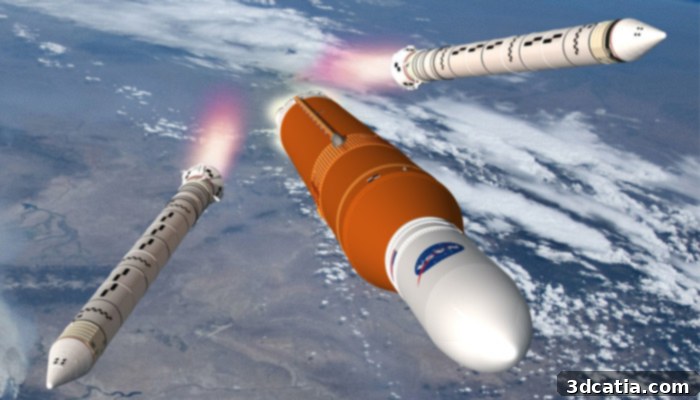
The new GRX-810 alloy could dramatically impact the manufacturing of critical rocket parts, offering enhanced performance and durability (photo credits: NASA).
Development and Unprecedented Characteristics of NASA GRX-810
The genesis of GRX-810 involved a sophisticated blend of computational precision and manufacturing innovation. Researchers at NASA leveraged highly accurate computer models to meticulously determine the ideal composition of the alloy, paying particular attention to the precise quantity and distribution of nanoscale oxides required. Following this rigorous design phase, they employed advanced 3D printing technologies to uniformly inject these nanoscale oxides throughout the material. While the exact proprietary process remains undisclosed by NASA, this innovative dispersion method allowed them to rapidly and cost-effectively produce an exceptionally durable alloy. This new material not only exhibits superior moldability but also demonstrates an extraordinary capacity to withstand extreme temperatures, a critical requirement for aerospace applications. Its strength, a defining characteristic, has been dramatically increased. According to the development team, GRX-810 is up to an astonishing 1,000 times stronger than materials previously available for similar high-performance uses.
Dale Hopkins, the deputy project manager of NASA’s Transformational Tools and Technologies project, underscored the significance of this breakthrough: “This breakthrough is revolutionary for materials development. New types of stronger and more lightweight materials play a key role as NASA aims to change the future of flight. Previously, an increase in tensile strength usually lowered a material’s ability to stretch and bend before breaking, which is why our new alloy is remarkable.” This statement highlights a long-standing challenge in materials science: improving one mechanical property often comes at the expense of another. GRX-810 defies this trade-off, offering not just immense strength but also enhanced ductility and fracture resistance, making it a truly game-changing material for next-generation aerospace designs.
Transforming the Aerospace Landscape: Potential Applications and Impact
The profound implications of NASA’s GRX-810 for the aerospace industry are immediately apparent and far-reaching. Imagine jet engines that operate at higher temperatures, leading to significantly greater fuel efficiency due to improved thermodynamic cycles. GRX-810, with its exceptional durability and unparalleled thermal resistance, makes such advancements a tangible reality. By enabling hotter and more efficient engine operations, this alloy can dramatically reduce fuel consumption, translating into substantial operational cost savings and a reduced environmental footprint for the aviation sector. Furthermore, the enhanced strength and resilience of components manufactured with GRX-810 could extend their service life, leading to lower maintenance costs and increased operational uptime for critical aerospace systems, from commercial airliners to advanced military aircraft and spacecraft.
Beyond jet engines, the applications for GRX-810 span a vast array of high-stress and high-temperature environments. This includes internal components of spacecraft that must endure the brutal conditions of space, reusable rocket engines facing extreme heat and pressure cycles, and even parts for hypersonic flight vehicles. When questioned about the specific performance metrics of GRX-810, the development team elaborated on its truly outstanding capabilities. The alloy exhibits twice the strength to withstand fractures compared to conventional materials, meaning it can endure significantly higher loads before structural failure. It boasts three and a half times the flexibility, allowing it to bend and deform considerably before breaking, a crucial characteristic for components subjected to dynamic stresses. Most impressively, GRX-810 demonstrates more than 1,000 times the durability when exposed to high temperatures, indicating exceptional resistance to creep and fatigue even under prolonged thermal stress. These extraordinary qualities collectively unlock a vast field of possibilities, paving the way for the design and construction of lighter, stronger, and more efficient aerospace vehicles and systems for future exploration and transportation.
Beyond the First Step: NASA’s Vision for Future Materials Science and Exploration
The development of GRX-810 is by no means the culmination of NASA’s materials research but rather a powerful initial step. The agency is committed to further leveraging the synergistic power of thermodynamic modeling and advanced additive manufacturing to push the boundaries of innovative material creation. This integrated approach represents a paradigm shift in how new materials are discovered and developed, promising to accelerate the pace of technological advancement across numerous industries.
Tim Smith, a distinguished materials scientist at NASA’s Glenn Research Center in Cleveland and one of the brilliant minds behind the new alloy, eloquently summarizes the transformative impact of this methodology:
“Applying these two processes has drastically accelerated the rate of our materials development. We can now produce new materials faster and with better performance than before. What used to take years through a trial-and-error process, now takes a matter of weeks or months to make discoveries.”
This acceleration in discovery is vital for NASA’s ambitious future missions, from returning humans to the Moon to enabling long-duration human missions to Mars. Faster material development cycles mean that next-generation spacecraft and propulsion systems can be designed, tested, and deployed with unprecedented speed and efficiency. The ability to rapidly iterate on alloy compositions and manufacturing processes will allow engineers to tailor materials precisely to the extreme demands of spaceflight, leading to safer, more reliable, and more cost-effective solutions for exploring the cosmos. GRX-810 is not just a new alloy; it’s a testament to a revolutionary approach that will continue to unlock the potential of advanced materials for decades to come, shaping the future of space exploration and flight.
For more detailed information regarding this groundbreaking material, you can explore the official NASA feature HERE. What are your thoughts on NASA’s revolutionary GRX-810 alloy and its potential impact on future technologies? Share your insights and opinions in a comment below or join the conversation on our social media channels: LinkedIn, Facebook, and Twitter! Don’t miss out on the latest advancements in 3D printing and materials science – sign up for our free weekly Newsletter here to receive top news straight to your inbox. You can also discover a wealth of related content and videos on our official YouTube channel.
*Cover photo credits: NASA