
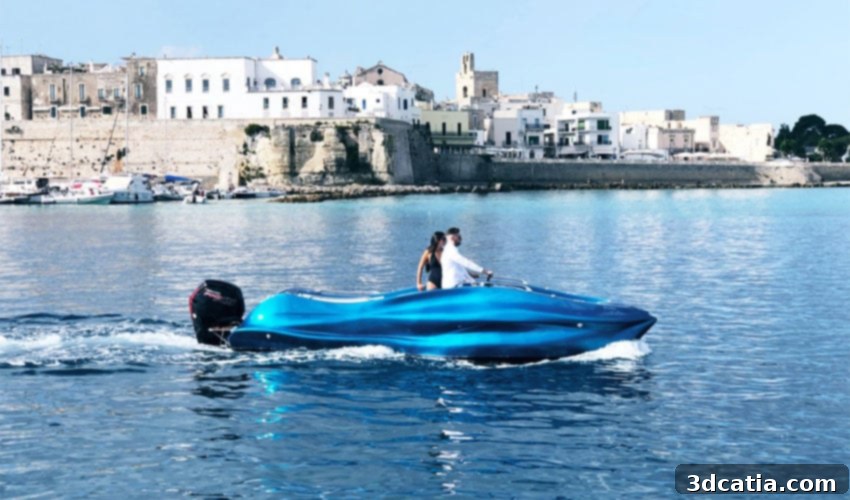
MAMBO: The World’s First 3D Printed Fiberglass Boat Redefines Marine Innovation
Remember the groundbreaking 3D printed fiberglass boat that captured significant attention in the aisles of Formnext 2019? After much anticipation and meticulous development, this innovative vessel, a true testament to the transformative power of additive manufacturing, has finally made its historic splash! Named MAMBO, an acronym for Motor Additive Manufacturing Boat, this pioneering creation represents a monumental leap forward in maritime engineering and design. The project, brought to life through a visionary collaboration between Italian startup Moi Composites and esteemed partners including software expert Autodesk, boat builder Catmarine, naval architect Micad, and material science leader Owens Corning, proudly made its public debut on Italian waters at the prestigious Genoa Boat Show. MAMBO isn’t merely a concept or a prototype; it’s a fully functional and luxurious craft, measuring an impressive 6.5 meters in length and 2.5 meters in width, with a total weight of approximately 800 kg. Designed for authentic navigation, it comes equipped with a sophisticated navigation system, elegant cork flooring, plush white leather seats, and a powerful 115 hp engine. This remarkable achievement marks an unprecedented “first” for the global maritime sector, showcasing the immense potential of advanced manufacturing techniques to revolutionize boat design, customization, and construction.
The impact of additive manufacturing continues to expand across diverse industries, proving its efficacy as much in the demanding aerospace sector as it does beneath the waves. Maritime applications, in particular, are rapidly multiplying, driven by critical needs ranging from enhancing environmental sustainability and designing more efficient nautical devices to the rapid, on-demand production of bespoke spare parts for all types of vessels, from superyachts to cargo ships. 3D printing technologies have firmly established their value proposition in the challenging field of boat manufacturing, demonstrating capabilities that were once confined to the realm of science fiction. A notable precedent for large-scale maritime 3D printing was the colossal University of Maine’s 3D printed boat, which not only shattered world records for its sheer size but also highlighted the feasibility of large-format additive manufacturing to create entire hull structures in a single, continuous process. In the case of the visionary Italian manufacturer Moi Composites, the emphasis for MAMBO shifts slightly, foregrounding the revolutionary material science and manufacturing method employed: MAMBO distinguishes itself by being expertly crafted from a unique fiberglass composite, pushing the boundaries of what’s possible with advanced materials in high-performance marine applications.
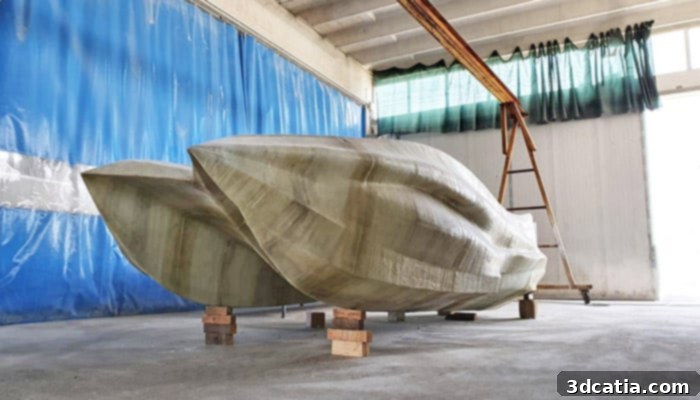
Image credits: Autodesk. MAMBO showcasing its distinctively smooth, 3D printed fiberglass hull before painting.
Continuous Fiber Manufacturing: The Advanced Technology Behind MAMBO
Moi Composites stands at the cutting edge of additive manufacturing with its proprietary Continuous Fiber Manufacturing (CFM) 3D printing technology. This advanced method represents a significant paradigm shift in composite fabrication, enabling the creation of exceptionally strong, remarkably lightweight, and intricately shaped structures. At its core, CFM utilizes a sophisticated industrial Kuka robot, which is meticulously guided by complex, generative design algorithms. This robotic system precisely deposits a thermosetting plastic that is continuously reinforced with high-strength fibers – in MAMBO’s innovative construction, these were continuous glass fibers. Crucially, immediately after deposition, this composite material is rapidly cured by a focused UV light source, ensuring instant solidification and robust structural integrity. This innovative, robotic-driven process unlocks unprecedented advantages over traditional manufacturing techniques. It allows for the design and production of parts that are not only significantly lighter than conventionally built counterparts but also far more resistant to stress, fatigue, and environmental factors, leading to remarkably durable products over extended periods. Furthermore, CFM drastically reduces material waste by building only where material is needed, aligning perfectly with modern demands for sustainable and efficient production methods. A key benefit is the complete elimination of the need for expensive, time-consuming, and often geometrically limiting molds, which are a cornerstone of conventional boat building. The Italian startup has consistently demonstrated the transformative capabilities of this technology through various groundbreaking projects, tracing its origins back to the development of their pioneering Atropos robot. However, the MAMBO boat undoubtedly stands as one of the most outstanding and visually compelling examples of what CFM technology can truly achieve, setting a new benchmark for large-scale composite additive manufacturing.
A Vision Realized Through Collaboration: The Journey to Create MAMBO
The successful realization of MAMBO was a profound testament to the power of powerful collaboration and a shared, ambitious vision. Moi Composites, with indispensable support from several industry leaders, including the software expertise of Autodesk, meticulously engineered a 6.5-meter long and 2.5-meter wide motorboat featuring a distinctive Y-shaped hull. This unique and high-performance hull design drew its initial inspiration from the iconic Arcidiavolo, a legendary boat originally conceived by the renowned naval architect Sonny Levi. The dedicated development teams explained that this foundational design allowed them to construct a monohull structure characterized by truly organic, free-form, and asymmetrical shapes – geometries that would be incredibly challenging, if not entirely impossible, to achieve with conventional manufacturing techniques requiring rigid molds. The resulting aesthetic evokes a profound sense of continuous flow and dynamic elegance, mirroring the very currents of the water it’s designed to navigate with precision and grace. Gabriele Natale, CEO and co-founder of Moi Composites, reflected on this ambitious and rewarding journey: “We participated in the Genoa Boat Show in 2017, and it was during this very event that we first conceived the bold idea of making MAMBO a reality. We then had the privilege to witness the project evolve from an initial concept to a tangible digital design, then brought it to life through innovative manufacturing, and finally, MAMBO arrived today at the sea. We have not just 3D printed a boat; we have elevated the concept of customization, offering a truly one-of-a-kind design created and tailored directly from the owner’s mind. This empowers everyone to understand and experience the sea in their own unique and personal way. All this profound progress and innovation would simply not have happened without the unwavering support of our exceptional partners, who believed alongside us in this ambitious project and helped us turn this extraordinary dream into a tangible, seaworthy reality.”
The Manufacturing Process: From Digital Blueprint to Seaworthy Masterpiece
The meticulous construction of the MAMBO motorboat was a testament to the seamless integration of advanced robotics and innovative material science, leveraging the full capabilities of Moi Composites’ Continuous Fiber Manufacturing technology. The process involved two advanced Kuka robots working in precise concert, systematically building the boat section by intricate section. Each individual segment of the hull was expertly laminated into a robust sandwich structure, a technique known for maximizing strength while minimizing weight. This lamination process meticulously incorporated carefully selected polyester resin and continuous fiberglass, ensuring optimal structural integrity and performance characteristics. This layered approach not only guarantees exceptional strength and rigidity but also optimizes the boat’s weight distribution, contributing to its impressive speed and stability. Once all the individual sections were precisely printed and thoroughly cured, they underwent a meticulous assembly process, where they were seamlessly joined to form the cohesive and structurally sound hull of the MAMBO. This method allows for the creation of complex geometries with unparalleled accuracy and repeatability. The final aesthetic touch, before its grand public reveal at the Genoa Boat Show, was the application of a vibrant blue paint finish. This striking color not only gave the boat a sleek, modern, and distinctive aesthetic but also perfectly complemented its innovative underlying construction. This entire process, from initial digital blueprint and design optimization to the final polished, seaworthy product, powerfully exemplifies the transformative potential of additive manufacturing in the demanding marine sector. It’s a compelling demonstration of how customized, high-performance vessels can be produced with unprecedented efficiency, design freedom, and material optimization, moving far beyond the inherent constraints and limitations of traditional boat-building methods.
Beyond MAMBO: The Future of 3D Printing in Marine Applications and Beyond
MAMBO is far more than just an exceptional boat; it is a powerful and tangible statement about the future of manufacturing and design across the entire marine industry. This pioneering project will undoubtedly inspire countless boat manufacturers, naval architects, designers, and engineers globally to explore and embrace the vast and often untapped possibilities offered by additive manufacturing. The advantages are extensive and transformative: from the ability to create incredibly complex, optimized geometries for superior hydrodynamics and enhanced fuel efficiency, to the potential for rapid prototyping and swift iterative design improvements that shorten development cycles. Moreover, advanced 3D printing facilitates a level of customization previously unattainable, allowing for truly bespoke boats tailored precisely to individual preferences, which significantly enhances the owner’s connection to their vessel and their experience of the marine environment. Sustainability is another critically important aspect, as optimized material usage, reduced waste, and the potential for local manufacturing align perfectly with global efforts towards greener, more responsible industrial practices. Imagine a future where entire fleets of specialized vessels, ranging from luxurious recreational yachts and high-performance racing boats to efficient commercial workboats, autonomous underwater vehicles (AUVs), and even essential components for large cargo ships, are custom-built with greater speed, lower overall costs, and dramatically enhanced performance thanks to advanced composite 3D printing. The profound implications extend significantly to repairs and maintenance, where the on-demand production of highly specific spare parts can drastically cut downtime, reduce logistical challenges, and improve operational efficiency for vessels operating in remote or challenging locations around the globe.
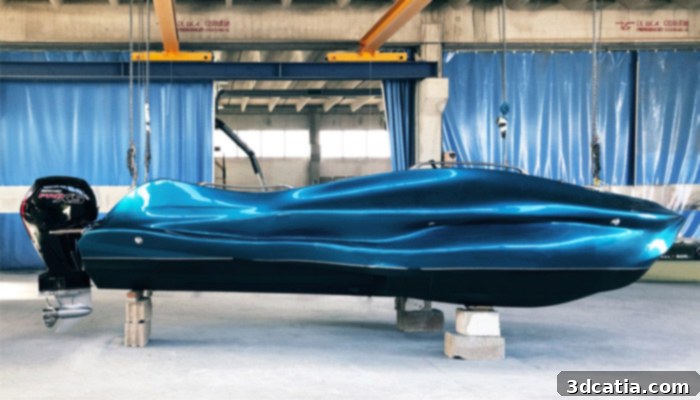
Once 3D printed, the MAMBO boat received a striking blue paint finish, making it ready for its grand public unveiling and its first voyages.
Moi Composites: Pushing the Boundaries of Composite Innovation
Moi Composites continues to lead the charge and set new benchmarks in advanced composite manufacturing, consistently pushing the envelope of what is technologically possible. Their ambitious vision is nothing less than to fundamentally transform how products are designed, engineered, and ultimately produced, leveraging the unique and powerful capabilities of their CFM technology to create structures with unparalleled performance characteristics. The resounding success of MAMBO is a vivid and compelling demonstration of their exceptional expertise, but it represents just one facet of their broader and more ambitious mission. By seamlessly integrating advanced robotics, sophisticated algorithmic design, and cutting-edge material science, Moi Composites is not merely building boats; they are actively crafting the future of customizable, high-strength, and remarkably lightweight structures for a myriad of industries, from marine and aerospace to automotive and beyond. Their unwavering commitment to relentless innovation, combined with a strong focus on sustainability and efficiency, firmly positions them as a pivotal player in the ongoing global revolution of additive manufacturing, inspiring other industries to adopt similar progressive and transformative methodologies that promise a more efficient, customizable, and sustainable future.
For those eager to delve deeper into this incredible feat of engineering and explore other pioneering projects and groundbreaking technologies developed by Moi Composites, additional comprehensive information is readily available on their official website. This venture stands as a powerful testament to human ingenuity, collaborative spirit, and technological prowess, demonstrating in no uncertain terms how cutting-edge innovation can bring revolutionary ideas to life and redefine entire industries.
What are your thoughts on MAMBO, the pioneering 3D printed fiberglass boat, and the broader implications of additive manufacturing for the marine industry’s future? We invite you to share your valuable perspectives and engaging comments below, or connect and engage with us on our Facebook and Twitter pages! Don’t miss out on the very latest advancements, groundbreaking innovations, and breaking news in the dynamic world of 3D printing; make sure to sign up for our free weekly Newsletter, delivering all the essential updates and insights directly to your inbox!