
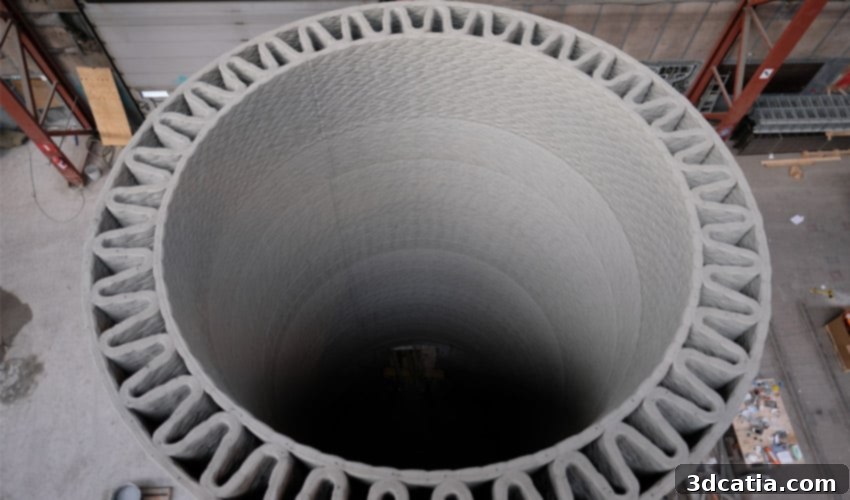
3D Printed Concrete Wind Turbine Bases: Powering Taller, More Efficient Renewable Energy
The global imperative to transition towards sustainable energy sources is more urgent than ever, and wind power stands as a cornerstone in this monumental shift. However, unlocking the full potential of wind turbines – particularly in terms of their height and energy capture efficiency – has long been constrained by significant logistical and manufacturing hurdles. A groundbreaking alliance between three industrial giants, GE Renewable Energy, COBOD, and LafargeHolcim, is poised to redefine the landscape of wind energy infrastructure. This innovative partnership is dedicated to developing and implementing 3D printed concrete bases for next-generation wind turbines, designed to reach unprecedented heights of up to 200 meters. By harnessing stronger and more consistent winds found at these elevated levels, these advanced turbines promise vastly improved energy output and efficiency. The core objective of this collaboration is clear: to substantially accelerate global renewable energy production while simultaneously driving down the overall cost of green electricity, showcasing the profound impact of concrete 3D printing in large-scale industrial applications.
For decades, the design and deployment of wind turbines have been intrinsically linked to the limitations imposed by conventional transportation methods. The vast majority of wind turbines currently in operation rarely exceed 100 meters in height, a constraint largely dictated by the diameter of their base sections. Traditional manufacturing techniques produce turbine base components, often made from pre-cast concrete or steel, which typically cannot exceed a diameter of around 4.5 meters if they are to be transported by road. Any component wider than this critical threshold presents an enormous logistical challenge. Such oversized loads necessitate specialized transport vehicles, meticulous route planning to avoid bridges, tunnels, and tight turns, potentially require temporary road closures, and incur exorbitant costs dueil to permits and escorts. In many instances, transporting larger components is simply not feasible over existing road networks. This bottleneck significantly impacts where wind farms can be sited and the maximum size of turbines that can be deployed, often forcing developers to compromise on optimal wind resources and, consequently, on potential energy generation.
This is precisely where the revolutionary capabilities of additive manufacturing, specifically large-format concrete 3D printing, offer a paradigm shift. By enabling localized, on-site fabrication, this advanced technology fundamentally disrupts the traditional supply chain model that has long hindered the wind energy sector. Instead of producing massive base sections in distant factories and then attempting to navigate the complex logistics of transporting them to remote wind farm locations, 3D concrete printing allows for the direct construction of these monumental components right at the installation site. This localized manufacturing approach liberates project developers from the stringent constraints of road transportation, empowering them to design and produce components of virtually any desired diameter and height, precisely when and where they are needed. For wind turbine construction, this means the base dimensions can be significantly increased without the prohibitive costs, environmental impact, and logistical headaches associated with transporting oversized structures. Furthermore, the layer-by-layer nature of 3D printing offers unparalleled design flexibility, allowing engineers to optimize the internal and external geometry of the base for maximum structural integrity, material efficiency, and enhanced aerodynamic performance.
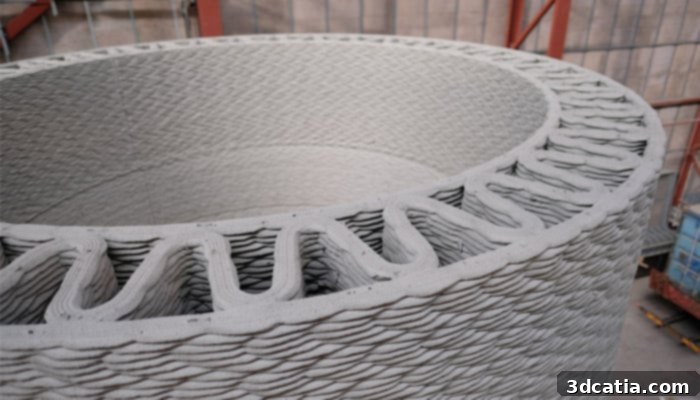
Partners GE, COBOD, and LafargeHolcim leverage 3D concrete printing technology to design and build significantly taller wind turbine towers, overcoming traditional logistical barriers. | Credits: GE
Unlocking Greater Energy Potential with Taller Turbines
The inherent advantage of increasing a wind turbine’s height is rooted in fundamental atmospheric physics. As altitude increases, wind speeds generally become stronger, more consistent, and less subject to ground-level turbulence caused by obstacles like terrain, buildings, or vegetation. This means that a turbine operating at greater heights can effectively tap into a more powerful and reliable wind resource, converting more kinetic energy into electricity. To put this into perspective with concrete figures: a typical 5 MW wind turbine, when positioned with a hub height of 80 meters, might generate an average of 15.1 GWh of electricity annually. However, by simply doubling the height of that same turbine to 160 meters, its annual energy production could surge to an impressive 20.2 GWh – representing a substantial increase of approximately 33%. This significant boost in energy yield per turbine has profound implications, translating directly into enhanced profitability for wind farm developers, a faster return on investment, and ultimately, a more economically viable and cost-effective source of clean, renewable electricity for consumers and grids worldwide. The dual benefits of increased energy generation from optimally sized, taller structures and the reduced manufacturing and logistical costs facilitated by on-site concrete 3D printing create a potent synergy that accelerates the competitiveness and widespread adoption of wind power in the global energy landscape.
Matteo Bellucci, the Head of Advanced Manufacturing Technologies for GE Renewable Energy, eloquently articulates the transformative vision driving this project. He states: “3D printing is in GE’s DNA and we believe that additive large format manufacturing will revolutionise the wind industry. Concrete 3D printing has progressed significantly over the last five years and we believe it is moving closer to a real application in the industrial world. We are committed to taking full advantage of this technology both for the design flexibility it allows and for the logistical simplification it offers on such massive components.” Bellucci’s insights highlight GE’s strategic foresight and its deep-rooted commitment to pioneering advanced manufacturing techniques. The emphasis on “design flexibility” is particularly noteworthy; it signifies that engineers are no longer bound by the rigid constraints of traditional molds or fabrication processes. This newfound freedom allows for the exploration of innovative structural designs that can optimize material distribution, enhance the structural integrity of the base, and potentially reduce the overall concrete volume required, further driving down costs and environmental impact. This adaptability also extends to creating customized base structures perfectly tailored to specific site conditions, such as varying soil compositions, seismic activity, or unique environmental considerations, ensuring optimal performance and longevity for each installation.
A Synergistic Alliance: Innovation in Action
These compelling advantages directly motivated GE, LafargeHolcim, and COBOD to forge this impactful collaboration. A significant milestone was achieved last October with the successful printing of a first prototype in Copenhagen, serving as a tangible proof-of-concept for their combined expertise and shared commitment. Each partner brings a distinct and critical set of capabilities to this synergistic alliance, ensuring a comprehensive and robust approach to the project. GE Renewable Energy, a global leader in the design, manufacturing, and marketing of wind turbines, contributes its extensive understanding of turbine performance specifications, aerodynamic integration, and overall system engineering. COBOD International, recognized globally for its cutting-edge robotic construction 3D printers and unparalleled expertise in printing large-scale structures, provides the advanced additive manufacturing technology and execution capabilities. LafargeHolcim, a world leader in innovative building materials, contributes its profound knowledge of concrete formulations, developing bespoke material mixes specifically optimized for the unique requirements of 3D printing – mixtures that are not only structurally robust and durable but also possess the precise flowability for automated extrusion and rapid curing. This powerful trifecta of specialized knowledge ensures that every facet of the project, from advanced material science and robotic printing to seamless turbine integration, is handled with unparalleled precision and expertise.
The ambitious goal shared by the three partners is to utilize 3D concrete printing to produce modular wind turbine bases ranging from 10 to an impressive 80 meters in height. These robust, locally manufactured concrete structures will then serve as the foundational support for the upper steel sections of the wind turbine towers, ultimately allowing for total hub heights of up to 200 meters. This innovative hybrid tower design – combining a 3D printed concrete base with conventional steel upper sections – represents an ingenious engineering solution. It strategically leverages the inherent strengths of concrete for the wider, heavier lower sections where on-site fabrication offers immense logistical and cost benefits, while integrating the proven performance and standardized production of steel for the lighter, more easily transportable upper sections. This approach dramatically extends the reach of wind turbines into higher, windier airflows without the prohibitive complexities of transporting colossal, monolithic structures. The successful prototype in Copenhagen was a pivotal moment, validating the feasibility of printing large-scale, load-bearing concrete structures on-site and laying critical groundwork for future commercial deployment and widespread adoption.
Broader Impact and Future Outlook for Sustainable Energy
Edelio Bermejo, the R&D Director at LafargeHolcim, eloquently summarizes the expansive vision of this project, stating: “3D printing on concrete is a very promising technology for us, as its incredible design flexibility expands the range of construction possibilities. As a user and promoter of clean energy, we are delighted to put our expertise in materials and design to work on this revolutionary project, which will enable large wind turbine towers to be built at lower cost and accelerate access to renewable energy.” Bermejo’s statement underscores LafargeHolcim’s profound commitment not only to pioneering innovative construction materials but also to championing sustainable building practices and advancing the broader clean energy agenda. The far-reaching implications of this technology extend well beyond just wind turbines. The ability to precisely 3D print large, complex concrete structures on-site with significant design freedom could fundamentally transform various sectors of civil engineering and infrastructure development, impacting everything from the construction of specialized foundations and bespoke architectural elements to resilient protective barriers and future urban developments. By making critical renewable energy infrastructure more accessible, affordable, and adaptable, this collaboration directly contributes to achieving ambitious global climate goals and fostering a more resilient and sustainable future for all.
The rapid development and impending implementation of 3D printed concrete bases for next-generation wind turbines represent a pivotal shift in how we approach large-scale industrial construction and the deployment of renewable energy. It signifies a profound move towards more localized, highly efficient, and inherently sustainable manufacturing processes. As these additive manufacturing technologies continue to mature and become more widely adopted across various industries, we can confidently anticipate a significant acceleration in the global embrace of wind power. This will directly contribute to reducing our collective reliance on finite fossil fuels and pave a clearer path towards a greener, more energy-secure world. This groundbreaking project not only powerfully demonstrates the immense, untapped potential of additive manufacturing in heavy industry but also highlights the critical importance of strategic inter-company collaboration in effectively tackling some of the most complex and pressing global challenges of our time. For those keen to delve deeper into the technical specifics and strategic insights driving this pioneering initiative, the full official press release from GE can be accessed HERE.
What are your thoughts on this innovative collaboration and its potential to profoundly reshape the renewable energy landscape? We warmly invite you to share your valuable perspectives and insights in the comments section below, or engage with us and the wider community on our dedicated Facebook and Twitter pages! For a continuous stream of the latest cutting-edge news, breakthroughs, and in-depth analyses from the dynamic world of additive manufacturing, don’t miss out – sign up for our free weekly Newsletter, delivering all the essential updates directly to your inbox.