
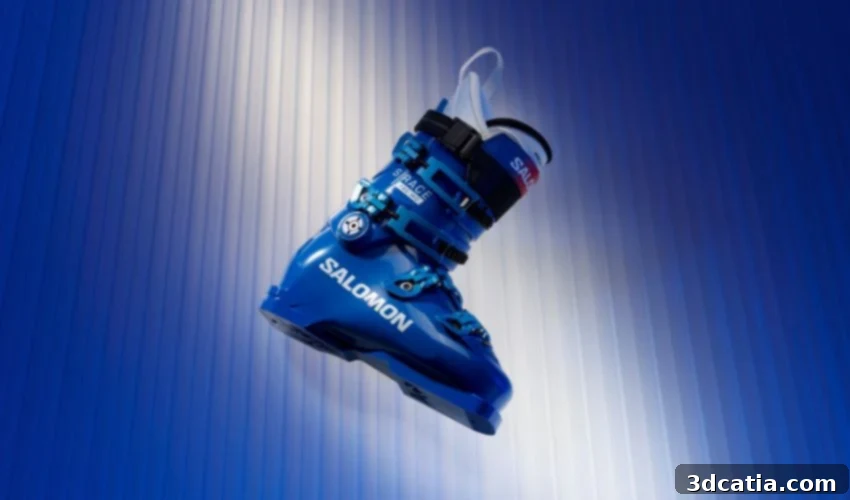
Revolutionizing Performance: How Salomon Leveraged Prodways SLS 3D Printing for Next-Generation Ski Boots
In today’s highly dynamic and fiercely competitive industrial landscape, innovation is not merely an advantage; it is an absolute imperative for sustained success. As businesses navigate an environment characterized by rapidly evolving customer demands, increasing market pressures, and the continuous launch of products boasting enhanced features, leaders across countless sectors are proactively embracing cutting-edge technologies. Their objective is clear: to deliver not just novel products, but significantly improved solutions that truly resonate with their customer base. Within the transformative era of Industry 4.0, companies are actively optimizing their entire production ecosystems. This optimization extends beyond mere economic efficiency, encompassing crucial goals such as fostering greater sustainability, implementing smarter manufacturing processes, and ultimately achieving a more resilient and responsive supply chain.
It is precisely within this context of industrial evolution and heightened demands that the role of industrial 3D printing, also known as additive manufacturing, has become increasingly indispensable. This transformative technology directly addresses many of these pressing needs, proving invaluable for applications ranging from lightning-fast rapid prototyping to the efficient production of high-performance end-use components. The inherent benefits of additive manufacturing are vast and compelling. Chief among these is the unprecedented ability to conceptualize and realize parts with complex geometries and intricate internal structures that were previously impossible to achieve through traditional manufacturing methods, thanks to sophisticated digital design tools. Furthermore, 3D printing empowers companies to conduct iterative design and testing cycles on various shapes and material compositions with remarkable speed and significantly reduced costs. This agility facilitates the development of highly customized, high-performance products tailored to specific user requirements. A compelling real-world illustration of this paradigm shift comes from Salomon, the renowned French outdoor sports equipment manufacturing giant. Salomon strategically decided to optimize its new line of ski boots using advanced additive manufacturing techniques, specifically harnessing the power of Selective Laser Sintering (SLS) technology provided by leading additive manufacturing solutions provider, Prodways.

Enhancing Product Development: The Strategic Advantages of SLS 3D Printing in Prototyping and Pre-Production
Salomon stands as a globally recognized powerhouse in the manufacturing of some of the most robust, durable, and high-performance outdoor equipment available. From specialized hiking footwear designed for challenging terrains to precision-engineered ski boots built for elite athletes, the company serves as a comprehensive resource for professionals, sports enthusiasts, and outdoor adventurers worldwide. Salomon’s commitment to quality and innovation has consistently positioned it at the forefront of the outdoor sports industry, making its choice of advanced manufacturing methods a significant benchmark for others.
The specific challenge for Salomon emerged during the development of a groundbreaking new line of ski boots explicitly engineered for professional athletes. These individuals operate at the absolute pinnacle of their sport, demanding an unparalleled degree of performance, precision, and reliability from their equipment. Meeting such stringent requirements necessitated an innovative approach to design and validation. After extensive research and numerous initial testing phases, Salomon’s visionary design team made the pivotal decision to seamlessly integrate rapid prototyping into their comprehensive product development process, specifically leveraging Prodways’ advanced SLS 3D printing technology. This strategic integration of rapid prototyping is fundamental in modern product development cycles, particularly for rigorously testing various product features, evaluating material performance under specific conditions, and assessing overall product functionality before committing to costly tooling for mass production. In the intricate case of Salomon’s high-performance ski boots, utilizing industrial 3D printing provided an invaluable advantage, enabling designers to quickly produce multiple physical prototypes. These prototypes allowed for thorough analysis and iteration, ensuring that the final product was meticulously optimized and perfectly suited to the exacting needs of the most demanding professional skiers.
Why SLS 3D Printing Excelled for Salomon’s High-Performance Needs
It came as no surprise to the Salomon team that Selective Laser Sintering (SLS) technology proved to be the optimal additive manufacturing solution for their ambitious project. SLS is a widely adopted and highly respected additive technology at the industrial scale, celebrated for its remarkable speed, exceptional precision, and capability to handle high-volume production. Its ability to create complex geometries without the need for support structures further contributes to its efficiency and design freedom. Specifically, the Prodways machine employed by Salomon, the advanced ProMaker P1000x 3D printer, boasts an impressively large build chamber measuring 300 x 300 x 360 mm. This generous build volume, combined with the printer’s inherent speed and capacity for producing parts with fine detail, proved immensely beneficial during Salomon’s intensive product testing and analysis phase. The versatility of the ProMaker P1000x allowed Salomon’s engineers to print full-scale prototypes rapidly, facilitating comprehensive fit checks, structural integrity assessments, and dynamic performance evaluations in a fraction of the time and cost associated with traditional prototyping methods.
From Digital Design to High-Performance Reality: Developing Salomon Ski Boots with 3D Printing
The journey to realizing Salomon’s groundbreaking new ski boot began with meticulous digital design. The initial concept and intricate design specifications were meticulously crafted using sophisticated computer-aided design (CAD) software. This powerful digital environment allowed Salomon’s talented designers to create incredibly accurate and detailed virtual prototypes of the ski boot, enabling them to explore various configurations, refine ergonomic aspects, and validate complex mechanical interactions before any physical production began. Once the digital design was finalized and approved, the subsequent crucial step involved translating these virtual models into tangible, physical prototypes. These boot prototypes were then precisely 3D printed using Prodways’ cutting-edge ProMaker P1000x 3D printer. The material chosen for these critical prototypes was polypropylene (PP 1200), a high-performance polymer developed by BASF. This material selection was deliberate, given PP 1200’s superior properties: excellent chemical resistance, high elasticity for flexibility and impact absorption, notably low moisture absorption crucial for outdoor sports equipment, and commendable recyclability, aligning with modern sustainability goals.
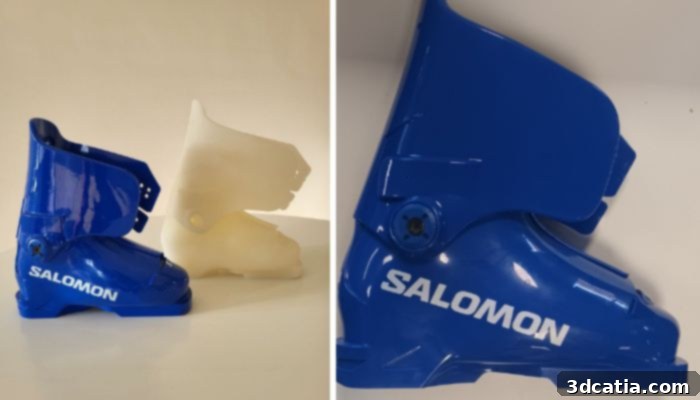
The vibrant blue finished boot shell, produced via injection molding after prototype approval. Once fitted with the liner, straps, and all necessary components, it is ready for wear and peak performance.
Accelerating Innovation: The Tangible Benefits of Additive Manufacturing for Salomon
The integration of 3D printing into Salomon’s development workflow provided an unparalleled level of analytical capability and design flexibility. With the rapid production of physical prototypes, Salomon’s designers were able to conduct comprehensive evaluations of various critical aspects of the ski boot. They could meticulously check the assembly of different components, ensuring perfect fit and alignment, which is paramount for high-performance gear. Furthermore, they could closely examine part deformations under stress and assess the stiffness characteristics of different sections of the boot shell, vital for control and power transfer. The design of intricate elements such as the lace hooks and their secure attachment points was thoroughly verified, eliminating potential failure points. Moreover, a detailed geometric analysis of the entire boot structure was performed, allowing for precise adjustments to optimize fit, comfort, and aerodynamic performance. From a strategic and practical standpoint, the adoption of additive manufacturing dramatically accelerated the timeline for prototyping, allowing for much quicker cycles of studying, testing, and refining the product. This iterative process was not only faster but also led to substantial savings on overall production costs. By drastically reducing the number of conventional steps typically involved between the initial CAD validation and the final mass production of the product, Salomon effectively streamlined its entire development pipeline, leading to a more efficient and cost-effective journey to market.
This highly efficient, iterative design and testing process, empowered by Prodways’ SLS 3D printing technology, was absolutely instrumental in guaranteeing that Salomon’s new ski boots achieved the highest possible standards of quality and uncompromising performance. Such rigorous development ensured they would meet and exceed the exceptionally high demands of professional athletes who rely on Salomon equipment for their competitive edge. The ability to quickly experiment with designs, test materials, and validate functional performance meant that every aspect of the boot could be optimized for maximum athletic benefit. For those interested in delving deeper into the capabilities and applications of Prodways’ cutting-edge SLS 3D printing solutions, further information can be found HERE.
What are your thoughts on Salomon’s innovative use of Prodways’ SLS 3D printing solutions to engineer their new line of high-performance ski boots? We encourage you to share your insights and comments below, or engage with us on our Linkedin, Facebook, and Twitter pages! Don’t miss out on the latest advancements and news in additive manufacturing – be sure to sign up for our free weekly Newsletter here, delivered directly to your inbox! You can also explore all our informative videos and content on our dedicated YouTube channel.
*All Photo Credits: Prodways