

Unveiling the Wohlers Report 2024: Metal 3D Printing Drives Additive Manufacturing’s Next Growth Wave
It is once again that pivotal time of the year when the additive manufacturing industry turns its attention to the comprehensive annual insights provided by Wohlers Associates, powered by ASTM International. The eagerly anticipated 29th annual report, the Wohlers Report 2024, has been meticulously compiled, offering an in-depth analysis of the sector’s performance and future trajectories. This monumental undertaking involved extensive surveys across the global additive manufacturing landscape, engaging with an impressive 245 organizations. These participants represent a diverse cross-section of the industry, including leading service providers, innovative AM system manufacturers, and vital third-party material producers. The insights gathered are truly international, drawing upon the expertise of 110 individuals hailing from 35 different countries, making the report a truly global barometer for the industry. This year, the spotlight shines brightly on a particularly dynamic segment: metal 3D printing, signaling a significant shift and acceleration in this crucial technology.

As seasoned industry observers know, the Wohlers Report consistently aims to deliver a comprehensive, holistic overview of additive manufacturing advancements and trends over the preceding year. Its coverage is exceptionally broad, spanning every critical aspect of the AM workflow. From the foundational principles of design for additive manufacturing (DfAM), which unlocks the unique capabilities of 3D printing, to the ever-evolving landscape of additive manufacturing materials, and from the diverse range of AM processes to the essential stages of post-processing and finishing, the report leaves no stone unturned. Crucially, it culminates with forward-looking predictions for the future trajectory of the market and an analysis of key manufacturers driving innovation.
A particularly noteworthy feature of the Wohlers Report 2024 is the dedication of an entire section to new materials and their rigorous qualification processes. This focus underscores a major trend: the significant growth observed in recent years in the development and adoption of advanced materials, particularly as more and more users are selecting additive manufacturing for the production of demanding end-use parts. This emphasis reflects the industry’s maturation, moving beyond prototyping into mainstream manufacturing. The report thoroughly examines the increasing importance of these qualified materials in high-stakes sectors such as aerospace, where lightweighting and complex geometries are paramount; defense, requiring robust and specialized components; healthcare, driven by custom implants and surgical tools; and energy, where high-performance, durable parts are essential for extreme environments. Furthermore, the report extensively discusses how the establishment of new industry standards, alongside continuous advancements in AM machine capabilities and innovative post-processing methods, will collectively drive the transition towards more robust, reliable, and scalable additive manufacturing solutions. This comprehensive outlook paints a generally positive picture for the industry’s future, despite the acknowledged challenges of 2023, which proved to be a tumultuous year for many players in the sector.
Terry Wohlers, the influential head of advisory services and market intelligence at Wohlers Associates, offers a clear perspective on the industry’s driving forces. He explains, “Investors, government agencies, and organizations adopting AM are eager to know what will drive growth in the future. Significant expansion will come from a much wider range of applications and demand for end-use parts. For this to occur, systems will become faster, reducing the production cost per part. A reduction in material pricing, due largely to competitive pressures, will lower costs further.” Wohlers’ insights underscore a critical pivot: the industry’s journey from niche applications and prototyping to mass customization and the widespread production of functional components. The key enablers are identified as enhanced speed, which directly translates to lower operational costs, and increased competition among material producers, pushing prices down and making AM more economically viable for a broader array of uses. In this vision of the future, metal additive manufacturing conspicuously emerges as the segment upon which many are placing their strategic bets for significant forthcoming growth.
Wohlers Report 2024 Shows the Remarkable Growth of Metal 3D Printing
While polymer 3D printing undeniably continues to constitute the largest segment of the additive manufacturing market, holding the majority share due to its versatility and cost-effectiveness, the rapid and accelerating growth of metal additive manufacturing is an irrefutable trend that cannot be overlooked. This burgeoning expansion has been robustly highlighted and quantitatively affirmed in the latest Wohlers Report 2024. According to the comprehensive data meticulously gathered and analyzed by Wohlers Associates, the metal 3D printing segment has experienced an impressive year-on-year increase of 24.4%. This remarkable growth rate significantly outpaces the general additive manufacturing market, which, as the report indicates, expanded by a solid 11.1% to reach a staggering $20.035 billion. The differential in growth rates underscores a clear narrative: metal AM is not just growing; it is actively driving a new wave of innovation and industrial adoption within the broader AM landscape.
Wohlers Associates has been diligently tracking the evolving state of metal 3D printing for over two decades, specifically since 2002. This long-term perspective provides invaluable context to current trends. As vividly illustrated in the report’s accompanying graph, while there was a period of relative stagnation in the early years between 2002 and 2012, metal AM has experienced a dramatic and sustained “take-off” since 2013. This inflection point marked the beginning of exponential growth, driven by advancements in technology, broader material availability, and increasing industrial confidence. The growth is quantifiably reflected in the sales of metal AM solutions: in 2023, a significant 3,793 systems were sold globally, a substantial increase from the 3,049 systems sold in 2022. These figures not only demonstrate impressive year-over-year expansion but also signal a robust recovery and resurgence of the market following the notable dip experienced during the global COVID-19 pandemic in 2020. The resilience and adaptability of the metal AM sector, in navigating and overcoming such widespread economic disruption, further solidify its position as a critical and increasingly indispensable technology for modern manufacturing. For those seeking deeper, granular insights into the current state of the entire additive manufacturing market, including detailed analysis on polymer 3D printing trends, the full Wohlers Report 2024 is available for purchase for individuals or organizations directly HERE.
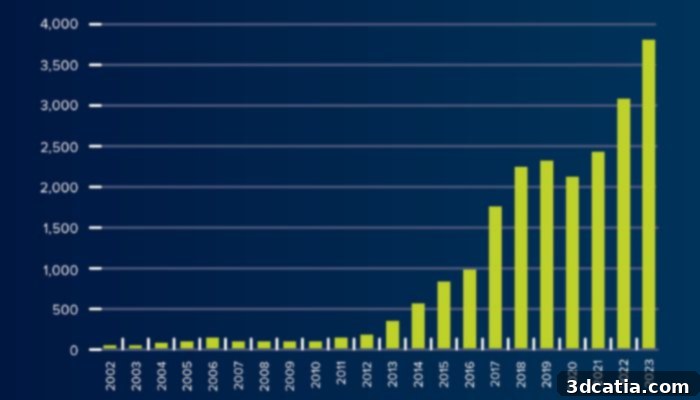
A graph showing the sales of metal AM solutions over the years (photo credits: Wohlers Report 2024)
The rapid ascent of metal 3D printing is not merely a statistical anomaly; it is a testament to significant advancements across various fronts. Technological innovations, such as improved laser systems, enhanced powder bed fusion techniques, and the emergence of new binder jetting solutions, have dramatically increased speed, accuracy, and part quality. Furthermore, the expansion of qualified metal alloys, including exotic materials and high-performance steels, has opened doors to applications previously unattainable. These advancements, coupled with a growing understanding of design for additive manufacturing (DfAM) principles, enable engineers to create lighter, stronger, and more complex parts with optimized performance. Industries are increasingly recognizing the strategic advantages of metal AM, from enabling agile supply chains and reducing waste to facilitating the production of highly customized components for critical applications. The ability to produce parts on demand, reduce lead times, and consolidate assemblies into single, complex geometries provides a compelling business case for widespread adoption, particularly in sectors where performance and precision are non-negotiable.
Despite this impressive growth, challenges remain that the industry is actively addressing. The initial capital investment for metal AM systems can be substantial, and the complexity of post-processing, including heat treatment, support removal, and surface finishing, requires specialized expertise and equipment. Material costs, while subject to competitive pressures as noted by Terry Wohlers, still represent a significant factor. Moreover, the industry continues to work towards greater standardization in processes, materials, and qualification protocols to ensure consistency and reliability across different platforms and manufacturers. However, these challenges are being systematically tackled through continuous R&D, collaborative industry efforts, and the development of integrated software and hardware solutions. The future of metal AM looks bright, driven by increasing automation, advanced process monitoring, and the integration of artificial intelligence and machine learning to optimize every stage of the manufacturing process. These innovations promise to further reduce costs, enhance efficiency, and broaden the spectrum of applications where metal 3D printing can deliver unparalleled value.
The Wohlers Report 2024 unequivocally confirms that additive manufacturing, especially metal 3D printing, is at a crucial inflection point. The insights provided are indispensable for anyone navigating this dynamic landscape, from investors and manufacturers to researchers and end-users. The sustained growth, technological maturation, and expanding applications underscore AM’s transition from a specialized prototyping tool to a robust manufacturing solution. What do you think of the key findings from the Wohlers Report 2024? Let us know your thoughts in a comment below or connect with us on our LinkedIn, Facebook, and Twitter pages! Don’t forget to sign up for our free weekly newsletter here to receive the latest 3D printing news directly to your inbox! You can also find all our compelling videos and industry coverage on our YouTube channel, offering visual insights into the world of additive manufacturing.