
Revolutionizing Surgical Planning: How 3D Printing and Stratasys Digital Anatomy Models are Transforming Healthcare
The medical sector is undergoing a profound transformation, with additive manufacturing technologies increasingly playing a pivotal role in enhancing patient care and improving treatment outcomes. Once a nascent concept, 3D printing has matured into a powerful tool, offering unprecedented design freedom that allows for the creation of highly customized medical devices. This innovation spans a wide range of applications, from bespoke prosthetics and orthotics to complex surgical implants and, critically, realistic anatomical models. These sophisticated models are becoming indispensable in surgical planning and rehearsal, a crucial stage in any medical intervention. Many healthcare professionals now believe that 3D printing will soon integrate seamlessly into clinicians’ daily routines, offering invaluable insights when evaluating various treatment pathways and surgical approaches.
Leading the charge in this medical revolution is Stratasys, a global leader in 3D printing solutions. The company recently highlighted the significant impact its technologies are having through various customer projects worldwide. Just one year after the highly anticipated launch of its J750 Digital Anatomy 3D printer, Stratasys proudly reported successful installations and widespread adoption of the system across numerous healthcare institutions and medical service providers globally. This rapid acceptance and deployment underscore the immense growth potential and undeniable value that 3D printing brings to the healthcare segment, particularly in creating lifelike anatomical representations for advanced medical practices.
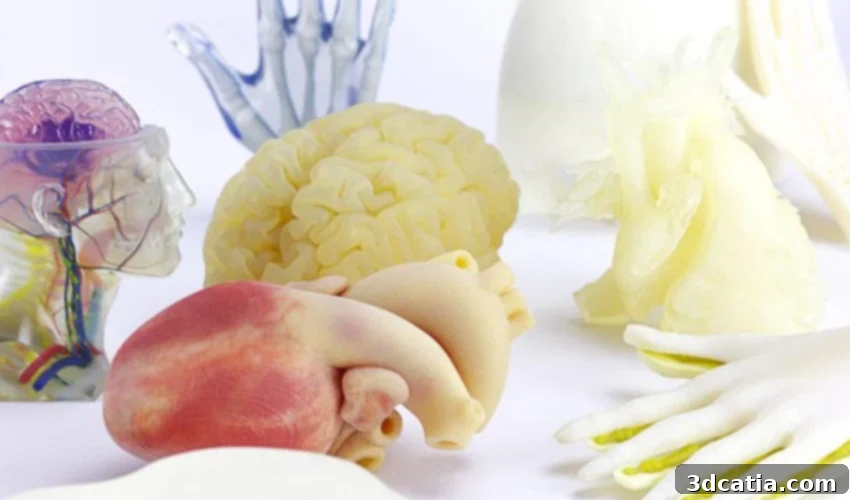
The J750 Digital Anatomy 3D printer, introduced by Stratasys, was specifically designed to deepen the company’s commitment to the medical field by offering an even more responsive and accurate solution. This groundbreaking system leverages PolyJet technology to produce models that not only look like human anatomy but also precisely mimic the actual feel, responsiveness, and biomechanics of human tissue. This unparalleled realism is achieved through advanced material combinations, allowing models to replicate everything from bone to soft tissue, complete with varying densities and textures. Surgeons can now experience the tactile feedback of human tissue, making the planning process remarkably close to real-life operating room conditions.
The success of the J750 Digital Anatomy printer is evidenced by its adoption by a diverse array of prestigious institutions and service providers. These include renowned facilities such as Seattle Children’s Hospital, the VA Health Care System, and Nicklaus Children’s Hospital in Miami, all of whom have invested in the new system to significantly improve patient care and accelerate medical innovation. Internationally, organizations like Medilife and BIO3DModel in Italy, and Tknika and AIJU in Spain, are also leveraging this technology. The unique capability of these 3D printed models means they can be punctured, sutured, cut, and physically manipulated with the same precision and resistance as actual human tissue. This interactive quality makes them invaluable for comprehensive surgical preparation, allowing medical teams to practice intricate procedures multiple times before entering the operating room, thereby refining techniques and anticipating potential challenges.
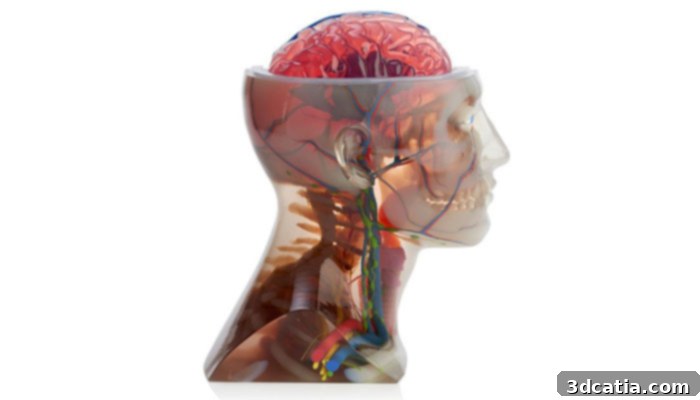
Anatomical model produced by the J750 Digital Anatomy | Image via Stratasys
Enhancing Surgical Planning Through Realistic 3D Printed Anatomical Models
One of the most compelling applications of the Stratasys J750 Digital Anatomy printer is in detailed surgical planning. For instance, Seattle Children’s Hospital has integrated the 3D printer into its in-house operations to create precise duplicates of complex anatomical structures like airways, livers, and hearts. This allows surgical teams to meticulously prepare for operations in a far more effective and personalized manner than ever before. Seth Friedman, Ph.D., Manager of Innovation Imaging and Simulation Modeling in the Improvement and Innovation Department at Seattle Children’s Hospital, elaborated on the transformative impact of this technology. “The earliest prints using TissueMatrix material were instrumental for understanding the optimal fit for a custom tracheostomy tube […] I believe that by making models in parallel to a patient’s care journey we can truly make a difference. Now integrated into a systemic program called Custom Care, we have little doubt this new technology will help us provide the best care possible to our patients and families,” commented Dr. Friedman. This quote highlights the direct benefit to individual patients, enabling custom solutions that were previously difficult to conceptualize or test.
The impact extends significantly to highly intricate procedures, such as complex heart surgeries. Dr. Redmond Burke, chief of Cardiovascular Surgery and co-director of the Heart Program, emphasized the critical role these models now play in surgical planning. “It’s very valuable to be able to actually cut open a model to get a very clear vision of what we’ll see in the operating room. We believe this is a significant advance that will allow us to reduce the trauma of patients undergoing complex heart surgery,” Dr. Burke stated. He further added that this cutting-edge technology opens up entirely new avenues not only in patient care but also in medical education and surgical training. The ability to simulate various surgical scenarios, anticipate anatomical variations, and practice delicate maneuvers on a realistic model before touching a patient directly translates to increased surgical confidence, reduced operating times, and ultimately, better patient outcomes and reduced complications.
Traditionally, surgeons have relied primarily on two-dimensional imaging data from CT scans or MRI before entering the operating room. While these images provide vital information, they inherently lack the three-dimensional tactile and visual fidelity crucial for understanding complex anatomical relationships. 3D printing bridges this gap by creating physical models that surgeons can hold, manipulate, and even dissect, offering a tangible representation of the patient’s unique anatomy. This revolutionizes how doctors approach complex cases, allowing them to visualize the surgical field in an unprecedented manner, foresee potential challenges, and develop tailored strategies. For procedures involving delicate structures or critical pathways, this hands-on preparation can be the difference between a routine operation and one fraught with unexpected complications.
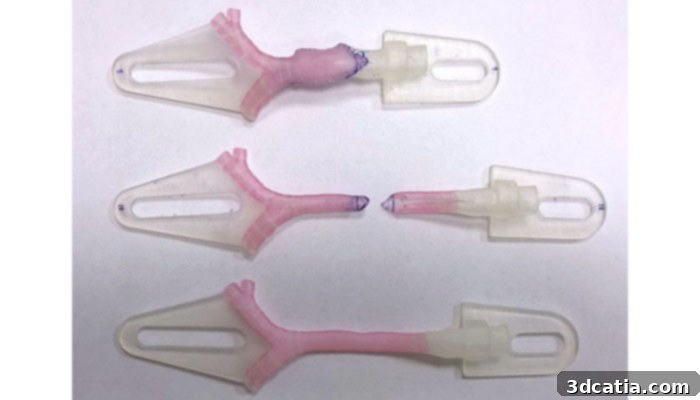
3D printed anatomical models showing virtual surgical planning for a slide tracheoplasty procedure | Image via Seattle Children’s Hospital
Beyond the Operating Room: Expanding Benefits and Future Outlook
The advantages of 3D printing in medicine extend beyond enhanced surgical planning; the technology also delivers significant time and efficiency savings throughout the healthcare workflow. The ability to quickly produce patient-specific models means that medical teams can make faster, more informed decisions. For example, in the UK, Axial3D exemplifies this efficiency, aiming to produce and ship highly detailed, patient-specific 3D printed anatomical models within an impressive 48-hour timeframe. This rapid turnaround is critical in cases where time is of the essence, allowing for timely surgical interventions and reducing patient waiting times. Such efficiency not only benefits individual patients but also contributes to optimizing hospital resources and improving overall healthcare system performance.
Moreover, 3D printed anatomical models are proving to be invaluable tools in medical education and training. Students and resident doctors can gain hands-on experience with realistic models, learning complex anatomy and practicing surgical techniques without the ethical and logistical constraints of cadavers or live patients. This allows for repeated practice, skill refinement, and a deeper understanding of human pathology. For rare conditions or complex anomalies, customized 3D models provide an unparalleled teaching aid, ensuring that future generations of medical professionals are better prepared for the challenges they will face. This educational advantage not only improves individual clinician competence but also contributes to a higher standard of care across the medical community.
The integration of 3D printing into clinical practice also fosters a more patient-centric approach to healthcare. Patients and their families can better understand upcoming procedures by interacting with a physical model of the affected anatomy. This tangible representation can demystify complex medical terminology, alleviate anxiety, and empower patients to participate more actively in their treatment decisions. The ability to see and touch a replica of their own anatomy can be incredibly reassuring and informative, leading to greater trust and satisfaction with their care. This empathetic aspect of 3D printing’s application highlights its holistic benefits beyond purely technical advancements.
As we look to the future, the role of 3D printing in healthcare is poised for exponential growth. Continuous advancements in materials science, printer technology, and software development will unlock even greater capabilities, leading to more realistic models, faster production times, and broader applications. From personalized drug delivery systems to bioprinted tissues and organs, the potential impact of additive manufacturing on medicine is vast and continually expanding. The success of systems like the Stratasys J750 Digital Anatomy printer serves as a powerful testament to this ongoing revolution, demonstrating that what was once considered futuristic is rapidly becoming an essential component of modern medical practice.
What are your thoughts on the profound changes brought about by 3D printing in surgical planning, medical education, and patient care? Share your insights in the comments section below or join the conversation on our Facebook and Twitter pages! Don’t forget to subscribe to our free weekly Newsletter for all the latest news and innovations in the world of 3D printing, delivered directly to your inbox!