
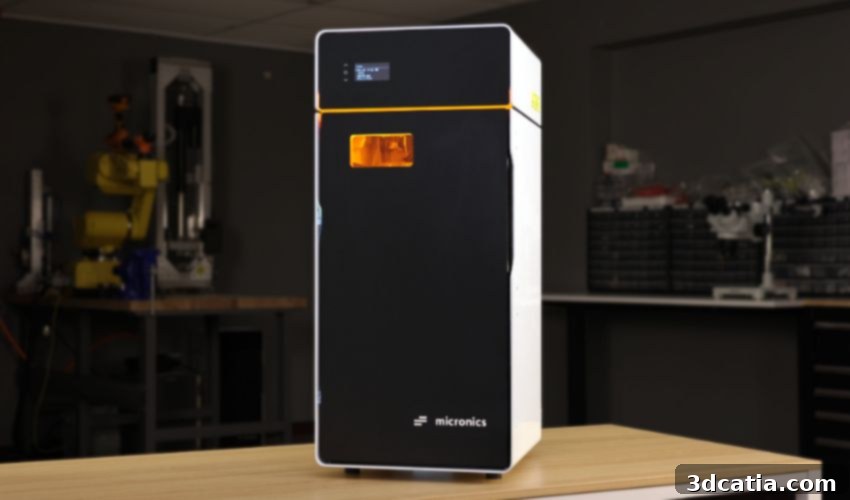
The Micronics Micron: Unlocking Affordable Industrial Desktop SLS 3D Printing
The landscape of additive manufacturing is continuously evolving, with 3D printing technology becoming an indispensable tool across various industries. As these advanced manufacturing processes mature, we’ve witnessed an exponential surge in demand for industrial-grade capabilities, moving beyond mere prototyping to functional part production and even small-batch manufacturing. However, one persistent hurdle has significantly limited wider adoption: price. This is particularly true for sophisticated laser-based technologies like Selective Laser Sintering (SLS), which inherently involve complex optical systems and high-power components, leading to substantially higher costs compared to more accessible fused deposition modeling (FDM) solutions, which boast a plethora of cheap solutions available. For many small and medium-sized enterprises (SMEs), educational institutions, and independent innovators, the dream of bringing industrial-quality production in-house often remains just that – a dream, confined by budgets stretching into tens of thousands of dollars.
Yet, this long-standing barrier may finally be crumbling. A groundbreaking announcement from Madison, Wisconsin-based Micronics is poised to disrupt the market. The company has officially launched a Kickstarter campaign for its revolutionary desktop SLS 3D printer, the Micron, which astonishingly retails for under $3,000. This price point is not just competitive; it’s transformative, significantly undercutting many existing and potential competitors in the market and redefining expectations for what an SLS 3D printer can cost. The implications of such an affordable, high-performance machine could be profound, making industrial-grade additive manufacturing capabilities accessible to a far broader audience than ever before.
Micronics first began generating significant buzz back in April with the release of a compelling video showcasing their innovative printer. The price point, in particular, immediately captured the industry’s attention. While there has been a noticeable trend towards more affordable selective laser sintering (SLS) solutions in recent years—with notable examples including the Fuse 1 from Formlabs or the Lisa X from Sinterit—these machines typically start at prices exceeding $15,000, and often significantly higher. Even these “more affordable” options remain out of reach for many. If the Micron SLS 3D printer indeed delivers on its ambitious promises of effectiveness and reliability at this unprecedented price point, it would signify a monumental leap forward in democratizing industrial 3D printing, empowering countless new users to leverage the power of advanced manufacturing.
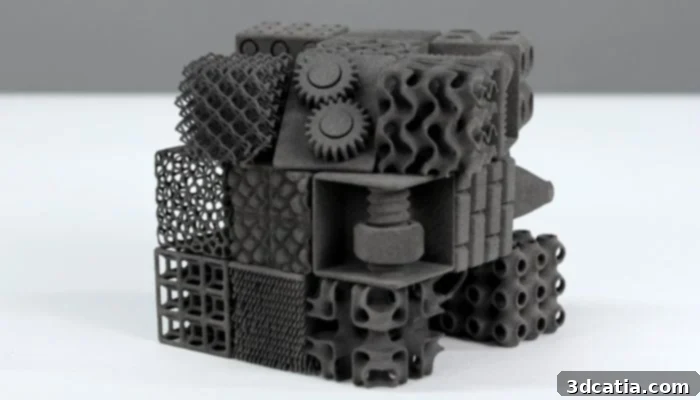
A part made with the Micron 3D printer, showcasing its precision capabilities.
A Closer Look at the Micronics Micron Desktop SLS Solution
Officially named the Micron 3D printer, this groundbreaking solution has been boldly touted by Micronics as delivering “the power of industrial manufacturing at your desktop.” This slogan encapsulates the company’s vision to bridge the gap between expensive, large-format industrial systems and the need for high-quality, functional parts on a smaller scale. Not only that, but the initial video that introduced the machine to the world made an even more audacious claim: that “it could print anything.” While the veracity of such a broad statement remains to be fully demonstrated under various conditions and materials, what is abundantly clear is the Micronics team’s unwavering commitment to addressing a critical, unmet need in the additive manufacturing market: truly affordable industrial 3D printing. This focus aims to empower small businesses, design studios, educational institutions, and individual innovators who previously lacked access to such sophisticated technology due to prohibitive costs.
The concept of “industrial manufacturing at your desktop” is more than just a tagline; it represents a paradigm shift. Historically, SLS technology was confined to specialized service bureaus or large corporations with substantial capital. By bringing this capability to a desktop format, Micronics is enabling rapid iteration of prototypes, in-house production of custom end-use parts, and even distributed manufacturing models for smaller volumes. This accessibility can significantly accelerate product development cycles, foster greater innovation, and reduce reliance on external suppliers, ultimately streamlining workflows and reducing operational costs for a wide range of users.
Diving into the specifications of the Micron 3D printer, the machine boasts a respectable build volume of 160 x 160 x 205 mm, which translates to approximately 5.2 liters. While the usable build volume is slightly smaller at 145 x 145 x 200 mm, offering around 4.2 liters of space, it remains highly capable for a desktop unit. This size, although more compact than some industrial-grade SLS systems, is competitive within the “desktop” or “compact” SLS category and is perfectly suited for producing functional prototypes, jigs, fixtures, and small-to-medium sized end-use parts. The powder storage compatibility stands at a generous 8.9 liters, ensuring sufficient material supply for multiple print jobs without constant replenishment, which is crucial for efficient workflow. What truly sets the Micron apart is its material versatility. It is currently compatible with industry-standard materials like PA12 (Nylon 12) and TPU 90A. Furthermore, Micronics has expressed plans for future compatibility with advanced engineering polymers such as PA12-GF (glass-filled Nylon 12), PA12-CF (carbon-fiber-filled Nylon 12), PA11 (Nylon 11), and PP (Polypropylene), though specific timelines for these additions have not yet been announced. This planned expansion significantly broadens the potential applications, allowing users to leverage materials with enhanced mechanical properties for more demanding functional components.
The choice of materials like PA12 and TPU 90A offers users a robust foundation for a wide array of applications. PA12 is renowned in additive manufacturing for its excellent mechanical strength, stiffness, chemical resistance, and thermal stability, making it ideal for durable functional prototypes and end-use parts. TPU 90A, on the other hand, provides flexibility and elasticity, perfect for producing seals, gaskets, grippers, and components requiring rubber-like properties. The anticipated compatibility with reinforced nylons (PA12-GF and PA12-CF) will enable the creation of even stronger, stiffer, and more temperature-resistant parts, catering to demanding engineering applications. PA11, a bio-based nylon, offers improved ductility and impact resistance, while PP is known for its excellent chemical resistance, low density, and cost-effectiveness, further expanding the Micron’s utility for various industrial and consumer product segments.
Beyond its impressive material capabilities, according to the manufacturers, the Micron 3D printer incorporates a number of advanced features typically found in much higher-priced SLS machines. One of the most significant advantages of SLS technology, fully leveraged by the Micron, is its ability to produce support-free, precise 3D prints. Unlike FDM or SLA, where intricate geometries often necessitate extensive support structures that require tedious post-processing, SLS uses the surrounding unsintered powder as a natural support, allowing for unparalleled design freedom. This means users can create highly intricate and interlocking geometries with ease, significantly reducing post-processing time and material waste. The resulting parts exhibit a superior surface finish and complex internal structures that would be impossible or extremely difficult to achieve with other additive manufacturing methods.
Precision is paramount in industrial applications, and the Micron addresses this with a custom closed-loop galvo laser system. A galvo system uses mirrors to precisely direct the laser beam across the powder bed, and the “closed-loop” aspect ensures real-time feedback and correction, leading to exceptional accuracy and consistency. This advanced system allows for the achievement of remarkable repeatability of less than 0.02mm, ensuring that successive parts are virtually identical in dimension and quality – a critical factor for batch production and interchangeable components. Furthermore, the laser’s finely tuned spot size of just 0.25mm enables the creation of exceptionally fine features, sharp edges, and smooth surfaces, pushing the boundaries of detail possible on a desktop machine. This level of precision, combined with compatibility with high-performance materials like nylon, ensures that the resulting printed parts are not only high-quality but also incredibly durable and robust, suitable for demanding end-use applications.
A hallmark of SLS technology, and a key feature of the Micron, is the production of fully dense parts with isotropic properties. “Fully dense” means the parts have minimal internal voids, leading to superior mechanical strength compared to parts produced by FDM, which often have internal infill patterns. “Isotropic properties” implies that the mechanical characteristics (like strength and stiffness) are uniform in all directions, unlike FDM parts which are typically weaker along the Z-axis. This makes SLS parts, and specifically those from the Micron, exceptionally reliable and predictable for functional applications where consistent performance under various stresses is crucial. Additionally, these parts exhibit excellent chemical resistance, making them suitable for environments exposed to various solvents, oils, or aggressive cleaning agents, and superior abrasion resistance, ensuring longevity in wear-intensive applications. These properties are invaluable for industries ranging from automotive and aerospace to medical and consumer goods.
Beyond the hardware, the software aspect of the Micron is equally considered. Micronics offers MicroSlicer, a custom-built slicer software that will be available for free. This is a significant value proposition, as proprietary software for industrial machines can often add substantial hidden costs. Micronics highlights MicroSlicer’s innovative feature: an interactive physics-based packing algorithm. This intelligent algorithm helps users optimize the build layout by efficiently arranging multiple parts within the build volume, maximizing throughput and minimizing material waste. The physics-based approach ensures stable and secure packing, potentially reducing print failures due to part movement during the sintering process. User-friendly software is essential for making advanced technology accessible, and a free, intelligent slicer is a clear benefit to Micron users.
Safety has also been a paramount consideration in the design of the Micron 3D printer, recognizing that desktop industrial equipment must integrate seamlessly into diverse environments, including offices, labs, and educational settings. The machine incorporates a comprehensive safety system, starting with 2-stage carbon-HEPA filters. These filters are crucial for capturing fine particulate matter released during the sintering process and absorbing volatile organic compounds (VOCs) that can be generated, ensuring clean and safe air quality. Additionally, a removable fume extractor provides targeted ventilation, enhancing user safety and comfort during operation. Perhaps most critically, the Micron features a fully enclosed powder handling system. This design minimizes user exposure to the fine polymer powder, which can be a respiratory irritant and requires careful management. The enclosed system also helps maintain the integrity of the powder, preventing contamination and moisture absorption, both of which can negatively impact print quality and material lifespan. These integrated safety features underscore Micronics’ commitment to making advanced SLS technology not just affordable, but also safe and user-friendly for a wider audience.
The upcoming launch of the Micron, now live on Kickstarter, promises to calm some of the lingering doubts that have been prevalent since Micronics’ initial video turned so many heads. It’s natural for such a disruptive price point to be met with skepticism, but the detailed specifications and features presented paint a picture of a well-engineered solution. Regardless, it will be incredibly interesting to observe whether the Micron truly delivers on its promise of a good, compact SLS 3D printer at such an unprecedented and affordable price point. The Kickstarter campaign officially opened on June 13th at 12pm CDT, offering early adopters the chance to be part of this revolution. You can follow its progress and potentially back the project HERE or delve deeper into its capabilities by watching the insightful video below, which provides a visual overview of the Micron in action.
What do you think of the Micron 3D printer from Micronics? Do you believe it will live up to the immense hype and potentially revolutionize the desktop industrial 3D printing market? We invite you to share your thoughts and predictions in a comment below or engage with us on our social media channels. Find us on LinkedIn, Facebook, and Twitter pages! Don’t forget to sign up for our free weekly newsletter here for the latest 3D printing news, insights, and market updates delivered straight to your inbox every week! You can also find all our comprehensive video reviews, interviews, and technology showcases on our YouTube channel, where we explore the fascinating world of additive manufacturing in depth.
*All Photo Credits: Micronics