
Micro 3D Printing: Revolutionizing Medical Devices, Regenerative Medicine, and Advanced Healthcare Research
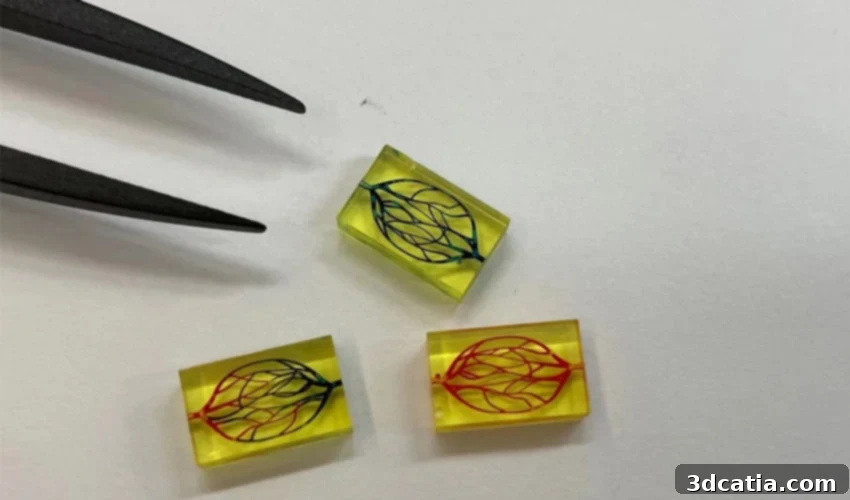
Micro 3D printing technology is poised to fundamentally revolutionize the medical sector and significantly advance biomedical research. Its potential applications are vast, spanning the creation of intricate medical devices, innovative treatments for various diseases, and even the engineering of functional tissues and organs. Recognizing this immense potential, Boston Micro Fabrication (BMF) has strategically partnered with the University of Nottingham’s esteemed Center for Additive Manufacturing (CAM). This collaboration underpins the “Dial Up” project, funded by a critical EPSRC grant, which aims to “standardize 3D printing in medical technology and life science applications.” This initiative seeks to establish robust protocols for integrating additive manufacturing into mainstream medical practice. BMF’s unparalleled micro-printing technology, known for its exceptional precision, is already demonstrating its capabilities in diverse medical applications. These include the development of specialized intestinal patches to combat chronic diseases and the creation of sophisticated microstructures designed to precisely control cellular phenotype, promising advancements in personalized medicine and biological engineering.
The Transformative Precision of Additive Manufacturing in Healthcare
The profound advantages of additive manufacturing (3D printing) for the medical sector are increasingly acknowledged. Healthcare professionals are leveraging this technology to develop highly customized, patient-specific devices, from bespoke prosthetics that perfectly match a patient’s anatomy to personalized surgical guides that enhance procedural accuracy. This capability allows clinicians to develop tailor-made devices, significantly improving fit, comfort, and therapeutic effectiveness. Beyond patient care, 3D printing is revolutionizing medical education by enabling realistic anatomical models and advanced surgical training aids, offering invaluable hands-on experience without risk. Boston Micro Fabrication’s micro-stereolithography technology offers unparalleled precision, with resolutions reaching an astounding 2 microns. This capability facilitates the production of incredibly fine features and complex geometries, indispensable in the demanding healthcare sector for applications such as micro-fluidic channels for lab-on-a-chip devices, intricate tissue engineering scaffolds, and advanced drug delivery systems, where precise interaction with biological systems is paramount.
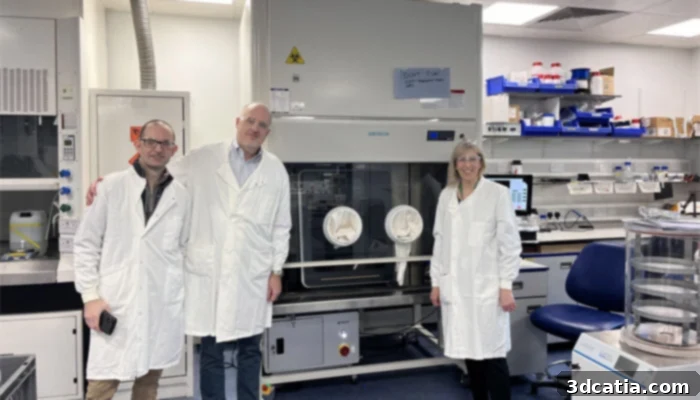
Professors Ricky Wildman and Felicity Rose from the University of Nottingham’s Biodiscovery Institute with BMF’s CEO John Kawola
The “Dial Up” Project: Pioneering Medical Applications
Targeting Intestinal Diseases with Regenerative Patches
Under the “Dial Up” project, BMF’s micro-printing process is rigorously tested for medical applications, with a primary focus on chronic intestinal diseases. The ambitious goal is to engineer a sophisticated patch capable of actively regenerating inflamed intestinal tissue. This patch must be non-intrusive for internal placement, and the materials must be highly biocompatible, promoting cell proliferation and integration without adverse immune responses. These stringent requirements – high precision, non-invasiveness, and advanced biocompatibility – are formidable hurdles. BMF’s micro-printing technology, with its ultra-high resolution and capacity to work with advanced biomaterials, is uniquely positioned to overcome these challenges, paving the way for revolutionary treatments for conditions like Crohn’s disease or ulcerative colitis by precisely controlling the patch’s architecture and porosity at the micro-scale, ensuring optimal healing within the delicate intestinal environment.
Guiding Cellular Behavior: Micro-Architectures for Phenotype Control
Beyond the intestinal patch, the University of Nottingham team, using BMF’s technology, is developing specialized micro-architectures to control and direct cell phenotype – a cell’s observable characteristics like differentiation and function. This capability holds immense promise for regenerative medicine. By fabricating micro-architectures with precise geometries, researchers can create microenvironments that actively guide cellular processes, forming microparticles that lead stem cells to specific areas for repair. Imagine guiding stem cells to regenerate damaged cardiac tissue or neural connections following injury. BMF’s micro 3D printing technology is instrumental in producing these complex, reproducible micro-environments, allowing unprecedented control over cell-material interactions and cellular destiny at the scale of individual cells, thereby facilitating direct communication and interaction with biological systems.
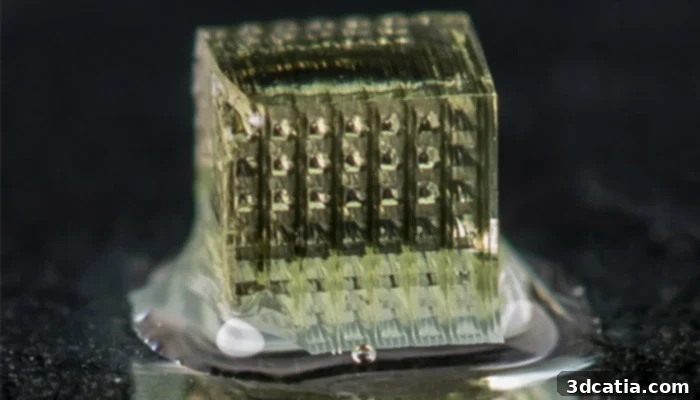
3D printed reactor core for synthesizing small organic molecules. Reactants flow into the structure, where entrapped enzymes catalyze their reaction into useful product molecules. BMF’s micro 3D printing technology was used to create the functional hydrogel (credits: University of Nottingham’s Biodiscovery Institute)
Overcoming Medical Device Rejection: The Role of Surface Engineering
A persistent and critical challenge in modern medicine is the human body’s rejection of implanted medical devices. Many implants, from stents to orthopedic devices, often fail to properly integrate with surrounding biological tissue, leading to serious consequences like chronic inflammation, infection, and device failure, frequently necessitating painful and costly revision surgeries. Through diligent research, the University of Nottingham team, in collaboration with BMF, has discovered that implant acceptance is significantly influenced by both the intrinsic properties of the materials used and the physical surface patterns, or topographies, of the device. These intricate micro-scale surface features dictate how host cells interact, directly affecting cell adhesion, proliferation, differentiation, and overall immune responses. BMF’s micro 3D printing technology is invaluable in addressing this. Its unparalleled precision allows researchers to meticulously control and reproduce these critical material compositions and surface topographies with extreme fidelity. The technology is utilized to rigorously test and validate various material combinations and intricate patterns on implantable devices. By enabling the precise creation of micro-scale features like pores or specific textures, BMF’s printers facilitate the systematic study of how these topographies interact with biological cells. This research optimizes implant designs for better bio-integration, minimizing adverse immune reactions, and enhancing long-term functional success, ultimately improving patient outcomes.
Future Horizons: Integrating AI and Machine Learning for Optimized Healthcare Solutions
The research project by the University of Nottingham and Boston Micro Fabrication represents a holistic approach to finding new methods for manufacturing tailor-made medical devices and improving healthcare. This initiative recognizes that innovation involves advanced manufacturing, intelligent design, and process optimization. Looking ahead, researchers aim to integrate artificial intelligence (AI) and machine learning (ML) to process vast amounts of data from design, material testing, and micro 3D printing phases. By employing AI algorithms, the team seeks to identify complex patterns and correlations to devise significantly more efficient and predictive models. Machine learning can predict optimal material composition, surface topography for implants, or effective micro-architectures for stem cell differentiation. This intelligent automation accelerates design cycles, reduces costs, and enhances the efficacy and safety of medical devices. The synergy between high-precision micro 3D printing and cutting-edge AI promises an era of intelligent manufacturing where patient-specific medical solutions are optimally designed through data-driven insights, leading to unprecedented personalization and therapeutic success.
Conclusion: Paving the Way for a New Era in Medical Innovation
In conclusion, the synergistic efforts of Boston Micro Fabrication and the University of Nottingham, particularly through the ambitious “Dial Up” project, are paving the way for a new era in medical innovation. By harnessing micro 3D printing technology, these pioneers are developing groundbreaking approaches to diagnostics, therapeutics, and regenerative medicine. The ability to create patient-specific devices with micron-level precision, engineer intricate micro-architectures for cellular control, and optimize implant surfaces to prevent rejection represents a monumental leap forward in addressing healthcare’s most persistent challenges. The integration of advanced computational methods like AI and machine learning further promises to accelerate discovery and enhance the efficacy of these novel solutions, driving a future where personalized, precise, and effective medical interventions are standard. The potential for micro 3D printing to revolutionize chronic disease treatment, facilitate tissue regeneration, and improve the long-term success of medical implants is immense and will undoubtedly transform patient care globally.
To learn more about Boston Micro Fabrication’s micro 3D printing technology, click HERE. We invite you to share your thoughts on the transformative use of micro 3D printing in chronic disease treatment and beyond. Engage with us by leaving a comment below or by connecting on our LinkedIn, Facebook, and Twitter pages! For the latest 3D printing news, sign up for our free weekly newsletter here, delivered straight to your inbox. Explore our insightful videos on our dedicated YouTube channel.
*Credits cover picture: Boston Micro Fabrication