
Iris van Herpen’s “Shift Souls”: A Glimpse into the Future of Haute Couture with 3D Printing
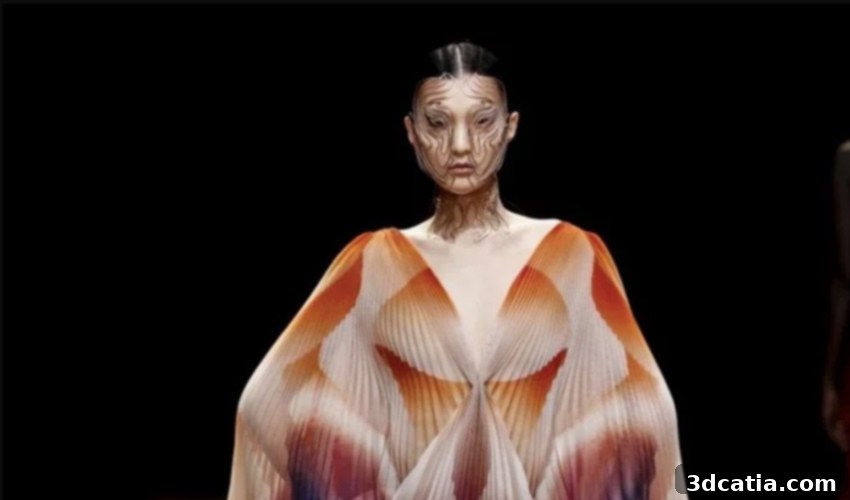
Dutch designer Iris van Herpen stands as an unparalleled visionary in the fashion world, consistently pushing the boundaries of what is possible by seamlessly blending haute couture with cutting-edge 3D printing technology. Her name has become synonymous with innovation, and her collections frequently feature intricate 3D printed elements, from gravity-defying dresses to exquisitely crafted accessories. Her latest masterpiece, the “Shift Souls” collection, debuted during a mesmerizing fashion show at the prestigious Musée des Beaux-Arts in Paris, offering yet another compelling demonstration of the transformative capabilities of advanced manufacturing technologies within the fashion industry today.
The advent of 3D printing has fundamentally redefined the parameters of design, granting creators an unprecedented degree of freedom in terms of geometric complexity and structural ingenuity. Unlike traditional manufacturing techniques, additive manufacturing enables designers to conjure and produce forms that were once considered impossible or exorbitantly expensive to achieve. Iris van Herpen’s recent works serve as a prime example of this paradigm shift, where time-honored craftsmanship converges harmoniously with state-of-the-art technological advancements. The “Shift Souls” collection, comprising 18 distinct and vividly colorful styles, is a profound exploration of human identity and transformation. According to the designer herself, the collection delves deeply into “the evolution of the human form, its idealization over time and the hybridization of female forms in mythology,” revealing a narrative that is both deeply conceptual and visually stunning.
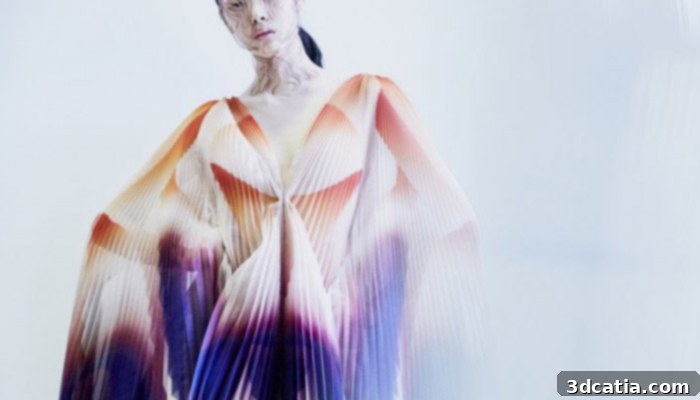
Van Herpen elucidates that her collection is rooted in a highly experimental and meticulous approach. Each piece is a testament to the intricate interplay of diverse technologies, being additively manufactured, precisely laser cut, and rigorously defined by complex algorithms. The vibrant, multi-hued silks, which form the ethereal outer layers of the garments, are painstakingly assembled onto delicate yet robust 3D printed frames made from PETG (Polyethylene terephthalate glycol). This innovative layering technique allows the designer to achieve an extraordinary optical illusion, where the fabrics appear to distort and reshape the mannequin’s body, creating an otherworldly aesthetic. As Iris van Herpen describes, “we then obtain clothes that recall mythological creatures, approaching birds,” transforming the human silhouette into something simultaneously familiar and fantastical.
The Transformative Power of 3D Printing in High Fashion
The integration of 3D printing into haute couture is more than just a trend; it represents a fundamental shift in how fashion is conceived, designed, and produced. For designers like Iris van Herpen, this technology unlocks a realm of possibilities that traditional needle and thread simply cannot replicate. The ability to create complex geometries, intricate lattice structures, and organic forms with unparalleled precision allows for the realization of truly architectural garments that transcend conventional notions of clothing. Beyond aesthetic freedom, 3D printing also offers significant advantages in terms of customization and personalization. Each piece can be tailored precisely to an individual’s body, ensuring a perfect fit and a unique design that is virtually impossible with mass-produced apparel.
Moreover, the use of diverse materials in 3D printing—from flexible filaments to rigid polymers like PETG—opens up new avenues for textural exploration and functional innovation. PETG, for instance, is known for its durability, flexibility, and transparency, making it an ideal choice for creating lightweight yet robust structural components within garments. This material versatility allows designers to experiment with different properties, creating pieces that are not only visually striking but also surprisingly comfortable and adaptable. The precision of algorithmic design, coupled with the accuracy of laser cutting and additive manufacturing, ensures that every curve, every angle, and every detail of van Herpen’s vision is meticulously brought to life, creating an experience that is as much art as it is fashion.
“Cellchemy”: 3D Printed Jewelry to Complement Her Vision
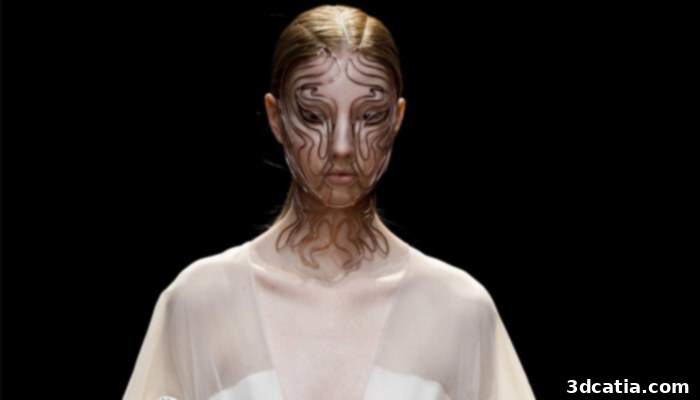
To perfectly complement the ethereal and transformative nature of the “Shift Souls” collection, Iris van Herpen meticulously designed a series of breathtaking 3D printed face jewelry, aptly named “Cellchemy.” These intricate accessories are not merely adornments but extensions of the garments’ conceptual depth, enhancing the wearer’s transformation into mythological beings. For the development and fabrication of these unique pieces, van Herpen engaged in a cutting-edge collaboration with the experts at Delft University of Technology, renowned for their advanced research in digital fabrication.
The technical process behind “Cellchemy” was as innovative as the final product. The teams at Delft University initiated the project by meticulously scanning the faces of the mannequins, capturing every contour and nuance with high precision. This digital data then served as the foundation for sophisticated algorithmic modeling software. This software was crucial in allowing the designers to combine the precise 3D anatomical shapes with an array of desired colors and textures, creating designs that perfectly conformed to and complemented the facial structure. While specific details regarding the exact multi-material 3D printing process employed for these accessories remain somewhat confidential, Iris van Herpen confirmed the use of an advanced multi-material 3D machine, highlighting the complex capabilities required to bring these vibrant and intricate pieces to fruition. The “Cellchemy” jewelry stands as a testament to the endless possibilities that emerge when interdisciplinary collaboration and technological prowess converge in the pursuit of artistic excellence.
Blending Handmade Craftsmanship with Digital Innovation
Despite her reputation as a pioneer in digital fashion, Iris van Herpen offers a nuanced perspective on the role of technology in her creative process. In a revealing interview with Vogue magazine, she articulated her philosophy: “People think that everything I make is printed in 3D, but the basis of my work is really handmade. I think a lot of people are trying to separate the two, but I see these two methods as equal and I really think they can complement each other. Sometimes, a texture I developed on a 3D printer can be a source of inspiration for a manual technique, and sometimes it is the other way round.”
This statement is critical to understanding the true genius of Iris van Herpen. Her approach is not about replacing traditional craftsmanship with technology, but rather about fostering a dynamic synergy between them. The delicate hand-stitching, intricate draping, and meticulous fabric manipulation that characterize haute couture are not diminished by the integration of 3D printing; instead, they are elevated and redefined. A digitally fabricated texture might spark an idea for a new embroidery technique, or a centuries-old hand-crafting method might inspire a novel algorithmic pattern. This bidirectional flow of inspiration creates a rich tapestry where the precision and scalability of digital tools enhance the artistry and tactile quality of handmade work, and vice versa. It’s a compelling argument for the future of fashion, suggesting that the most innovative creations will emerge not from a binary choice between old and new, but from their intelligent and imaginative integration.
The Broader Impact on the Fashion Landscape
Iris van Herpen’s work extends far beyond the confines of a single collection; it serves as a powerful beacon for the entire fashion industry. By consistently showcasing the artistic and practical applications of 3D printing and other advanced technologies, she challenges conventional notions of textile and garment construction. Her influence inspires a new generation of designers to explore interdisciplinary approaches, encouraging them to look beyond traditional ateliers and embrace technological tools as integral components of their creative toolkit. This pioneering spirit accelerates the adoption of digital fabrication methods, fostering innovation in material science, design software, and production workflows.
Furthermore, van Herpen’s exploration of personalized and algorithmically designed pieces hints at a future where fashion is truly bespoke and sustainable. The ability to create garments on demand, with minimal waste and maximum customization, holds immense potential for reducing the environmental footprint of the notoriously wasteful fashion industry. Her collections spark critical conversations about the future of sustainability, craftsmanship in the digital age, and the evolving relationship between the human body and wearable art. She is not just designing clothes; she is crafting a vision for an entirely new fashion paradigm.
For those eager to delve deeper into the extraordinary universe of Iris van Herpen’s creations and philosophy, more information is available on her official website, which you can access HERE. Additionally, immerse yourself in the dynamic visual storytelling of her work by watching the captivating video below:
What are your thoughts on Iris van Herpen’s groundbreaking haute couture collection and her innovative integration of 3D printing? Share your perspectives and join the conversation by leaving a comment below, or connect with us on our Facebook and Twitter pages! Don’t miss out on the latest advancements and news in the world of additive manufacturing – be sure to sign up for our free weekly Newsletter, delivering all the essential updates straight to your inbox!