
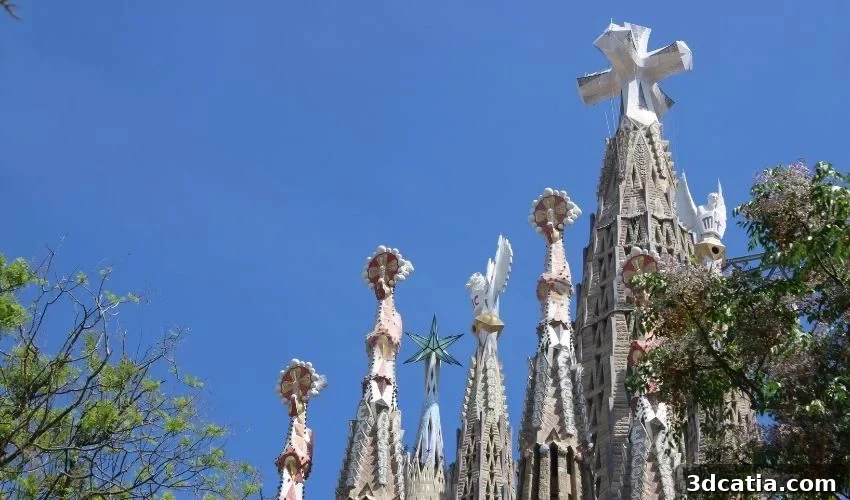
At 172.5 meters, the Tower of Jesus Christ makes the Sagrada Família the tallest Catholic church in the world. Pope Leo XIV blessed it on June 10, 2026, 144 years after the cornerstone was laid. Crowning the tower is a cross that measures 17 meters tall, 13 meters wide and weighs more than 12 tons. Its surface is clad in over 13,000 pieces of glazed white ceramic. Although the final ceramic tiles themselves were not 3D printed, digital manufacturing—and specifically 3D printing—played a key role in the cross’s production.
How 3D Printing Helped Build the Sagrada Família Cross
A common misconception about digital manufacturing in heritage projects is that technology displaces traditional craft. The reality at the Sagrada Família is the opposite: digital tools complemented and amplified craftsmanship. According to Aldo Sollazo, CEO of LAMÁQUINA, the digital manufacturing firm that partnered with Cerámica Cumella on the project, the white ceramic tiles covering the cross were produced in conventional ceramic workshops. 3D printing was used to fabricate the molds and supporting structures needed during the firing process.
“3D printing was used in a crucial intermediate stage of the process: producing the molds that supported the pieces during firing,” Sollazo explains. Those printed molds were made from a ceramic-compatible material and functioned as precise supports to monitor thermal behavior during firing. By using tailored molds, the team could ensure each element retained its intended geometry before final installation.

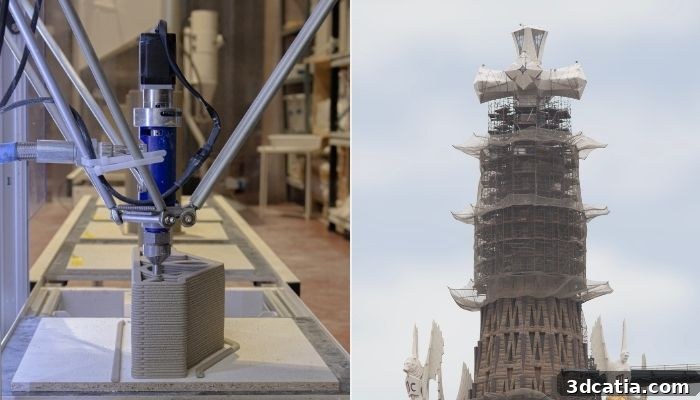
Printing of the molds (left); Tower of Jesus Christ (right). (Photo credit: LAMÁQUINA – Pilar Jiménez).
Every tile on the cross has a distinct geometry, and each required a dedicated support strategy to control warping and deformation during the high temperatures of firing. Rather than a mass-production mindset, this was a highly controlled manufacturing workflow where each printed mold acted as a precise interface between design intent, material behavior and construction constraints.
Cerámica Cumella, the workshop responsible for cladding the entire tower, produced more than 50,000 hand-glazed pieces using a coding system based on shape, color and position. For the exterior of the cross alone they designed nearly 500 unique shapes in glass and glazed white ceramic. Achieving the perfect shade of white was a particular challenge: after extensive trials they narrowed the options down to 15 shades that best capture and reflect sunlight. For the production of support molds and firing fixtures, Cumella relied on LAMÁQUINA’s 3D printing expertise.
Working alongside a historic craft workshop was both demanding and rewarding for the digital team. Sollazo notes that contributing advanced manufacturing technology to a project of such cultural significance demonstrates how 3D printing can be rigorously integrated into complex construction processes, meeting structural, material and production requirements at the highest level without replacing the human hand.
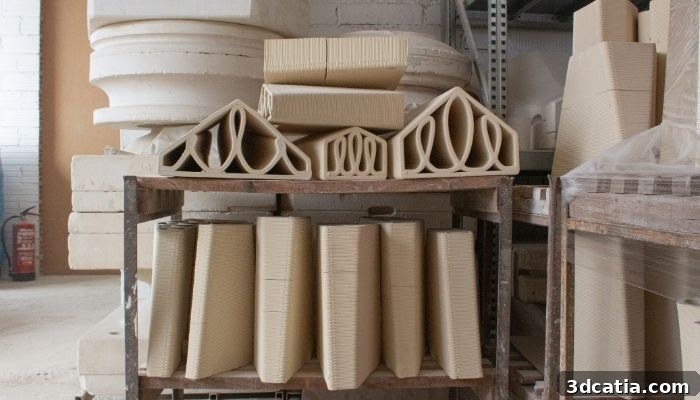
Support molds used for ceramic firing (Photo credit: LAMÁQUINA – Pilar Jiménez).
From Gaudí’s Plaster Models to the Cross’s Molds
The Sagrada Família’s adoption of 3D printing has precedent. In 2001 the Construction Board of the Expiatory Temple began using digital fabrication to produce prototypes of the building’s most complex components, replacing many handmade plaster models. The technology chosen at the time produced white plaster parts that echoed the materiality Gaudí himself used for physical models, and it allowed teams to produce and iterate parts in hours rather than weeks.
Gaudí’s practice of working with three-dimensional models has long informed the cathedral’s design process, but many of the original plaster models were lost in the 1936 fire. Digital fabrication and 3D printing provided a new way to reconstruct that three-dimensional knowledge and continue the project with fidelity to the original vision.
Twenty-five years after those early digital experiments, LAMÁQUINA brought 3D printing back to the Sagrada Família, this time focused on printed molds and firing supports rather than final ceramic components. As Sollazo summarizes, the technology does not replace traditional processes; it expands what is possible, allowing craftsmen and engineers to solve problems that would have been much harder to address by manual methods alone. In that way, 3D printing has become part of a story that has been unfolding for 144 years, joining centuries-old craft with contemporary digital tools to complete Gaudí’s monumental work.
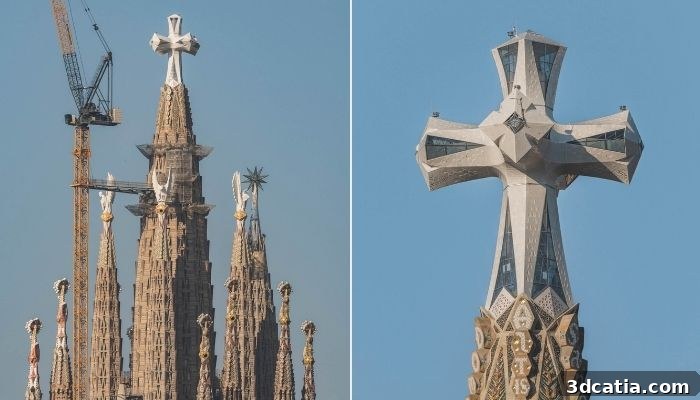
The Tower of Jesus Christ was completed in 2026, marking the centenary of Gaudí’s death (Photo credit: Sagrada Família).
The collaboration between Cerámica Cumella and LAMÁQUINA illustrates how contemporary manufacturing techniques can support traditional artisanal production without erasing it. By using printed molds to control thermal behavior and preserve each tile’s geometry, the project combined the precision of digital design with the subtlety of hand glazing and assembly. The result is a carefully crafted surface that both honors Gaudí’s formal language and benefits from modern engineering methods.
*Cover Photo Credits: 3Dnatives
