
Top 5 Transformative 3D Printing Videos: Shaping the Future with Additive Manufacturing
This week, we delve into the most compelling advancements in additive manufacturing, highlighting how 3D printing technology is profoundly reshaping various industries and our society at large. From precision medical applications to robust automotive solutions, the influence of 3D printing technologies is expanding at an unprecedented rate, driving innovation and efficiency across countless sectors. Staying informed about these breakthroughs is crucial for anyone involved in or interested in the future of manufacturing.
Our curated selection of the week features five groundbreaking videos that offer insightful glimpses into the cutting edge of this revolutionary field. We explore the inspiring journey of VELO3D, a pioneer in advanced metal 3D printing, witness the incredible potential of large-format additive manufacturing, uncover new material frontiers with glass 3D printing, and much more. Each video provides a unique perspective on the power and versatility of 3D printing, showcasing innovations that are not just theoretical but are actively being implemented to solve real-world challenges. For those eager to dive deeper into the world of 3D printing, you can find an extensive library of engaging content on our Youtube channel. We hope you enjoy this week’s selection and gain valuable insights into the exciting trajectory of additive manufacturing!
Top 1: Unlocking Design Freedom in Metal 3D Printing with VELO3D
#TALK3D with Benny Buller from VELO3D
Launched in 2014, VELO3D has rapidly emerged as a key player in the metal 3D printing landscape. The company’s core mission is to empower leading industrial manufacturers to achieve unparalleled design complexity, breaking free from the traditional constraints of conventional manufacturing methods. VELO3D specializes in creating solutions that enable engineers to realize intricate geometries and innovative designs that were previously impossible to produce.
At the heart of VELO3D’s offering are two integrated components: the Sapphire production 3D printer and the Flow print preparation software. The Sapphire printer is renowned for its ability to print complex metal parts with minimal or no support structures, a significant advancement that dramatically reduces post-processing and increases design freedom. Complementing this hardware, the Flow software provides intelligent algorithms that optimize print paths and ensure high-fidelity replication of designs, from initial concept to final product.
The focus on “next-level design complexity” is particularly crucial for sectors like aerospace, defense, and energy, where components often require highly optimized internal structures for lightweighting, improved performance, or enhanced thermal management. VELO3D’s technology allows for the creation of intricate cooling channels, delicate lattice structures, and overhangs without compromising part quality or mechanical properties. This capability directly translates into more efficient, durable, and cost-effective components, driving innovation in critical industries.
In the insightful #Talk3D video below, you’ll have the opportunity to hear directly from Benny Buller, the visionary CEO of VELO3D. He shares his profound insights into the company’s foundational philosophy, his strategic vision for the future of metal additive manufacturing, and how VELO3D is continuously pushing the boundaries of what’s possible with industrial 3D printing. Discover how his leadership is guiding VELO3D to reshape engineering and manufacturing workflows, fostering an environment where design innovation can truly thrive.
Top 2: ABB RobotStudio: Revolutionizing Industrial 3D Printing with Robotics
Integrating Robot Automation for Enhanced Additive Manufacturing
ABB, a global leader in industrial robotics and automation systems, continually innovates to meet the evolving demands of modern manufacturing. Their latest advancements are particularly impactful in the realm of 3D printing, where precision, speed, and versatility are paramount. The following video showcases ABB’s RobotStudio, a powerful software platform, and its transformative 3D printing capabilities.
RobotStudio serves as a comprehensive simulation and offline programming software, allowing engineers to program, configure, and optimize their industrial robots on a standard PC without interrupting ongoing production lines. This capability alone offers significant benefits, including reduced downtime, faster deployment of new processes, and a safe environment for testing complex robot movements. With the integration of 3D printing functionalities, RobotStudio extends its utility even further, bridging the gap between design and physical production with unprecedented efficiency.
The new 3D printing feature in RobotStudio is a game-changer for many manufacturing scenarios. It effectively eliminates the need for laborious manual programming, which traditionally consumed considerable time and resources. By automating the programming process for 3D printing tasks, manufacturers can achieve significantly faster prototype production and accelerate product development cycles. This automation also enhances accuracy and repeatability, leading to higher quality prints and reduced material waste.
What sets ABB’s RobotStudio apart is its broad versatility. It supports a diverse array of additive manufacturing processes, moving beyond conventional filament extrusion to include advanced techniques like welding and printing with specialized materials such as granules or concrete. This adaptability makes it an ideal solution for a wide range of applications, from intricate metal parts to large-scale construction components. Its robust support for various processes makes it particularly well-suited for low-volume, high-mix production environments, where flexibility and rapid changeovers are crucial. The convergence of advanced robotics with additive manufacturing, as demonstrated by RobotStudio, represents a significant leap forward in creating highly automated, efficient, and versatile manufacturing systems.
Top 3: A Breakthrough in Glass 3D Printing from ETH Zurich
Pioneering New Methods for Additive Manufacturing with Difficult Materials
Additive manufacturing has made incredible strides, working with an ever-expanding array of materials, from various plastics and metals to ceramics and composites. However, one material that has historically presented significant challenges for 3D printing is glass. Its unique properties, including high melting temperatures, brittleness, and transparency, make it notoriously difficult to process with conventional additive methods.
Despite these challenges, the demand for 3D printed glass components is substantial, driven by potential applications in optics, medical devices, architecture, and decorative arts, where its optical clarity, chemical resistance, and aesthetic appeal are highly valued. The ability to freely design and produce complex glass structures could revolutionize these fields, opening doors to previously impossible innovations.
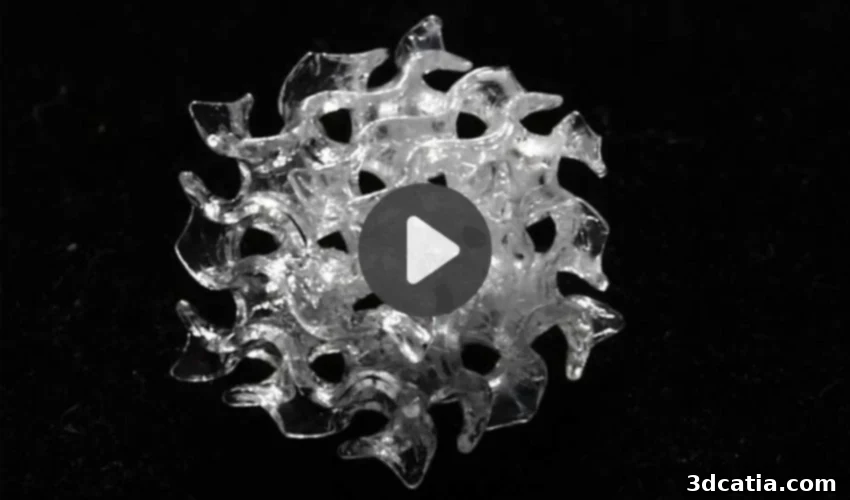
Addressing this critical need, a groundbreaking new technique has emerged from the prestigious ETH Zurich, a leading research institution. This innovative method is based on stereolithography (SLA), a photo-polymerization process typically used with liquid resins. The researchers at ETH Zurich have adapted this technology to work with glass, promising a new era for intricate glass fabrication. Essentially, they use a specially formulated resin containing glass particles, which is then selectively solidified layer by layer using UV light. After printing, the “green” part is subjected to a debinding and sintering process, where the resin is removed, and the glass particles fuse together, resulting in a dense, transparent glass object.
This breakthrough holds immense potential for a wide range of applications. Imagine custom optical lenses with complex internal structures, intricate lab-on-a-chip devices for medical diagnostics, or uniquely designed architectural elements that leverage the full beauty and versatility of glass. The ability to create arbitrary geometries with high precision opens up exciting possibilities for both functional and aesthetic products. The video below provides a fascinating look into this pioneering research and demonstrates the remarkable capabilities of this new glass 3D printing technique, showcasing how material science continues to push the boundaries of additive manufacturing.
Top 4: The Future is Big: The Rise of Large-Format 3D Printing
Why Industrial Production Demands Bigger Additive Manufacturing Solutions
While smaller desktop 3D printers have democratized rapid prototyping, the true industrialization of additive manufacturing increasingly relies on large-format solutions. The ability to print larger parts, or multiple smaller parts simultaneously, is becoming a critical requirement for moving 3D printing from a niche prototyping tool to a mainstream production technology. Large-format 3D printing addresses the needs of industries that require components exceeding the build volumes of standard machines, such as automotive, aerospace, furniture, and large-scale tooling.
In the following video, BigRep, a prominent innovator in the large-format additive manufacturing space, eloquently explains the burgeoning importance of these expansive solutions for modern industry. BigRep has been at the forefront of developing printers that not only offer impressive build volumes but also deliver the reliability and precision required for demanding industrial applications. Their machines are designed to produce functional prototypes, manufacturing aids, molds, and even end-use parts with speed and efficiency.
To meet the rigorous demands of industrial production, BigRep has engineered the BigRep PRO, a flagship large-format 3D printer that embodies advanced capabilities. The PRO boasts highly modular controls, ensuring flexibility and adaptability for diverse manufacturing needs. Crucially, it incorporates temperature-controlled filament chambers, which maintain optimal material conditions throughout the printing process, preventing moisture absorption and ensuring consistent print quality, especially for high-performance engineering plastics. Furthermore, its advanced build platform is designed for precision and stability, essential for printing large, warp-free objects.
The evolution of 3D printing into a production-ready process hinges on the availability of robust, scalable solutions like the BigRep PRO. These machines enable users to seamlessly transition from conceptual design and prototyping to the direct manufacturing of industrial-grade components. The ability to produce full-scale prototypes or even short-run production parts without requiring assembly from smaller segments significantly streamlines workflows, reduces lead times, and lowers overall manufacturing costs. BigRep’s commitment to advancing large-format 3D printing is crucial for empowering industries worldwide to fully leverage the transformative power of additive manufacturing for industrial-scale production. Watch the video to see how these monumental machines are changing the game.
Top 5: Building the Future: 3D Printing in the Construction Sector
Branch Technology’s Cellular Fabrication Revolutionizes Construction
The construction industry, often perceived as slow to adopt new technologies, is experiencing a profound transformation through the integration of 3D printing. Additive manufacturing offers compelling solutions to some of construction’s biggest challenges, including labor shortages, material waste, lengthy construction times, and the desire for more complex and sustainable architectural designs. From printing entire houses to creating intricate structural components, 3D printing is redefining how we build.
Leading this innovative charge is Branch Technology, a company that has developed a truly unique and impactful approach to construction 3D printing. In the video below, Branch Technology proudly presents its patented Cellular Fabrication (C-Fab) process. This revolutionary technique stands apart from conventional construction 3D printing methods, which typically involve extruding concrete or similar materials layer by layer to form solid walls. Instead, C-Fab focuses on creating lightweight, highly optimized cellular matrices that serve as molds or structural frameworks.
How does C-Fab differ and why is it so significant? Unlike traditional layer-by-layer printing that builds solid structures, Branch Technology’s C-Fab process prints open-cell matrix structures in free space. These intricate, lightweight lattice forms are then sprayed with conventional construction materials like foam insulation and concrete, filling the voids and creating robust, structurally efficient, and highly customized building components or even entire building envelopes. This method offers several distinct advantages:
- Material Optimization: By printing only the necessary structural elements, C-Fab significantly reduces material usage and waste compared to solid 3D printing or traditional construction.
- Design Freedom: The ability to print free-form, non-planar structures opens up unprecedented architectural possibilities, allowing for highly complex and organic geometries that are otherwise difficult or costly to achieve.
- Structural Efficiency: The cellular nature of the printed matrix allows for optimized strength-to-weight ratios, potentially leading to lighter yet stronger structures.
- Speed and Cost-Effectiveness: While the 3D printing aspect is complex, the overall construction process can be accelerated, and labor costs reduced, especially for bespoke designs.
- Sustainability: Reduced material consumption and waste contribute to more environmentally friendly building practices.
The video provides a detailed explanation of how C-Fab works and highlights its profound implications for the construction industry, showcasing examples that demonstrate its capability to produce visually stunning and structurally sound buildings. Branch Technology’s innovation is not just about automating construction; it’s about enabling a new paradigm of architectural design and sustainable building, pushing the boundaries of what is possible in modern construction practices.
Conclusion: The Ever-Evolving Landscape of Additive Manufacturing
This week’s collection of videos truly underscores the incredible diversity and relentless innovation driving the 3D printing industry. From the sophisticated material science behind glass 3D printing at ETH Zurich to the industrial-scale automation demonstrated by ABB RobotStudio, and the groundbreaking structural solutions offered by Branch Technology, it’s clear that additive manufacturing is not just a technology but a dynamic force shaping multiple sectors.
We’ve seen how companies like VELO3D are empowering engineers with unprecedented design freedom in metal fabrication, and how BigRep is making large-format production a tangible reality for various industries. Each featured video offers a unique window into the future, showcasing how 3D printing is enhancing efficiency, enabling new product designs, and fostering sustainable practices across medical, automotive, aerospace, and construction fields.
What were your thoughts on this week’s top 5 transformative 3D printing videos? We encourage you to share your comments and insights below or engage with us on our social media platforms: find us on Facebook and Twitter! To ensure you never miss out on the latest news, breakthrough innovations, and expert analyses in the rapidly expanding 3D industry, make sure to sign up for our free weekly Newsletter. Stay informed and be part of the future of manufacturing!