
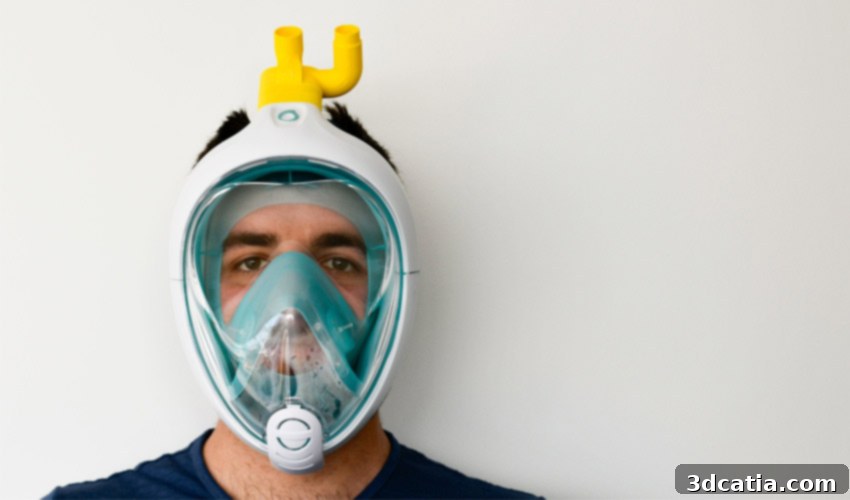
3D Printing Innovation: Isinnova Transforms Snorkeling Masks into Emergency CPAP Devices for COVID-19 Patients
The global COVID-19 pandemic presented unprecedented challenges to healthcare systems worldwide, particularly in the initial surge where critical medical equipment, such as ventilators and CPAP machines, was in extremely short supply. In Italy, one of the first and hardest-hit nations, the ingenuity of local innovators quickly came to the forefront. Following their crucial success in developing 3D printed emergency respirator valves for a hospital in Brescia, the Italian engineering firm Isinnova once again demonstrated the transformative power of additive manufacturing. They unveiled a groundbreaking new design aimed at converting readily available snorkeling masks into functional emergency Continuous Positive Airway Pressure (CPAP) masks. This innovative solution was developed to provide vital respiratory support for patients who, despite being able to breathe spontaneously, required assistance in maintaining clear airways to prevent their condition from deteriorating.
It is crucial to acknowledge that, as an emergency innovation, this device was not initially a medically certified product. Isinnova transparently communicated this, stating that its use was contingent upon the patient’s “acceptance of use of an uncertified biomedical device, by providing a signed declaration.” This reflects the dire circumstances of the pandemic, where conventional certification pathways were simply too slow to meet the urgent demand for life-saving equipment. With the number of COVID-19 cases escalating rapidly and hospitals struggling under immense pressure, such emergency solutions were not merely desirable but absolutely essential. The immediate impact of Isinnova’s ingenuity was significant; they reported that an impressive 500 of these 3D printed respirator masks had already been produced and deployed across Italy, providing critical relief to patients in desperate need.
The genesis of this remarkable innovation began with a proactive suggestion from Dr. Renato Favaro, a former chief physician at the Gardone Valtrompia Hospital. Dr. Favaro, witnessing the escalating crisis and the severe shortage of medical devices, proposed the audacious idea of adapting a standard snorkeling mask into an emergency CPAP mask for COVID-19 patients. His vision quickly spurred Isinnova into action. Recognizing the potential, Isinnova promptly reached out to Decathlon, the renowned sports retailer and manufacturer of the popular Easybreath full-face snorkeling mask. This collaboration was pivotal, as it allowed Isinnova to meticulously study the mask’s design and assess the feasibility of Dr. Favaro’s concept. The team’s engineering prowess soon led to a breakthrough: they successfully designed and developed a crucial 3D printable component that served as the essential interface between the snorkeling mask and a conventional ventilator system. This vital link, ingeniously named the Charlotte valve, allowed the Easybreath mask to be seamlessly integrated into the emergency respiratory support setup. The speed of development was astounding, reflecting the urgency of the moment and the flexibility of 3D printing technology. The prototype underwent initial testing with a colleague at Chiari Hospital, followed by a critical trial on a patient in need. Both tests yielded successful results, confirming the viability of this innovative approach. This development offered a beacon of hope, providing a potentially scalable and accessible solution for hospitals globally that were grappling with severe shortages of specialized medical equipment.
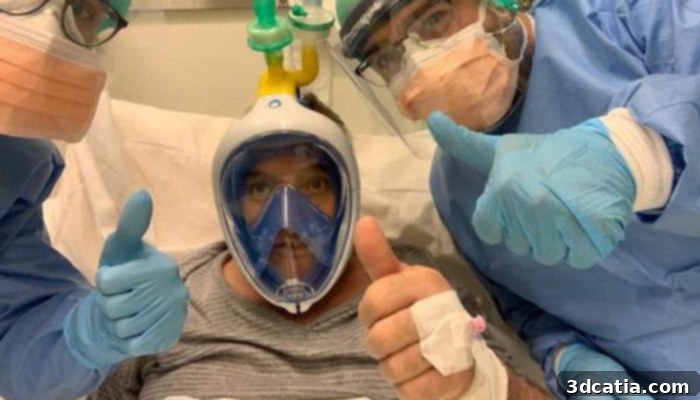
Initial tests of the 3D printed respirator adaptation on a patient proved successful, showcasing its potential.
In a move that underscored their commitment to global public health and collaborative problem-solving, Isinnova took the extraordinary step of publicly sharing the digital file of the Charlotte valve. This open-source approach meant the design was made available free of charge, empowering individuals, organizations, and medical facilities worldwide to produce the valve themselves. Alongside the design file, Isinnova also provided detailed instructions and recommended print settings, ensuring that anyone with access to a 3D printer could replicate the device effectively and safely. This act of sharing exemplifies the power of the open-source community, particularly during times of crisis, where collective knowledge can accelerate solutions. However, the company consistently reiterated a critical disclaimer: this was not a certified medical device in the traditional sense, and regulatory frameworks concerning medical device use can vary significantly from one country to another. In Italy, recognizing the unprecedented and urgent nature of the COVID-19 emergency and the absence of conventional alternatives, a specific provision allowed for the “compassionate use” of medical devices without CE marking for the proposed indication. This legal flexibility, driven by extreme necessity, highlights the ethical complexities and rapid adaptations required in a global health crisis.
While Isinnova’s initiative was met with widespread acclaim for its ingenuity and rapid deployment, Decathlon, as the manufacturer of the Easybreath snorkeling mask, issued a cautious statement. Their declaration emphasized that “The Easybreath mask, made visible by many Internet users in recent days and presented as a possible protective mask against the Coronavirus, was not designed for this use. As its initial use remains the practice of snorkeling, we therefore recommend that you do not modify the mask by yourself; this could affect its operation, particularly with regard to air flow.” This statement underscores the standard responsibilities of a manufacturer regarding product safety and intended use. While fully supportive of the spirit of innovation, Decathlon’s warning is a necessary cautionary note, highlighting potential risks associated with unauthorized modifications of consumer products, especially when they are intended for critical medical applications. Despite this, the collaboration between Isinnova and Decathlon in the early stages to study the mask’s design was crucial, ensuring that the modification was based on informed engineering rather than arbitrary DIY attempts. Therefore, it became paramount for anyone considering this solution to strictly adhere to the clear, precise, and professionally developed instructions published by Isinnova on their official website. These detailed guidelines are vital to ensure the modified mask functions as intended and safely delivers respiratory support.
The video provided by Isinnova further illustrates the assembly process, offering a visual step-by-step guide that complements the written instructions. This multi-modal approach to sharing information significantly lowers the barrier to entry for hospitals, workshops, and even skilled individuals looking to contribute to the emergency response. The story of the Charlotte valve and the adapted Easybreath mask stands as a powerful testament to the agility and problem-solving potential of 3D printing, especially when confronted with urgent global crises. It highlights how communities, medical professionals, and innovators can converge to create rapid, impactful solutions that bridge critical gaps in conventional supply chains. This particular innovation served as a cornerstone of the broader movement where additive manufacturing played a pivotal role in combating the pandemic, from producing personal protective equipment (PPE) to fabricating essential ventilator components. You can explore more initiatives and how 3D printing technology helped in the fight against COVID-19 HERE. The lessons learned from these rapid, open-source developments will undoubtedly shape future emergency preparedness strategies and the role of decentralized manufacturing in healthcare. What are your thoughts on this incredible example of rapid innovation and community collaboration during a global crisis? We encourage you to share your perspective in the comments section below or engage with us on our Facebook and Twitter pages. For all the latest news and advancements in the world of 3D printing, don’t forget to sign up for our free weekly Newsletter, delivered straight to your inbox!