
Top 5 3D Printing Innovations: Electric Saxophones, Smart Foams, AI, and Advanced Metal AM Technologies Unveiled This Week
Another eventful week in the dynamic realm of additive manufacturing has drawn to a close, and as is our tradition every Sunday, we’ve meticulously curated the most compelling and groundbreaking videos to keep you informed and inspired. This week’s selection dives deep into remarkable advancements, showcasing how 3D printing is continuously pushing boundaries across diverse industries. From revolutionary musical instruments to intelligent materials, AI-driven manufacturing, and robust metal fabrication techniques, our top five highlights offer a comprehensive glimpse into the future of production. We invite you to explore these incredible innovations and witness the transformative power of 3D printing in action. We sincerely hope you’re enjoying a relaxing and insightful Sunday!
This Week’s Featured 3D Printing Breakthroughs:
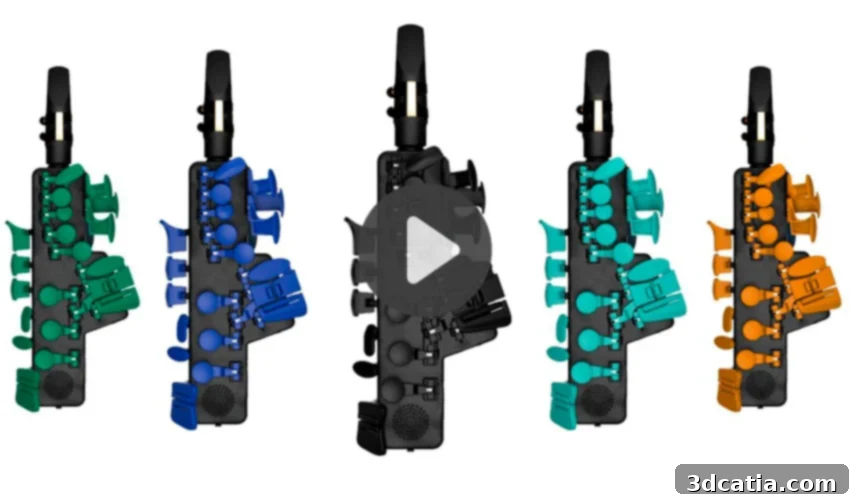
Top 1: Revolutionizing Music with a 3D Printed Electric Saxophone
In a testament to the creative potential of additive manufacturing, Barcelona-based startup Odisei Music is making waves in the world of musical instruments. Their flagship product, the Travel Sax, is an innovative electric saxophone engineered using advanced 3D printing technologies. This groundbreaking instrument addresses long-standing challenges faced by musicians, offering a significantly lighter and quieter alternative to traditional saxophones. Traditional saxophones are often heavy, cumbersome to transport, and can be quite loud for practice in shared spaces. By leveraging 3D printing, Odisei Music has achieved a compact, ergonomic design, drastically reducing weight and enhancing portability. The ability to produce complex internal geometries and optimize airflow channels through additive manufacturing has been crucial for its unique acoustic properties. Furthermore, being an electric instrument, the Travel Sax allows for silent practice with headphones, making it ideal for students and professionals alike, or versatile sound manipulation when amplified for performances. In this captivating episode of our exclusive 3D interviews, we sit down with Ramón Mañas, the visionary CEO and founder of Odisei Music, to discuss the inspiration behind the Travel Sax, the intricacies of its development using additive manufacturing, and its profound implications for musicians worldwide. He shares insights into how 3D printing enabled them to achieve a compact, ergonomic design while maintaining acoustic integrity and integrating advanced electronic components. This innovation highlights how 3D printing is not just for industrial parts but can also democratize access to musical expression and redefine traditional craftsmanship, opening new avenues for instrument design and personalization.
Top 2: Unveiling a Special 3D Printed Foam with Desktop Metal’s FreeFoam
Desktop Metal continues to innovate at the forefront of additive manufacturing with the introduction of FreeFoam, a revolutionary 3D printable resin designed for the volume production of foam parts. This groundbreaking material leverages Digital Light Processing (DLP) 3D printing technology to create a new class of photopolymer resins embedded with heat-activated foaming agents. The process begins with 3D printing the initial part using DLP, creating a dense, unexpanded component. This is followed by a crucial post-processing step where the FreeFoam components are briefly exposed to heat in a standard oven. During this controlled thermal activation, the internal foaming agents expand, forming intricate closed cells throughout the material. What makes FreeFoam truly remarkable is its programmability, allowing parts to expand anywhere from two to seven times their original printed size. This unique characteristic offers unparalleled logistical and economic advantages. Parts can be manufactured and shipped in a compact, unexpanded form, drastically reducing shipping, handling, and storage costs, and then expanded to their final dimensions at the point of use or assembly. This ‘ship flat, expand on-site’ model significantly optimizes supply chains. Beyond cost savings, FreeFoam represents a paradigm shift from traditional foam production, which often involves expensive tooling, molds, and generates considerable material waste, particularly for customized or low-volume parts. By eliminating the need for such tooling, it not only streamlines the manufacturing process but also unlocks unprecedented design freedom, enabling the creation of complex geometries, optimized internal lattice structures, and customized cellular patterns previously unattainable with conventional methods. The material also boasts an exceptional strength-to-weight ratio, yielding lightweight yet high-performance components. This capability is particularly vital for industries such as automotive and aerospace, where reducing vehicle weight directly translates to lower transportation costs, improved fuel efficiency, and enhanced product performance, contributing to a greener footprint. FreeFoam is poised to redefine how we design, produce, and utilize foam-based materials across a multitude of applications, from protective packaging, thermal insulation, and energy absorption in consumer goods to specialized cushioning and structural components in highly demanding industrial sectors.
Top 3: The Synergy of AI and Machine Learning in Metal Additive Manufacturing with Amir Barati Farimani
The integration of artificial intelligence (AI) and machine learning (ML) is rapidly transforming various sectors, and additive manufacturing is no exception. In a highly insightful interview, Amir Barati Farimani from Carnegie Mellon University (CMU) delves into his pioneering research focused on leveraging AI and ML to significantly advance metal additive manufacturing processes. His work aims to overcome existing limitations and unlock the full industrial potential of metal 3D printing. Metal AM, while offering unparalleled design freedom, material efficiency, and the ability to create complex geometries, presents inherent complexities due to the intricate interplay of process parameters, material behavior, and thermal dynamics. These factors often lead to challenges such as unpredictable part quality, internal defects like porosity, residual stresses, and inconsistent mechanical properties, hindering broader industrial adoption. Dr. Farimani elaborates on how AI and ML algorithms can be employed to analyze vast datasets generated during the printing process – including sensor data, imaging, and process parameters – enabling predictive modeling that optimizes critical parameters like laser power, scan speed, and layer thickness in real-time. This data-driven approach allows for greater precision and control, leading to superior part quality, enhanced structural integrity, and improved repeatability. Furthermore, he discusses the role of AI in generative design, where algorithms can automatically create optimized part geometries for specific performance requirements, and in identifying and correcting anomalies during the build process, thereby reducing costly trial-and-error, material waste, and production time. Dr. Farimani also candidly addresses the significant challenges researchers encounter in making AI truly effective for additive manufacturing, including the need for robust data collection methodologies, the development of sophisticated and validated predictive models, ensuring the interpretability and reliability of AI-driven insights, and integrating these intelligent systems into existing industrial workflows. His research is critical in paving the way for more intelligent, autonomous, and efficient metal AM systems, ultimately making these advanced technologies more accessible, reliable, and valuable for a wider array of industrial applications, from high-performance components in aerospace and medical devices to customized tools and complex structures in automotive and energy sectors.
Top 4: Additive Manufacturing Excellence: An Inside Look at Oerlikon AM Europe
When it comes to high-quality industrial additive manufacturing, Germany has established itself as a global leader, and Oerlikon AM Europe is a shining example of this prowess. Situated in Barleben, Germany, this impressive 3D printing company stands out for its commitment to precision engineering and innovation. Employing a dedicated team of over 100 specialists, Oerlikon AM Europe is at the forefront of producing performance-optimized metal and polymer components. What sets them apart is their versatile approach, integrating both state-of-the-art additive manufacturing techniques and refined conventional processes. This hybrid strategy allows them to leverage the unique advantages of 3D printing – such as the creation of complex geometries, significant lightweighting opportunities, and part consolidation – while complementing it with traditional methods for specific finishing, machining, or heat treatment requirements. This ensures the highest standards of quality, surface finish, and mechanical performance for critical applications. The company serves a prestigious clientele across demanding sectors including the automotive industry, aerospace, and various other high-tech industries. For these clients, Oerlikon AM delivers components that meet stringent performance criteria and often adhere to rigorous certification standards, contributing to improved efficiency, durability, and functionality of their end products, whether it’s for lightweight aerospace brackets, optimized engine components, or custom medical implants. The video provides an invaluable inside look into Oerlikon AM Europe’s advanced production facilities, showcasing their rigorous methodologies, cutting-edge machinery, and the deep material and process expertise that underpins their “Made in Germany” quality assurance. This focus on integrated solutions, comprehensive material portfolios, and a broad range of capabilities makes Oerlikon AM Europe a vital partner for companies looking to industrialize additive manufacturing and harness its full potential for high-volume, high-performance applications, from prototyping to serial production.
Top 5: Demystifying Wire Arc Additive Manufacturing (WAAM) for Industrial Scale Production
Our final feature this week delves into one of the most promising large-scale metal 3D printing technologies: Wire Arc Additive Manufacturing (WAAM). In an illuminating video, Dr. Maicol Fabbri shares his extensive expertise and experience from his scientific research in the field of WAAM at inspire AG. WAAM is a direct energy deposition process that utilizes an electric arc (similar to traditional welding processes) to melt a metallic wire feedstock, depositing layers of material to build complex 3D structures. It’s particularly renowned for its high deposition rates, meaning it can build parts much faster than powder-bed fusion methods, and its ability to fabricate very large parts that are often impossible with other AM techniques. This makes it an attractive solution for heavy industries such as aerospace (for large structural components), marine, oil & gas, and heavy machinery manufacturing, where size, material efficiency, and cost-effectiveness are paramount. Dr. Fabbri’s discussion places significant emphasis on the critical role of predictive tools in optimizing the WAAM process. He highlights that understanding and accurately predicting thermal behavior – specifically how temperature changes throughout the additive manufacturing process – is fundamental to achieving superior part quality. Uncontrolled temperature gradients and thermal cycles can lead to issues like residual stresses, distortion, cracking, and unfavorable microstructure, all of which compromise the mechanical properties and integrity of the final component. By employing advanced simulation and monitoring tools, engineers can anticipate these thermal effects, optimize deposition strategies, control cooling rates, and fine-tune process parameters to ensure consistent material properties, minimize defects, and achieve geometric accuracy. Dr. Fabbri’s insights underscore that a deep comprehension of the thermal cycles directly correlates with the ability to produce parts with the highest quality, robust mechanical performance, and minimal post-processing requirements. This understanding not only reduces trial-and-error in development but also enhances the reliability and industrial scalability of WAAM technology, accelerating its adoption for critical applications demanding both large size and uncompromised quality in sectors where conventional manufacturing methods may be less efficient or cost-prohibitive for intricate designs.
We hope this week’s exploration into the cutting-edge world of additive manufacturing has been as captivating for you as it was for us. Each of these stories showcases the incredible diversity and transformative power of 3D printing technology, from personal innovation to industrial scalability. Which video captured your imagination the most? What are your thoughts on Desktop Metal’s FreeFoam and its potential, or the exciting advancements in AI for metal AM? We’d love to hear your insights and feedback! Let us know in a comment below or connect with us on our LinkedIn, Facebook, and Twitter pages! Don’t forget to sign up for our free weekly Newsletter here, and receive the latest 3D printing news straight to your inbox every week. You can also find all our compelling videos and more inspiring content on our YouTube channel. Stay tuned for more innovations shaping the future of manufacturing!