
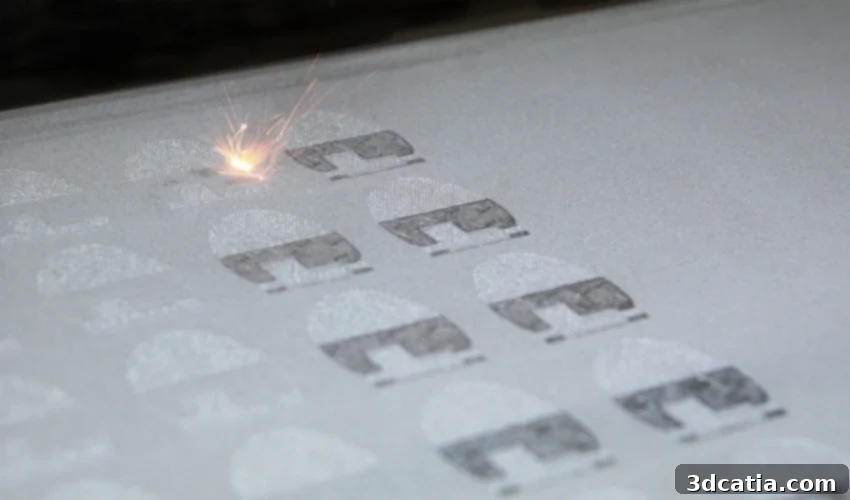
Audi Drives Automotive Innovation: Mastering Metal 3D Printing for Next-Gen Production and Advanced Tooling with EOS
The automotive industry is undergoing a profound transformation, driven by demands for efficiency, customization, and faster innovation cycles. At the forefront of this revolution, leading manufacturers like Audi are leveraging the power of additive manufacturing (AM), commonly known as 3D printing. For years, the premium German automaker has strategically integrated AM into its operations, initially for rapid prototyping and the creation of essential auxiliary tools. This commitment is exemplified by its Neckarsulm facility, where plastic 3D printing has long been an indispensable component of the production process. Recognizing the immense potential of metal additive manufacturing, Audi, a vital part of the Volkswagen Group, took a significant step in 2017 by inaugurating its dedicated metal 3D printing center in Ingolstadt. This state-of-the-art facility initially focused on producing specialized spare parts, but its capabilities have rapidly evolved. Today, it stands as a testament to Audi’s forward-thinking strategy, with the company now exclusively manufacturing certain critical tool parts using the Selective Laser Melting (SLM) process. To achieve this, Audi places its trust in robust and high-performance industrial systems, specifically relying on EOS M 400 models. This strategic adoption has enabled Audi to move away from conventional manufacturing methods, such as injection molding, for a growing number of components, marking a pivotal shift in its production paradigm.
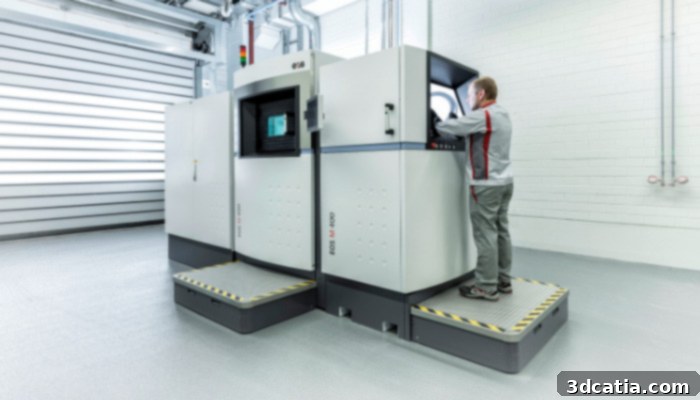
Audi utilizes the advanced EOS M 400 industrial 3D printer for the precise manufacturing of complex tool segments (Photo Credit: AUDI AG).
The success and continuous advancement of additive manufacturing within Audi’s operations are deeply rooted in a long-standing and productive collaboration with EOS, a global leader in high-end solutions for industrial 3D printing. This partnership dates back to 2016 when EOS provided crucial advisory and technical expertise during the establishment of Audi’s dedicated metal 3D printing center. Since then, the Ingolstadt facility has become a hub for innovation, consistently producing high-quality tools and components from various metal powders using the sophisticated laser sintering process. Over the past few years, Audi’s in-house experts have achieved remarkable milestones, manufacturing more than 100,000 additively produced parts. These components have been rigorously tested, successfully integrated into selected Audi models, and are progressively making their way into full series production. According to EOS, the recent decision by Audi to exclusively additively manufacture specific tool segments for hot forming represents a momentous achievement in their collaborative journey. Currently, EOS technology is employed in twelve distinct segments across four critical tools used for hot forming processes. This is merely the beginning, as Audi has ambitious plans to significantly increase the number of segments produced via this advanced method, indicating a strong commitment to scaling AM integration. These innovative tool segments are currently vital for manufacturing high-quality body parts, including those for the popular Audi A4. Looking ahead, additive manufacturing is also set to play a pivotal role in supporting the design and construction of electric vehicles, underscoring its strategic importance for Audi’s future mobility initiatives.
The transition from traditional, subtractive or formative manufacturing processes to additive manufacturing offers a multitude of compelling advantages for automobile manufacturers like Audi. One of the most significant benefits is the unprecedented ability to produce critical tools in-house. This capability dramatically streamlines the supply chain, not only reducing external dependencies and lead times but also significantly bolstering overall flexibility, efficiency, and the potential for greater product individualization. By bringing tool production under its own roof, Audi gains tighter control over quality, intellectual property, and design iterations, accelerating development cycles. Furthermore, additive manufacturing provides a powerful solution for creating individual spare parts that are no longer economically viable to produce in mass series today. This ensures long-term support for legacy models and offers a sustainable approach to maintenance and repairs. Beyond these operational improvements, 3D printing unlocks entirely new possibilities in tool design. It allows for the integration of highly complex, component-specific cooling channels directly within the tools. Unlike conventional methods that are limited by machining capabilities, AM can create intricate internal geometries that optimize thermal management. These sophisticated cooling channels ensure more homogeneous and efficient cooling during critical manufacturing processes, particularly in hot forming. The result is a significant reduction in cycle times, improved material integrity, and the consistent production of vehicle parts with exceptional quality for series production. The EOS M 400 system, specifically chosen by Audi, is perfectly suited for these demanding applications, capable of manufacturing robust tool segments with impressive dimensions—up to 400 mm in length and weighing up to 120 kg, demonstrating its industrial readiness and precision.
The strategic implications of integrating metal 3D printing extend far beyond just individual part production. For Audi, it represents a fundamental shift towards a more agile, resilient, and innovative manufacturing ecosystem. The ability to rapidly iterate on tool designs, incorporate advanced functionalities like optimized cooling, and produce components with unparalleled precision directly impacts vehicle performance, safety, and aesthetic quality. This strategic approach ensures that Audi vehicles continue to meet the brand’s exacting standards and consumer expectations for premium quality and cutting-edge technology. The ongoing collaboration with EOS also signifies a commitment to pushing the boundaries of what is possible with additive manufacturing, constantly seeking to refine processes and unlock new applications. This proactive engagement positions Audi as a leader in industrializing advanced manufacturing techniques, setting a benchmark for the wider automotive sector.
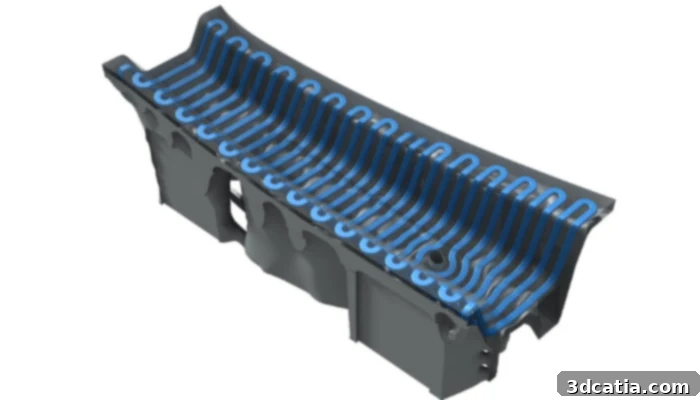
A visual representation of a topology-optimized, 3D-printed tool segment featuring integrated and highly efficient cooling channels, showcasing the design freedom enabled by AM. (Image rights: Audi AG)
Matthias Herker, the technical project manager at the Audi 3D printing center metal, articulated the deep-seated success and strategic importance of their additive manufacturing journey: “From initial qualification by EOS to internal further development and refinement of the entire process chain through to standardization of a new production method, we are now reaping the fruits of years of development within Audi’s production organization. Whenever conventional manufacturing methods reach their limit, we use additive manufacturing – which lets us meet quality standards and comply with production times.” This statement perfectly encapsulates Audi’s philosophy: additive manufacturing is not merely a supplementary technology but a crucial problem-solver that allows the company to overcome the inherent limitations of traditional techniques. It enables the creation of geometries and functionalities previously deemed impossible, ensuring that Audi can continue to innovate while maintaining its rigorous quality benchmarks and demanding production schedules. The journey from initial research and development to the standardization of a new production method highlights Audi’s methodical and comprehensive approach to integrating transformative technologies, ensuring that the benefits of AM are fully realized across its vast manufacturing operations. This commitment to pushing boundaries solidifies Audi’s position at the vanguard of automotive innovation, promising a future where advanced manufacturing techniques redefine vehicle design, production, and performance.
What are your thoughts on the expanding role of additive manufacturing in the automotive industry, and how do you foresee its impact on future vehicle development and production? We invite you to share your insights in a comment below or engage with us on our Linkedin, Facebook and Twitter pages! Don’t miss out on the latest advancements and news in 3D printing by signing up for our free weekly Newsletter here, delivering cutting-edge information straight to your inbox!